“CAM Sugar is proud to announce the definitive release of the original soundtrack composed by EnnioMorricone for Ilclandeisiciliani (The Sicilian Clan) by Henri Verneuil (1969), one of the most celebrated European noir films of the late 1960s, starring JeanGabin, AlainDelon, and LinoVentura.
Album cover sticker
This new edition comes in a limited italian exclusive 3LP Gatefold edition plus poster and it stems from an extraordinary discovery in CAM Sugar’s historical archives: the original master tapes of the complete recording sessions, preserved for decades and never before heard in their entirety. From these tapes emerged precious material, including eight previously unreleased themes—never issued in any format—now fully restored and presented to the public for the first time.
Inner gatefold (l)
With this release, CAM Sugar continues its mission to rediscover and enhance the immense heritage of Italian film music, returning to collective memory one of EnnioMorricone’s most emblematic works—finally in its complete, restored, and definitive form.
Sleeve 1A
· LP 1 – The Original 1969 Soundtrack Album
· LP 2 – Outtakes & Alternates
· LP 3 – The Lost Tape
Thus is born Archivio Segreto, a new series of CAM Sugar physical releases designed to bring to the public the composers’ works in their most complete and definitive form, enriched with unreleased tracks and studio materials.
Side 1
The restoration work, carried out with strict philological rigor, has fully recovered the authentic sound of the orchestra conducted by Morricone. High-resolution digitization and precise restoration have preserved the warmth and dynamic range of the original tape, recreating a spatial sound faithful to the Maestro’s vision. Available as a triple LP and double high-resolution CD, this edition represents the most complete and philologically accurate version ever released of this legendary score, reproducing the full recording session exactly as it was captured.
Sleeve 1B
The music of Il clan dei siciliani occupies a prominent place in Morricone’s career and in the history of European film music. His score combines elegance and tension, exquisitely portraying Verneuil’s protagonists—criminals bound by an ancient code of honor, caught in a world of modernity and betrayal. The main theme, “Il clan dei siciliani,” has become one of the composer’s most iconic pieces, with its clear melody, melodramatic structure, and orchestral arrangement that blends melancholy with sophistication. Since its first release as a 45 RPM single in 1969, the piece has stood as a classic of the genre, uniting popular appeal with musical depth.
Side 2
A musical journey through the soul of crime and honor—between melancholy and formal precision—signed by one of the greatest composers of the twentieth century.
Inner gatefold (c)
The CAM Sugar edition is not a mere reissue: it is an act of historical and cultural restoration. The eight unreleased tracks found on the master tapes reveal new shades of Morricone’s work, including thematic variations, sequences removed from the final edit, and musical ideas that shed light on the Maestro’s creative process at the height of his artistic maturity. The new edition also includes a booklet featuring period images, production notes, and a critical essay on the genesis of the soundtrack—offering listeners a fully immersive experience in the sonic and cinematic world of the film.”
In Paris, robber and murderer Roger Sartet escapes from custody with the help of the Manalese, a small, well-organized Sicilian Mafia clan consisting of patriarch Vittorio, his two sons, and his son-in-law. Sartet pays them with some valuable stamps he had stowed away, and the Manalese hide him in an apartment above the arcade game manufacturing company they own as a front. Jeanne, the French wife of Vittorio’s elder son, looks after Sartet, but he sneaks out to see a prostitute at a hotel and narrowly avoids getting captured by Commissaire Le Goff.
Alternate illustrated film poster
While in prison, Sartet got to know an engineer who worked on the security for a jewelry exhibition in Rome before becoming incarcerated, and he learns the details of the system. He proposes that the Manalese help him rob the show, but they are dubious of the hot-headed outsider, so Vittorio and his old friend Tony Nicosia, who has lived in New York City for decades, go to the exhibition to check it out. They notice additional security measures negate Sartet’s plan, but, after learning the show will soon be moved to New York, Nicosia comes up with a plan to steal the jewels in transit. He sends Jack, an alcoholic ex-pilot, to Paris to help the Manalese with the heist.
Figuring Sartet will need fake papers to leave the country, Le Goff tracks down the forger who made his previous fake passport. By coincidence, Vittorio was having the same man make several fake passports as part of the heist, and Le Goff finds the phone number of one of Vittorio’s employees at the forger’s studio. Le Goff questions Vittorio, but he says the employee no longer works for him
The Manalese clan retreat to a hideout near the Italian border. Jeanne sunbathes nude in front of Sartet and they start to make love, but are interrupted by Roberto, her six-year-old nephew. She entreats him not to tell anyone.
Sartet goes to Rome, where he discreetly kidnaps Edward Evans, an English insurance man, and takes Evans’ place among the small group of officials sent to guard the jewels during their trip on a passenger flight. As Jack, Jeanne, Vittorio, and his sons wait to catch the plane when it stops in Paris, they are surprised to see Evans’ wife arrive and, intending to accompany her husband to New York, board the plane early. Thinking fast when Mrs. Evans returns from the plane, Vittorio leads her to believe that Evans will be on the same flight the next day, as that is when the jewels are really being transported. While the plane loads and takes off, Mrs. Evans puts through a call to her husband’s hotel in Rome. When she learns he never arrived there, she contacts the police and identifies Sartet as one of the men she saw on the plane.
During the plane’s descent towards New York, the Manalese clan hijack the aircraft. Warned of Sartet’s imminent arrival in the United States, the local police race to the airport, but Jack lands the plane on a new stretch of highway that is not yet open. Nicosia’s men are waiting to unload the jewels, and the gangsters split up. Sartet hides out in New York while he waits for his share of the proceeds and a ticket to Veracruz.
Back home in Paris, the Manalese family watch a film in which a couple start to make love, and Roberto exclaims that it looks just like what Sartet was doing with Jeanne. Though Jeanne denies everything, Vittorio lures Sartet back to Paris by withholding his share of the loot. Jeanne calls Sartet’s sister, Monique, and asks her to warn him of the trap. Monique goes to the airport, where she finds Vittorio’s sons and son-in-law waiting for Sartet, and they are all arrested by Le Goff, who was monitoring Monique’s telephone.
Sartet, who had arrived in Paris by an earlier flight than expected, calls Vittorio to arrange a meeting at an isolated spot. Vittorio brings Jeanne with him, and, while Sartet examines the money, Vittorio shoots Sartet and Jeanne dead, leaving the cash by the corpses. When Vittorio returns home, Le Goff is waiting to arrest him.
Development
The Sicilian Clan was based on the second novel in a series by Auguste Le Breton. The first, which also featured the characters of Sartet and Le Goff, had been filmed by Bernard Borderie as Brigade antigangs in 1966.
The epitome of 1960s French cinema cool
The film rights to The Sicilian Clan were bought by Henri Verneuil, who teamed with Jacques-Eric Strauss and signed a deal with 20th Century Fox.[8] Verneuil wrote a screenplay with Pierre Pelegri and then José Giovanni. The two lead roles were written with Jean Gabin and Alain Delon in mind, as Verneuil had worked with both men before.[9] As the writing progressed, Verneuil began to feel that the police officer was another strong role, and he decided to cast Lino Ventura, who had made his film debut 15 years earlier in Touchez pas au grisbi, which also starred Gabin.[8]
Jean Gabin
Irina Demick was unhappy with her character in the film compared to the novel, in which she was more active, and wanted her to take part in the hijacking. Verneuil felt this would not be believable, but Demick had considerable influence, as she was the mistress of the head of Fox, Darryl F. Zanuck, so Verneuil rewrote the sequence.[8]
Lino Ventura
Filming
Second unit filming started in New York in March 1969. The main unit went into production on March 24 at Franstudio’s Saint-Maurice Studios. The film was shot in two versions: with the actors speaking French, and with the actors speaking English.[8]
Jean Gabin (l) and Alain Delon (r)
During production, Delon was involved in a real-life scandal, the Marković affair, which surrounded the still-unsolved murder of his former bodyguard Stevan Marković several months earlier.
Delon
Box office
In France, The Sicilian Clan drew 4,821,585 admissions,[10] making it the third-most-popular movie of 1969 in France, behind Once Upon a Time in the West and The Brain.[11] It was the second-highest-grossing film of all time in France, behind La Grande Vadrouille(1966), when only considering films not shown on a roadshow release basis.[1] In the United States and Canada, the film earned $1 million in theatrical rentals during 1970.[12]
According to Fox records, the film required $7,925,000 in rentals to break even, and it had earned worldwide rentals of $9,250,000 by 11 December 1970.[5] By September 1970, it had made Fox a profit of $533,000.[13]
Retrospectively, and more positively, in the book French Cinema: From Its Beginnings to the Present, author Rémi Fournier Lanzoni wrote: “This gangster film reinvented the classic gangster genre, elevating it to a higher level with its hard-boiled acting, deep character studies, and attractive photography.”[9]
Release
The film had its premiere in Paris on 8 December 1969.[1]
The stars of The Sicilian Clan at work…
References
“‘Sicilians’ Moves In French Stakes; Now B.O. Second”. Variety. 11 February 1970. p. 11.
Solomon, Aubrey. Twentieth Century Fox: A Corporate and Financial History (The Scarecrow Filmmakers Series). Lanham, Maryland: Scarecrow Press, 1989. ISBN978-0-8108-4244-1. p256
Michael L. Stephens Gangster films – 1996 “A surprising success in the United States (where it grossed over $2 million), The Sicilian Clan was an enormous box office success in Europe, and remains one of the all-time moneymakers in France. It is yet another variation on the heist gone wrong”
Cam Sugar releases The Maestro’s “dreamy, dark-tinged and psychedelic giallo score” on double LP yellow vinyl.
From Cam Sugar’s website:
“Senza Sapere Niente di Lei (1969, Luigi Comencini) is one of the first scores composed by Ennio Morricone for a Giallo movie, just ahead of the great season of the cult Italian thrilling genre forged by Dario Argento.
Reverse cover
The soundtrack perfectly mirrors the philosophy behind the Morricone Segreto series, not only for its extraordinary dark-tinged and psychedelic vibes, but also because of the rarity of the score, which so far has surprisingly remained unreleased on vinyl (with the exception of two tracks included on a 1980 CAM anthology LP, now pretty much impossible to find).
Album sticker
With “Senza Sapere Niente di Lei” Morricone composed one of his most dreamy and ethereal scores, with a sweet and delicate theme unfolding in a lullaby to the rhythm of a valzer, and interpreted in multiple keys: from lounge-jazz to experimental music. The final result is a sensual and suave sound that well matches the quintessential morbid style of Giallo cinema and of the film’s plot. In Milan, in winter time, a young lawyer (Philippe Leroy) meets a girl with a mysterious past (Paola Pitagora), falling in love with her and inevitably heading towards irreparable consequences.”
The MaestroNothing says “giallo” quite like the ubiquitous yellow label of J&B.
Aka The Fifth Cord, Giornata Nera Per L’ariete stars this site’s favourite Italian leading man, Franco Nero, as a reporter caught in a game of cat and mouse with a serial killer, and the score sits alongside other classic giallo compositions from The Maestro, such as What Have They Done To Solange and his Dario Argento Animal Trilogy (The Bird With The Crystal Plumage; Cat O’ Nine Tails; Four Flies On Grey Velvet).
This is Morricone at his creepy, dissonant best. The music unnerves you slowly and completely. Accompanied by the visuals directed by LuigiBazzoni (The Possessed) and lensed by master of colour and light Vittorio Storaro (Apocalypse Now), Morricone‘s score primes you for unbearable suspense.
“Quartet Records presents the premiere complete vinyl release of Ennio Morricone’s fascinating score for Folco Quilici’s OCEANO (1971), a pseudo-documentary film about a young Polynesian, Tanai, who goes in search of the island of his dreams. On an epic sea voyage from Polynesia to Alaska aboard a tiny fragile raft, he is guided by the voices of his ancestors.
Morricone’ score for OCEANO seeks to merge nature with mythology. It breathes, vibrates, transmits, and is characterized by its episodic and atmospheric structure, taking the form of an evocative soundscape. The composer draws on resources that recall a primitive, spiritual component: tribal percussion (tablas and bongos), solo woodwinds (flutes and clarinets), guitar, sitar, clanging metal and harp. The fusion of timbres in this instrumentation is unconventional. He expressively sets to music ideas associated with wind or nature, sound textures that construct Tanai’s intimate journey: we hear the sea, we feel the air roaring over the sail of his canoe, the danger lurking in the ocean, his loneliness. The music is another character that gives the film a lyrical dimension and complements the visual element, transcending its narrative function to become a gateway to meditation on the mystery of the sea and existence. Through his unmistakable style, Morricone invites us to immerse ourselves in a world of introspection, beauty and silent emotion.
The original 40-minute program was released on vinyl in 1971 in Italy and Japan, and both those LPs quickly became collector’s items. Quartet Records recently released a CD featuring the complete 70-minute score. This is the first release of the same program on vinyl, presented as a transparent blue-ocean 2XLP, mastered by Chris Malone, and packaged in a deluxe gatefold sleeve.”
Album Review from Main titles:
” On the one hand, it sounds like natural improvisational music, while on the other hand, it feels like precisely notated music. “
Written by Joep de Bruijn – Review of the expanded release
“Oceano is a 1971 semi-documentary directed by Folco Quilici, who usually made films and (semi)documentaries set in tropical climates and illustrated interesting social issues. After having made a semi-documentary about a Polynesian boy who raises a baby Shark (Ti-Koyo e il Suo Pescecane 1964), Oceano follows in those footsteps, following another Polynesian boy who goes on an adventure across the Pacific Ocean in search for his dream island.
Ennio Morricone’s score uses some specific sounds and instruments – who doesn’t expect to hear tribal percussion and a twirling woodwind? – to illustrate the setting in Oceano. Before I delve deeper into that, there’s a bit of surprise, which is evident in the opening cue ´Oceano (04:03)´ that introduces its main theme. It’s almost an exact replica of the breezy main theme of Il Grande Silenzio, minus the expressive main melody on top, and adding a new melody and more emphasis on tribal percussion. Most of its renditions in Oceano have more than enough deviating ingredients to keep it fresh, but is rather difficult to fully accept it. The composer did not only use the template of the western theme, he also re-introduces several instruments that characterised that score; the tribal percussions (tablas) and sitar foremost. Especially in some of their eerie, slightly dissonance performances, Morricone also emulates the underscore of Il Grande Silenzio. Even the disjointed woodwind and metal clanging. Luckily, they mostly serve an entirely new purpose.
Oceano as a whole is best described as a textural soundscape for the boy’s adventures on the island, with little dramatic progression, if you exclude different variations on the main theme, sometimes for solo woodwind. On the one hand, it sounds like natural improvisational music, while on the other hand, it feels like precisely notated music. I especially love the variations on tribal percussion, chirping woodwinds, understated use of Edda Del Orso, and all the additional instruments, in providing illustrative phrases to establish an intriguing atmosphere. It bears feelings of mystique, a certain eeriness, and because of the textural music, even no emotion or feeling at all. The encompassing highlight to illustrate this is the wonderful 10 minutes long Il vento è il vento e soffia dove vuole (#2), which includes one of the few musical variations on the sound of a bird. However, the most interesting bird sound is heard in the rather brooding tension of Il Sole è il Sole e brucia ciò che vuole, which includes an interesting echoing sound, sitar, slightly more, and less, intense percussion and a strange woodwind emulating an unpleasant high-pitched bird.
Oceano is not a score for everyone, given the soundscape that mingles with a traditional theme. But the seemingly undirected textural ideas are what set this score apart.
Aka “The Voyage of Tanai”
The score received three vinyl releases by the labels Soundtrack Listeners Communications/RCA, after which it was paired with L´Avventuriero by RCA, marking its CD debut, only to be expanded by the excellent GDM cd release in 2010.”
Tracklist 1. Oceano 4:03 2. Isola di Pasqua 2:01 3. Vulcano 1:01 4. Speranza per una terra amica 1:36 5. Le maschere morte 2:43 6. Il vento è vento e soffia dove vuole 4:47 7. Tanai 2:18 8. Odissea 1:58 9. Notte 1:40 10. Piccola ouverture 1:46 11. Viaggio 3:03 12. Il Sole è il Sole e brucia ciò che vuole 3:30 13. Partenza 2:14 14. Il vento è il vento e soffia dove vuole (#2) 10:42 15. Viaggio (#2) 1:23 16. Oceano (#2) 2:03 17. Isola di Pasqua (#2) 4:11 18. Notte (#2) 4:24 19. Partenza (#2) 1:13 20. Odissea (#2) 3:34 21. Oceano (#3) 6:19
Italian theatrical poster.A young Maestro, around the time he composed the score for “Slalom.”The Maestro’s screen credit.
The Album:
From the liner notes to Dagored’s 2000 pressing of “Slalom“:
“It is without doubt thanks to the perfect harmony between the composer and the director (a subject that I wit repeat again and again, since the final result is, of course, a single work which is presented to the spectator in the audience) that Morricone’s music for “Slalom” by LucianoSalce is an exharating, small work of art in its category.
Front cover sticker.
It is certainly a reliable example of our own Morricone’s activity in the 60s and 70s. Certainly, the rhythmic, melodic accents would not have been the same without the impressive participation of Alessandroni’s choral formation, and without Alessandro himself, whose contribution often results as being fundamental (and this is particularly the case here) not only for the formal but also for the substance of the work of music itself. Both amused and amusing, the music closely follows the vicissitudes of Gassman who is all the best of his theatrical art (and this music becomes a sort of grateful homage, from myself and from DAGORED, to the memory of Gassman, since the tributes after his death have not been numerous).
The music emphasizes with irony and (it is here that we can see the genius of Morricone’s compositions) above all with a perfect, formal style, the frenzied and amusing events that begin at Sestriere but… who knows where they will finish!
(The orchestration, and we are speaking of a master composer, is rich and vivacious and (Bruno) Nicolai’s orchestral direction is rigorous and has style and, at the same time, is tastefully characterized by a good, healthy sense of rhythm).
See the film if you have the chance… it’s two hours of fun! I have already mentioned Alessandroni, but I would like to further emphasize how the contribution (always discreet, as Sandro isn’t a person who likes to be in the spotlight at all costs) Of “I Cantori Moderni“, which, at the time, included voices such as those of Edda Dell’Orso, Gianna Spagnuto,Raoul, Giulia Alessandroni (just to name a few that first come to mind) returns to this beautiful and enjoyable soundtrack the improvised flavor of a genuine dish of real Italian music… the same music which, with the same name and excellent quality (Morricone) has rightly become a legend all over the world.”
Roberto Zamori/ Film Music Art Studio
Listen to the main theme (“Titoli”) from “Slalom” here:
Lucio and Riccardo, a pair of married pals, take their wives on a ski vacation in Sestriere but get distracted by the beautiful and seductive Nadia and Helen, who lure them into unexpected adventure and danger where Lucio is forced to go to Egypt with another passport and identity.
*This post is dedicated to Watercat, who was able to source a copy of the film for me, a major blind spot in my Friedkin viewings.
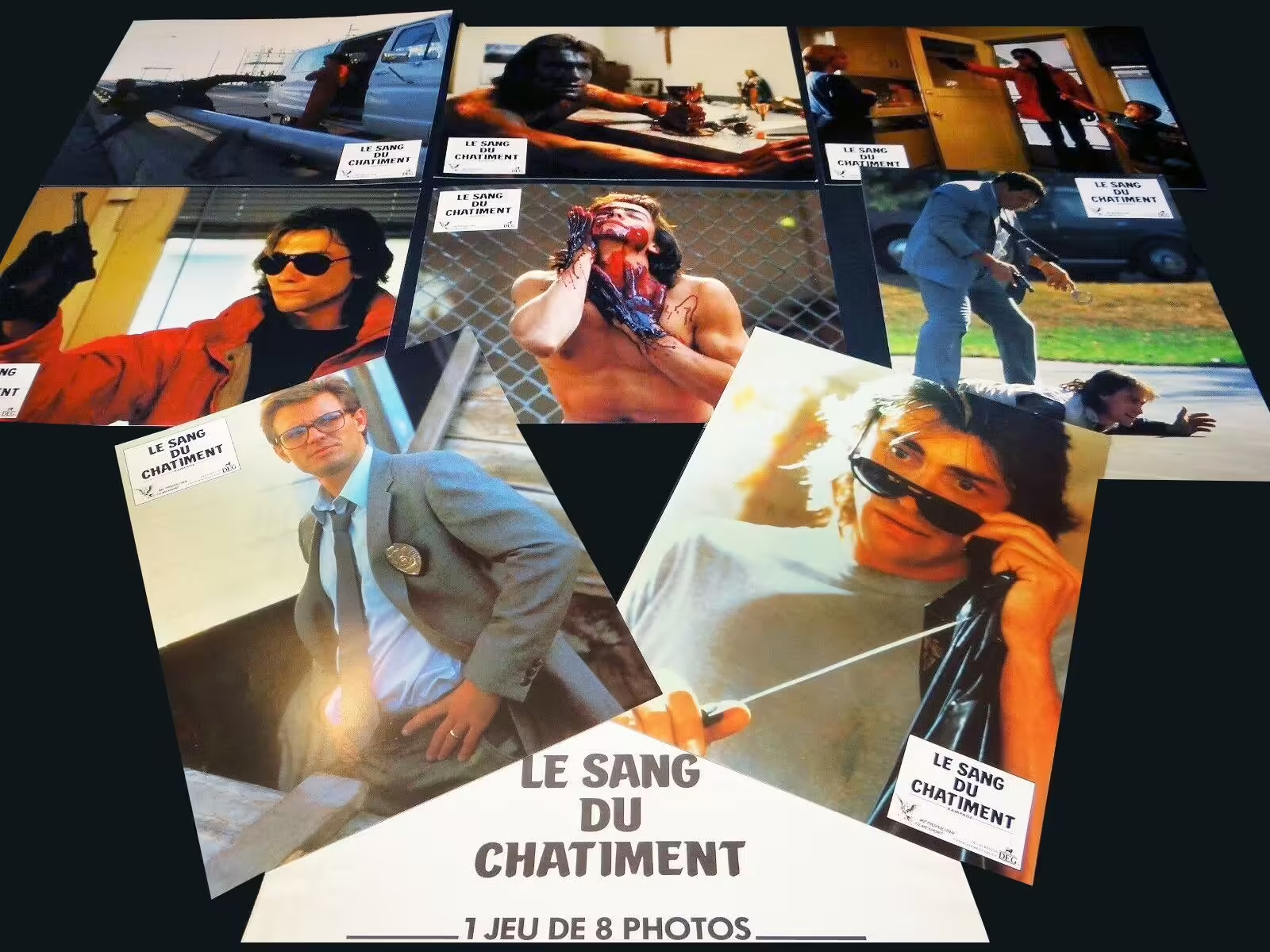
French poster for William Friedkin’s “Rampage” aka “LeSangDuChatiment.”Album cover art.The Maestro in 1986, with his score to RolandJoffe’s “TheMission,” a much more famous work composed the same as the music for WilliamFriedkin’s “Rampage.”
Written, produced, and directed by WilliamFriedkin (TheFrenchConnection, TheExorcist), this barely released, and still little seen serial killer thriller features one of Morricone’s most quietly unnerving scores.
Trailer.
Original trailer.
The Album:
Album cover art.Side One.Side Two.Reverse album cover.
Listen to Morricone’s complete score for “Rampage” here:
“Legal insanity is so often the default, modern-day defense for gruesome crimes and for Alex McArthur the claim is no different. Alex is an outwardly normal man who goes on incredible killing and mutilating sprees. When he is finally captured and brought to trial, the district attorney is torn between his own liberal ideals on guilt and personal responsibility, and the heinous crimes for which the accused is being tried.”
The film premiered at the Boston Film Festival on September 24, 1987, but its theatrical release was stalled for five years due to production company and distributor De Laurentiis Entertainment Group going bankrupt. In 1992, Miramax obtained distribution rights and gave the film a limited release in North America. For the Miramax release, Friedkin reedited the film and changed the ending.
Plot summary
Charles Reece is a serial killer who commits a number of brutal mutilation-slayings in order to drink blood as a result of paranoiddelusions. Reece is soon captured. Most of the film revolves around the trial and the prosecutor’s attempts to have Reece found sane and given the death penalty. Defense lawyers, meanwhile, argue that the defendant is not guilty by reason of insanity. The prosecutor, Anthony Fraser, was previously against capital punishment, but he seeks such a penalty in the face of Reece’s brutal crimes after meeting one victim’s grieving family.
In the end, Reece is found sane and given the death penalty, but Fraser’s internal debate about capital punishment is rendered academic when Reece is found to be insane by a scanning of his brain for mental illness. In the ending of the original version of the film, Reece is found dead in his cell, having overdosed himself on antipsychotics he had been stockpiling.
Alternate ending
In the ending of the revised version, Reece is sent to a state mental hospital, and in a chilling coda, he sends a letter to a person whose wife and child he has killed, asking the man to come and visit him. A final title card reveals that Reece is scheduled for a parole hearing in six months.
Charles Reece is a composite of several serial killers,[5] and primarily based on Richard Chase.[6]
The crimes that Reece commits are slightly different from Chase’s, however; Reece kills three women, a man and a young boy, whereas Chase killed two men, two women (one of whom was pregnant), a young boy and a 22-month-old baby. Additionally, Reece escapes at one point—which Chase did not do—murdering two guards and later a priest. However, Reece and Chase had a similar history of being institutionalized for mental illness prior to their murders, along with sharing a fascination with drinking blood and cutting open the organs of their victims. Reece wears a bright colored ski parka during his murders and walks into the houses of his victims, as did Chase. The two also share the same paranoia about being poisoned. When Reece is incarcerated, he refuses to eat the prison food since he believes it has been poisoned, which mirrors the behavior of Chase in prison. who tried to get the food he was being served tested since he thought it was poisoned.[7][8] Unlike with Reece in the 1992 cut, Chase was sentenced to death, but he was found dead in his prison cell, an apparent suicide, before the sentence could be carried out.[9][10] In the early 1990s, Friedkin said he changed this detail of Chase’s life in the second cut since having him be released from prison fitted better with the traditions of the United States.[11] In both versions of the film, Reece lives with his mother and has a job. When Chase’s crimes were being committed, he lived alone in an apartment and was unemployed. Reece’s father is also said to have died when he was a child, whereas Chase’s father was still alive when his crimes were being committed.
While Chase was noted for having an unkempt appearance and exhibiting traits of paranoid schizophrenia in public, the film’s makers intended to portray Reece as “quietly insane, not visually crazed.”[5] Alex McArthur said in 1992 that “Friedkin didn’t want me to play the guy as a raging maniac. We tried to illustrate the fact that many serial killers are clean-cut, ordinary appearing men who don’t look the part. They aren’t hideous monsters.”[5] To prepare for the role, Friedkin introduced McArthur to a psychiatrist who deals with schizophrenics. He showed McArthur video tapes of interviews with different serial killers and other schizoids.[5]
The incident where Reece goes on a rampage after escaping custody was inspired by a real-life event in Illinois, that occurred while the film was in production.[5] In this event, the killer painted his face silver, something which Reece also does.[5]
The film had a negative portrayal of courtroom experts, and this was personally motivated by Friedkin’s ongoing custody battle for his son, which he was having with his ex-wife.[12]
Soundtrack
The film’s score was composed, orchestrated, arranged and conducted by Ennio Morricone and was released on vinyl LP, cassette and compact disc by Virgin Records.[13]
Release
Rampage was filmed in late 1986 in Stockton, California, where it had a one day only fundraising premiere at the Stockton Royal Theaters in August 1987. It played at the Boston Film Festival in September 1987, and ran theatrically in some European countries in the late 1980s. Plans for the film’s theatrical release in America were shelved when production studio DEG, the distributor of Rampage, went bankrupt. The film was unreleased in North America for five years.[14] During that time, director Friedkin reedited the film, and changed the ending (with Reece no longer committing suicide in jail) before its US release in October 1992.[2][15] The European video versions usually feature the film’s original ending. The original cut of the film has a 1987 copyright date in the credits, while the later cut has a 1992 copyright date, and includes new distributor Miramax‘s logo at the beginning, instead of DEG’s. The original cut also has the standard disclaimer in the credits about the events and characters being fictitious, unlike the later cut, which has a customized disclaimer, mentioning that it was partly inspired by real events.
In retrospect, William Friedkin said: “At the time we made Rampage, [producer] Dino De Laurentiis was running out of money. He finally went bankrupt, after a long career as a producer. He was doing just scores of films and was unable to give any of them his real support and effort. And so literally by the time it came to release Rampage, he didn’t have the money to do it. And he was not only the financier, but the distributor. His company went bankrupt, and the film went to black for about five years. Eventually, the Weinsteins’ company Miramax took it out of bankruptcy and rereleased it. But this was among the lowest points in my career.”[16] There was a year long negotiation with Miramax, and a disappointing test screening of the original cut. The changes that Friedkin made with the 1992 cut addressed concerns from Miramax that the film was not coherent enough, in addition to addressing Friedkin’s changing stance towards the death penalty.[12] The 1992 cut included a previously unreleased scene of Reece buying a handgun at the beginning and lying about his history of mental illness (just as Richard Chase did), whereas the original cut begins with one of Reece’s murders, without explaining any of his background.
Regarding the five year gap between the film’s American release, McArthur said in 1992: “It was a weird experience. First it was coming out and then it wasn’t, back and forth. The fact that it was released at all is amazing.” McArthur added that: “I’ve changed a lot since that picture was made. I have three children now and I’m not sure I would play the part today. I certainly wouldn’t want my kids to see it.”[5]
In 1992, the film played at 175 theaters in the United States, grossing roughly half a million dollars against a budget of several million dollars. McArthur said in 1992 that the film was never intended to be a big commercial hit.[5]
Reception
The film received a polarized response.[17][18] Some critics ranked Rampage among Friedkin’s best work.[2] In his review, film critic Roger Ebert gave Rampage three stars out of four, saying: “This is not a movie about murder so much as a movie about insanity—as it applies to murder in modern American criminal courts…Friedkin[‘s] message is clear: Those who commit heinous crimes should pay for them, sane or insane. You kill somebody, you fry—unless the verdict is murky or there were extenuating circumstances.”[19]Gene Siskel opined the film needed more scenes in the courtroom.[20]Janet Maslin of The New York Times praised the acting and commented: “Rampage has a no-frills, realistic look that serves its subject well, and it avoids an exploitative tone.”[21]
Owen Gleiberman of Entertainment Weekly called the film “despicable”, saying that the “movie devolves into hateful propaganda” and “its muddled legal arguments come off as cover for a kind of righteous blood lust”.[22]Stephen King, an admirer of Rampage, wrote a letter to the magazine defending the film.[2]
Desson Howard of The Washington Post noted that in the film’s five year delay, there had been several high profile serial killer cases, saying: “In this Jeffrey Dahmer era, McArthur’s claims of unseen voices and delusions that he needed to replace his contaminated blood with others’ are familiar tabloid fare”, however, he noted that despite this, the film “still preserves a horrifying edge.”[23] In a separate 1992 review for The Washington Post, Richard Harrington had a more negative view, criticizing the film for feeling like a made for television feature, and claiming that it had a dated look to it due to its long delay.[24]
In retrospect, William Friedkin said: “There are a lot of people who [now] love Rampage, but I don’t think I hit my own mark with that”.[16] In another interview, Friedkin said he thought the film failed because audiences perceived it as being too serious, and they were expecting something different from him.[12]
In 2021, Patrick Jankiewicz of Fangoria wrote: “Half-serial killer thriller, half-courtroom drama, Rampage is an unnerving study on the nature of evil and what society should do about it.”[25]
Home media
Friedkin’s original cut featuring the alternate ending and some additional footage was released on LaserDisc in Japan only by Shochiku Home Video in 1990.[2]
The American edit of the film was released on LaserDisc in 1994 by Paramount Home Video.[2] The film received a DVD release by SPI International in Poland.[26]
Kino Lorber announced plans to release Rampage on Blu-ray in 4K UHD sometime in 2024.[27]
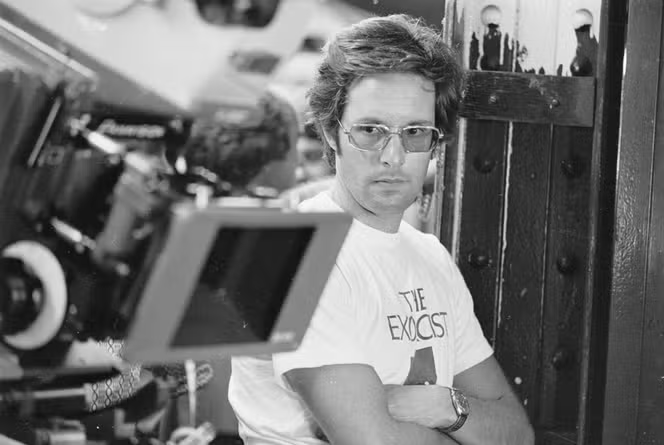
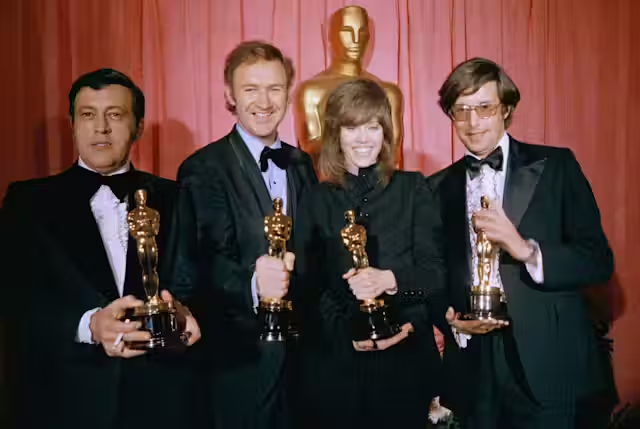
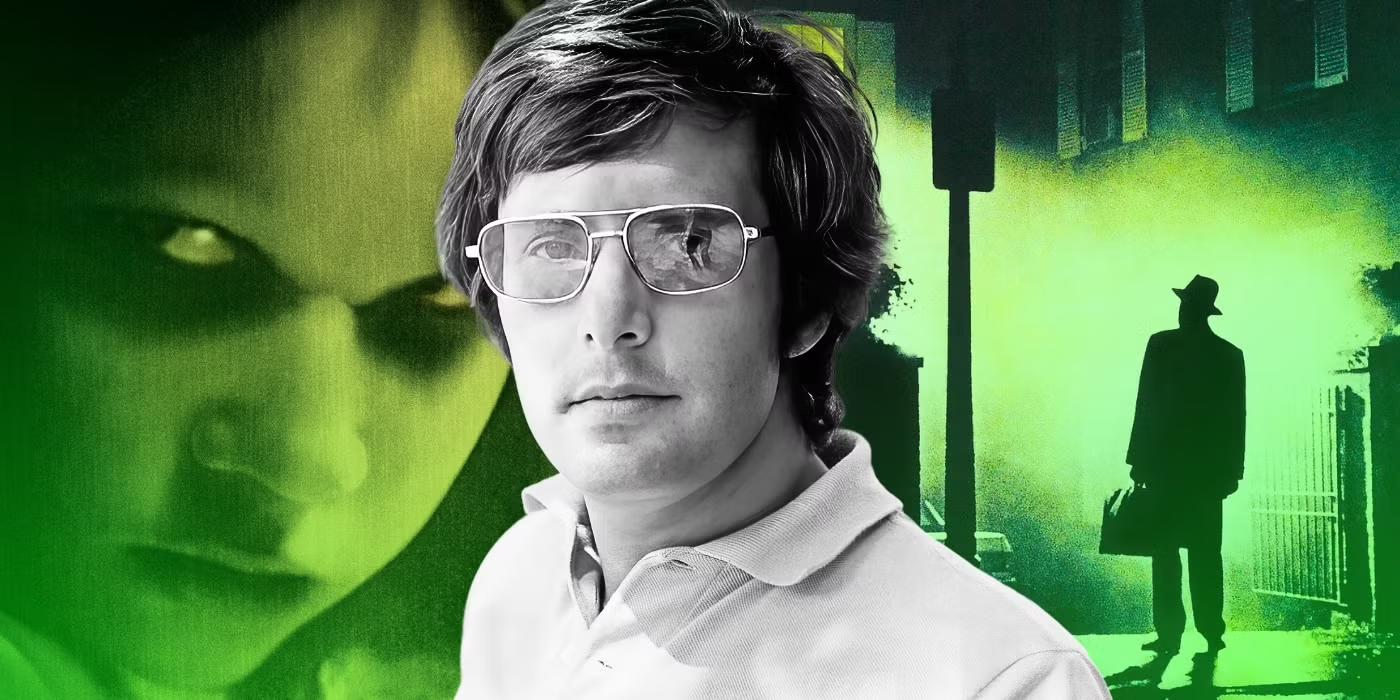
“William David Friedkin (/ˈfriːdkɪn/; August 29, 1935 – August 7, 2023) was an American film, television and opera director, producer, and screenwriter who was closely identified with the “New Hollywood” movement of the 1970s.[1][2] Beginning his career in documentaries in the early 1960s, he is best known for his crime thriller film The French Connection (1971), which won five Academy Awards, including Best Picture and Best Director, and the horror film The Exorcist (1973), which earned him another Academy Award nomination for Best Director.
Friedkin’s other films in the 1970s and 1980s include the drama The Boys in the Band(1970), considered a milestone of queer cinema; the originally deprecated, now lauded thriller Sorcerer (1977); the crime comedy drama The Brink’s Job (1978); the controversial thriller Cruising (1980);[3][4] and the neo-noir thriller To Live and Die in L.A.(1985). Although Friedkin’s works suffered an overall commercial and critical decline in the late 1980s, his last three feature films, all based on plays, were positively received by critics: the psychological horror film Bug (2006), the crime film Killer Joe (2011), and the legal drama film The Caine Mutiny Court-Martial (2023), released two months after his death. He also worked extensively as an opera director from 1998 until his death, and directed various television films and series episodes for television.
Early life and education
Friedkin was born in Chicago, Illinois, on August 29, 1935, the son of Rachael (née Green) and Louis Friedkin. His father was a semi-professional softball player, merchant seaman, and men’s clothing salesman. His mother, whom Friedkin called “a saint,” was a nurse.[5][6] His parents were Jewish emigrants from Ukraine, in the Russian empire.[7]His grandparents, parents, and other relatives fled Russia during a particularly violent anti-Jewish pogrom in 1903.[8] Friedkin’s father was somewhat uninterested in making money, and the family was generally lower middle class while he was growing up. According to film historian Peter Biskind, “Friedkin viewed his father with a mixture of affection and contempt for not making more of himself.”[5]
After attending public schools in Chicago, Friedkin enrolled at Senn High School, where he played basketball well enough to consider turning professional.[9] He was not a serious student and barely received grades good enough to graduate,[10] which he did at the age of 16.[11] He said this was because of social promotion and not because he was bright.[12]
Friedkin began going to movies as a teenager,[9] and cited Citizen Kane as one of his key influences. Several sources claim that Friedkin saw this motion picture as a teenager,[13] but Friedkin himself said that he did not see the film until 1960, when he was 25 years old. Only then, Friedkin said, did he become a true cineaste.[14] Among the movies that he also saw as a teenager and young adult were Les Diaboliques, The Wages of Fear (which many consider he remade as Sorcerer), and Psycho (which he viewed repeatedly, like Citizen Kane). Televised documentaries such as 1960’s Harvest of Shame were also important to his developing sense of cinema.[9]
As mentioned in his voice-over commentary on the DVD re-release of Alfred Hitchcock‘s Vertigo, Friedkin directed one of the last episodes of The Alfred Hitchcock Hour in 1965, called “Off Season”. Hitchcock admonished Friedkin for not wearing a tie while directing.[20]
Friedkin’s later movies did not achieve the same success. Sorcerer (1977), a $22 million American remake of the French classic The Wages of Fear, co-produced by both Universal and Paramount, starring Roy Scheider, was overshadowed by the blockbuster box-office success of Star Wars, which had been released exactly one week prior.[23] Friedkin considered it his finest film, and was personally devastated by its financial and critical failure (as mentioned by Friedkin himself in the 1999 documentary series The Directors). Sorcerer was shortly followed by the crime-comedy The Brink’s Job (1978), based on the real-life Great Brink’s Robbery in Boston, Massachusetts, which was also unsuccessful at the box-office.[25]
Publicity photo for “The Brink’s Job.“
1980–1999
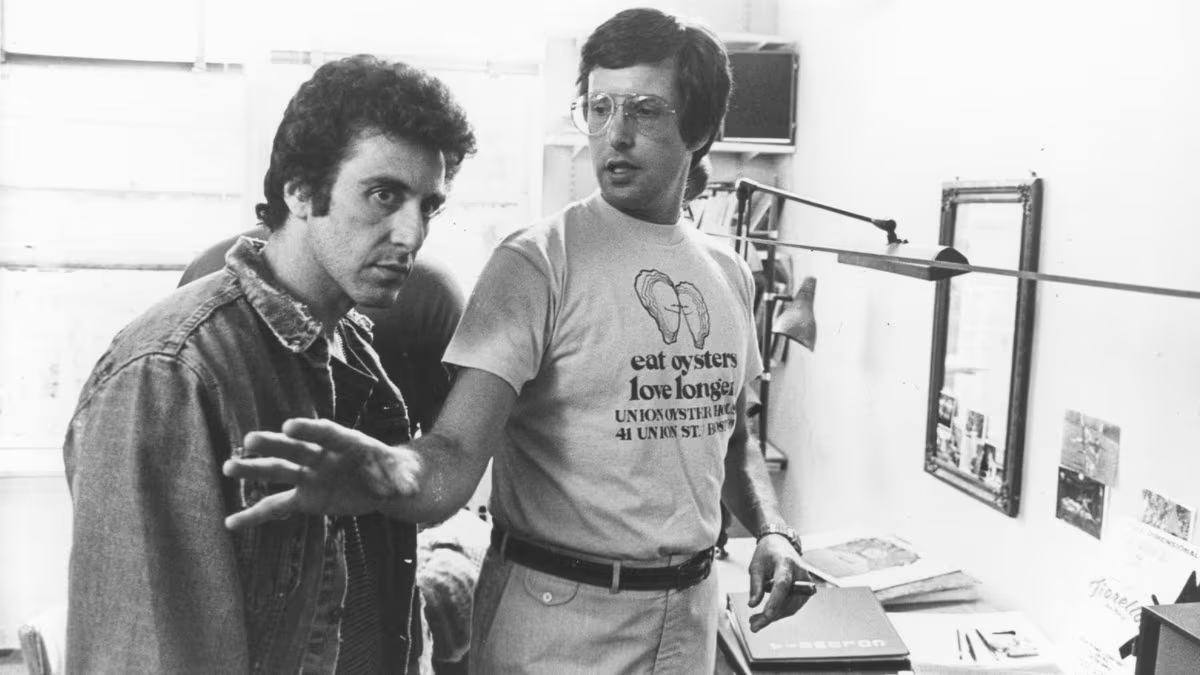
In 1980, Friedkin directed an adaptation of the Gerald Walker crime thriller Cruising, starring Al Pacino, which was protested during production and remains the subject of heated debate. It was critically assailed but performed moderately at the box office.[26]
In 1985, Friedkin directed the music video for Barbra Streisand‘s rendition of the West Side Story song “Somewhere“,[28] which she recorded for her twenty-fourth studio LP, The Broadway Album. He later appears as Streisand’s interviewer (uncredited) on the television special, “Putting It Together: The Making of the Broadway Album”.[29]
The action/crime movie To Live and Die in L.A. (1985), starring William Petersen and Willem Dafoe, was a critical favorite and drew comparisons to Friedkin’s own The French Connection (particularly for its car chase sequence), while his courtroom drama/thriller Rampage (1987) received a fairly positive review from Roger Ebert.[30] He next directed the cult classic horror film The Guardian(1990) and the thriller Jade (1995), starring Linda Fiorentino. Though the latter received an unfavorable response from critics and audiences, he said it was one of the favorite films he directed.[31]
Friedkin directs Nick Nolte in the under appreciated basketball drama “Blue Chips.”
“BlueChips” trailer.
“Jade” trailer.“Jade” suffered from the backlash against star DavidCaruso, who had the audacity (!) to leave his hit TV show, “NYPDBlue,” at the height of its popularity, seeking leading man status on the silver screen. The result of his short lived foray into big screen roles also included the excellent but overlooked pictures “MadDog& Glory” and “KissofDeath,” both personal favourites of the period.Brian De Palma favourite, DenisFranz (l), with Caruso, in the show that made him a star, NYPDBlue, which ruled the airwaves in the 90s.This oddly miscast, occasionally misguided, but unmistakably charming DeNiro / BillMurray vehicle was written by RichardPrice.This remake of the JulesDassin classic also features a crackling script by RichardPrice.
Also under-appreciated in “Jade” is the small but crucial part played by redheaded supermodel AngieEverhart, who may have played a disproportionate role in why I loved the film so much as a 15-year-old in 1995.Everhart in the DennisMiller horror-comedy, “Tales From The Crypt Presents: Bordello of Blood.”Everhart in modelling photo circa the filming of “Jade.”
*Before this post gets derailed into an Angie Everhart appreciation, we now return to Friedkin’s late-period career:
2000–2023
In 2000, The Exorcist was re-released in theaters with extra footage and grossed $40 million in the U.S. alone. Friedkin directed the 2006 film Bug due to a positive experience watching the stage version in 2004. He was surprised to find that he was, metaphorically, on the same page as the playwright and felt that he could relate well to the story.[32] The film won the FIPRESCI prize at the Cannes Film Festival. Later, Friedkin directed an episode of the TV series CSI: Crime Scene Investigation titled “Cockroaches”, which re-teamed him with To Live and Die in L.A. star William Petersen.[33] He directed again for CSI‘s 200th episode, “Mascara”.[34]
From left: Godard, Fellini, Kurosawa, Truffaut.WoodyAllen, before the controversies that would overshadow his film career.
In regard to influences of specific films on his films, Friedkin noted that The French Connection[‘s] documentary-like realism was the direct result of the influence of having seen Z, a French film by Costa-Gavras:
“Z” director, CostaGavras.
After I saw Z, I realized how I could shoot The French Connection. Because he shot Z like a documentary. It was a fiction film but it was made like it was actually happening. Like the camera didn’t know what was gonna happen next. And that is an induced technique. It looks like he happened upon the scene and captured what was going on as you do in a documentary. My first films were documentaries too. So I understood what he was doing but I never thought you could do that in a feature at that time until I saw Z.[42]
Poster for CostaGavras‘ “Z,” a major influence on Friedkin.Z – 40th Anniversary Trailer
Friedkin with his 1st wife, French film icon JeanneMoreau.
While filming The Boys in the Band in 1970, Friedkin began a relationship with Kitty Hawks, daughter of director Howard Hawks. It lasted two years, during which the couple announced their engagement, but the relationship ended about 1972.[51] Friedkin began a four-year relationship with Australian dancer and choreographer Jennifer Nairn-Smith in 1972. Although they announced an engagement twice, they never married. They had a son, Cedric, on November 27, 1976.[52][53] Friedkin and his second wife, Lesley-Anne Down, also had a son, Jack, born in 1982.[46] Friedkin was raised Jewish, but called himself an agnostic later in life, although he said that he strongly believed in the teachings of Jesus Christ.[54][55]
Friedkin, William. The Friedkin Connection: A Memoir. New York: HarperCollins, 2013. ISBN978-0-06-177512-3
Friedkin, William. Conversations at the American Film Institute With the Great Moviemakers: The Next Generation. George Stevens, Jr., ed. New York: Alfred A. Knopf, 2012. ISBN978-0-307-27347-5
The Friedkin Connection: A Memoir:
The Friedkin Connection by William Friedkin.
From the Amazon product page:
“’Friedkin’s book does the unthinkable: It relates the behind-the-scenes stories of his triumphs like The French Connection and The Exorcist, but also sees Friedkin take responsibility (brutally so) for his wrong calls. . . . In doing so, he captures the gut-wrenching shifts of a filmmaker’s life—the bizarre whipsaw from success to disaster.” —Variety
An acclaimed memoir from William Friedkin, a maverick of American cinema and Academy Award–winning director of such legendary films as The French Connection, The Exorcist, and To Live and Die in LA.The Friedkin Connection takes readers from the streets of Chicago to the suites of Hollywood and from the sixties to today, with autobiographical storytelling as fast-paced and intense as any of the auteur’s films.
Friedkin’s success story has the makings of classic American film. He was born in Chicago, the son of Russian immigrants. Immediately after high school, he found work in the mailroom of a local television station, and patiently worked his way into the directing booth during the heyday of live TV.
An award-winning documentary brought him attention as a talented new filmmaker and an advocate for justice, and it caught the eye of producer David L. Wolper, who brought Friedkin to Los Angeles. There he moved from television to film, displaying a versatile stylistic range. In 1971, The French Connection was released and won five Academy Awards, including Best Picture and Best Director, and two years later The Exorcist received ten Oscar nominations and catapulted Friedkin’s career to stardom.
Penned by the director himself, The Friedkin Connection takes readers on a journey through the numerous chance encounters and unplanned occurrences that led a young man from a poor urban neighborhood to success in one of the most competitive industries and art forms in the world. In this fascinating and candid story, he has much to say about the world of moviemaking and his place within it.”
The Doc: “Friedkin Uncut”
Poster for the career-spanning Freidkin documentary.
Watch a trailer for the career-retrospective documentary “FriedkinUncut” here:
https://www.youtube.com/watch?v=xBLUKjrdH3M
Trailer.
Watch a long discussion with WilliamFriedkin at the NewYork Film Academy here:
https://www.youtube.com/watch?v=pLCvMA4KM1I
Friedkin at NYFA.From the late director’s X (Twitter) account.
Film Posters:
Miramax re-release poster.French theatrical poster.1987 Japanese mini-flyer.1987 Japanese mini-flyer.U.S. poster.
Lobby Cards:
Home Video:
French VHS cover art.1992 Canadian VHS re-release.Reverse 1992 Paramount and Miramax VHS cover.
Ebert’s Take:
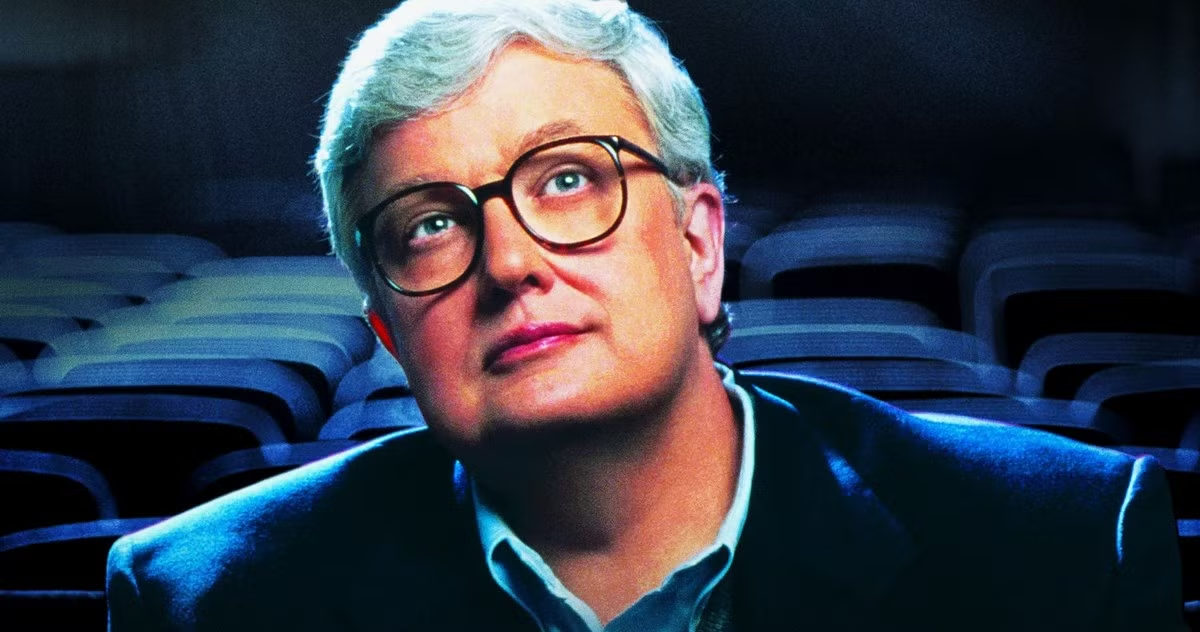
Still my favourite film lover, the late-great RogerEbert.
“He is a pleasant-looking young man with a smile on his face…
…perhaps too bland a smile, as if he is not smiling about anything – as if the smile is a mask. He goes into a sports store to buy a gun, and makes small talk with the clerk, who apologizes that there is an obligatory waiting period. Hey, no problem! He comes back two days before Christmas to pick up his purchase, and then walks into a home and shoots people dead and carves out parts of their bodies with the precision of an experienced butcher.
The police, confronted by the murder scene, call it the work of a madman. A few days later, he strikes again, in broad daylight, walking into a home and butchering a woman while her helpless child looks on in terror. Nobody in his right mind could commit an act like this, without apparent motive or even with one. And yet the man, whose name is Charles Reece, is played by Alex McArthur as the kind of guy you’d see at a football game, or out washing his car. He doesn’t even make much of an attempt to evade discovery, wearing the same windbreaker to all of his crimes.
William Friedkin’s “Rampage” is based, the movie assures us, on a real story. We do not need the assurances. Serial killing is the crime of our times, and who knows what confluence of forces has led to these strange people who stare out at us from the covers of true crime paperbacks, their appearance as normal as their crimes are bizarre. Jeffrey Dahmer, a bystander said on television, looked like such a nice young man.
ChevyChase (l) cannot believe what Ebert (c) is saying, but Siskell (r) is amused.
Friedkin tells the story of his killer more or less as a police procedural. We meet a cop (Michael Biehn) who tracks the killer, and then we see Reece captured by a simple means: He is identified by an eyewitness. Cornered at the gas station where he provides service with a smile, Reece leaps the back fence and runs away. The act of a reasonable man.
Eventually we see where Friedkin is going with the story.
This is not a movie about murder so much as a movie about insanity – as it applies to murder in modern American criminal courts. Friedkin plays with two decks and is happy to stack them both. His killer’s crimes are beyond our conception of possible human behavior, and then, in court, he is defended on the grounds that he must have been insane, and prosecuted on the grounds that he acted reasonably in so many other ways that he must have been sane. The difference between these two theories is the death penalty.
Friedkin does not quite say so in as many words, but his message is clear: Those who commit heinous crimes should pay for them, sane or insane. You kill somebody, you fry – unless the verdict is murky or there were extenuating circumstances. “Rampage” is not, however, a polemical film; it doesn’t press its points and doesn’t spend a lot of time on theory. It simply lays out the facts of a series of gruesome crimes, and then shows us how our gut feelings of good and evil grow confused after the testimony.
We are not much persuaded by the court arguments for either side. Friedkin wants it that way. Reece was sane, the prosecution argues, because he planned ahead to buy the gun and fled to avoid arrest. He was insane, the other side argues, because his crimes could not have been contemplated by a sane man. The prosecution offers an expert psychiatrist known as “Doctor Death” because of his invariable diagnosis of sanity. So it goes.
The film is realistic and matterof-fact, subdued compared to Friedkin’s great film of evil, “The Exorcist.” Alex McArthur, as the killer, is as unemotional and inoffensive as the protagonist of “Henry: Portrait of a Serial Killer.” The movie was completed five years ago and then caught in the bankruptcy of the Dino De Laurentiis studio. Finally released, it has, if anything, benefited by the delay; five years ago, we would not have known how much Charles Reece resembles Jeffrey Dahmer, how little the face can reveal of the soul.”
Additional Links:
Watch the original 1987 VHS trailer for “Rampage” here:
https://www.youtube.com/watch?v=8SwE6DXL3Ew
Original trailer.
Listen to Friedkin discussing his work with Morricone here:
https://www.youtube.com/watch?v=GMA9QwtceiA
Friedkin on Morricone.
Read Giant Freakin Robot’s re-appreciation of “Rampage” here:
Horn, D. C. (2023). The Lost Decade: Altman, Coppola, Friedkin and the Hollywood Renaissance Auteur in the 1980s. United States: Bloomsbury Publishing.
Terry, Clifford (October 30, 1992). “From mad to worse”. Chicago Tribune. Archived from the original on December 30, 2023. Retrieved December 30, 2023.
Brent Lang (April 12, 2013). “Director William Friedkin on Clashes With Pacino, Hackman and Why an Atheist Couldn’t Helm ‘Exorcist'”. The Wrap. Retrieved October 4, 2020. My personal beliefs are defined as agnostic. I’m someone who believes that the power of God and the soul are unknowable, but that anybody who says there is no God is not being honest about the mystery of fate. I was raised in the Jewish faith, but I strongly believe in the teachings of Jesus.
Winkler, Irwin (2019). A Life in Movies: Stories from Fifty Years in Hollywood. New York: Abrams Press. pp. 525–726. ISBN9781419734526.
“Daily News from New York, New York”. New York Daily News. January 20, 1970. p. 47. Production Merger Phil D’Antoni and William Friedkin have joined forces with Milton Berle Paul W. Benson Productions to do the film version of “The Brass Go-between,” a novel by Oliver Bleeck. The suspense-thriller will be shot on locations in Washington, D.
Pinnock, Tom (October 19, 2012). “Peter Gabriel: “You could feel the horror…””. Uncut. Retrieved July 24, 2023. I had written a short story on [the sleeve of] Genesis Live – one of the stories I used to tell onstage – and William Friedkin, who was the king of Hollywood because of The Exorcist, wanted me to work with him. Not as a musician, but as a screenwriter and ideas man. That was very exciting to me. In the end, unfortunately, nothing happened; it was one of many Hollywood projects that bit the dust.
Clagett, Thomas D. (August 1, 2002). William Friedkin: Films of Aberration, Obsession and Reality. Los Angeles, Calif.: Silman-James Press. ISBN9781879505612.
Archerd, Army (May 14, 2003). “Zanuck advises Polanski on next move”. Variety. Retrieved July 25, 2024. Friedkin will direct a movie based on an incident in Puccini’s life — the pic to star Placido, who will be needed (he’ll also sing) for three months on the pic!
“CONFUSING LIFETIME ACHIEVEMENT WITH STAR POWER”. Sun Sentinel. February 9, 2000. Retrieved August 13,2023. Ms. Burke handed over the dais to producer Richard Zanuck (Jaws, Driving Miss Daisy), who would present the evening’s first Lifetime Achievement Award to director William Friedkin.
Aftab, Kaleem (June 7, 2012). “Killer instincts”. The Sydney Morning Herald. Retrieved August 12, 2023. Was in competition at Venice, where it won the Golden Mouse (online critics’ best film).
“‘Beasts of the Southern Wild’ reçoit le Grand Prix de l’Union de la Critique de Cinéma”. RTBF.be (in French). January 6, 2013. Retrieved August 12, 2023. Cinq films étaient en lice pour cette récompense: “Beasts of the Southern Wild”, de Benh Zeitlin, “Take Shelter”, de Jeff Nichols, “Shame”, de Steve McQueen, “Ernest et Célestine”, de Benjamin Renner, Vincent Patar et Stéphane Aubier, et “Killer Joe”, de William Friedkin.
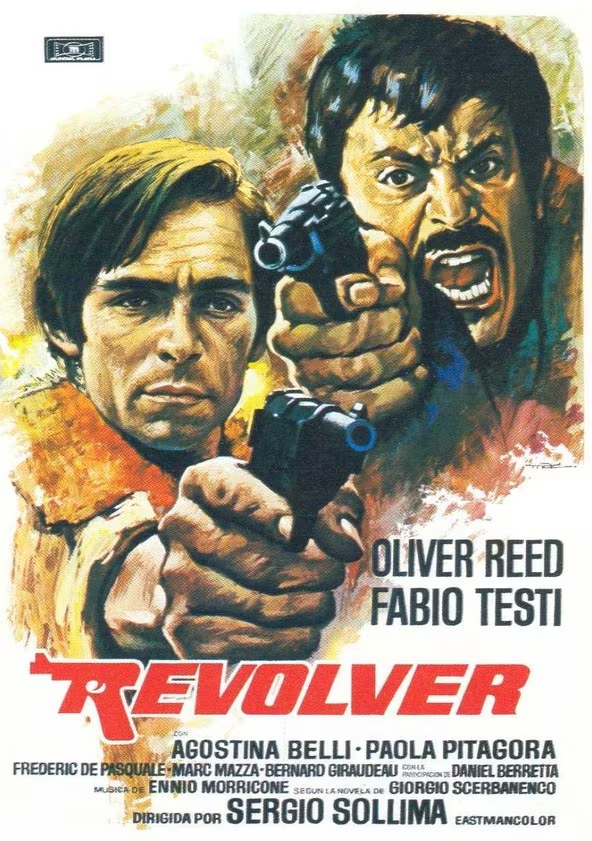
Spanish theatrical poster.The Maestro around the time he composed the score for “Revolver.”“Revolver” stars OliverReed, FabioTesti, and their excellent coats.
The Album:
Not to be confused with Guy Ritchie’s film of the same name, most people will be familiar with Morricone’s excellent 1973 score for director SergioSollima’spoliziottesco “Revolver” through the standout track “UnAmico,” which QuentinTarantino repurposed for his 2009 WWII opus, InglouriousBasterds.
Morricone-super-fan, QuentinTarantino.Tarantino’s “sound of war.”
Other Editions:
Original 1973 Italian pressing.1977 Japanese pressing.1995 German CD release.German CD back cover.2006 Italian CD re-issue.
The Film:
Synopsis from MoMA’s Ennio Morricone Film Series:
“Revolver” at the Moma.
“Revolver. 1973. Italy/West Germany/France. Directed by Sergio Sollima. Screenplay by Dino Maiuri, Massimo De Rita, Sollima. With Oliver Reed, Fabio Testi, Agostina Belli, Paola Pitagora. In Italian; English subtitles. DCP. 111 min.
An Italian resistance fighter during World War II, Sergio Solima wrote and directed some of the most socially conscious Spaghetti Westerns The Big Gundown and political crime thrillers, or poliziotteschi, of the 1960s and ’70s. Revolver is a gripping example of the latter, the bitterly cynical story of a deputy prison warden (Oliver Reed) who becomes a pawn in a shadowy conspiracy when his wife is kidnapped by the mob and he’s forced to ally with a convict (Fabio Testi). The film boasts one of Ennio Morricone’s most propulsive scores, anticipating that of Brian De Palma’s The Untouchables. Quentin Tarantino, a giddy fan both of Solima and Morricone, quoted the beautiful “Un amico” for the climax of his Inglourious Basterds, the song that seems to capture a lover’s—or a criminal’s—inclination to hope against hope.”
Reed reaches out to touch someone.
Blu-ray review from cineoutsider.com:
Partners in crime
Oliver Reed is at his restrained best as a prison warden forced to facilitate a jailbreak in order to save his wife in REVOLVER, Sergio Sollima’s rivetingly handled 1973 crime drama. Slarek explores the film on Eureka’s new Blu-ray, and adds another favourite to an increasingly long list.
How’s this for a pre-title sequence? In the darkest of dark Italian nights, the sound of hurried footsteps and exhausted panting is revealed to belong to two men, one of whom is nursing a serious stomach wound and being helped along by his concerned companion. As they reach a row of parked cars, they pause and steal one of them, then speed off into the night to the sound of approaching sirens. As dawn breaks, the car stops at an isolated spot beside a river, and the driver helps his injured cohort out and onto the riverbank, where he bemoans the fact that he came all the way to Italy to be killed by a night watchman. Realising that his injury will soon prove fatal, the wounded man makes his companion promise not to let his body end up on an autopsy table at a morgue. Moments later, he dies, and the man that we by now know is a close and devoted friend mourns his loss with a farewell kiss. Then, as the opening titles unfold, he digs a hole by the riverside and buries his friend with the gun that probably led to his death. And so begins the 1973 Italian poliziotteschiRevolver, and I’m sure I’m not the only one who suspects an influence on the post-title scene of Reservoir Dogs.*If the above wasn’t enough to grab your attention – and it certainly did mine – then worry not, because the intrigue doesn’t stop there. In the next scene, wealthy oil magnate Harmakolos (Jean de Grave) walks out of his plush Parisian hotel and opts to walk instead of taking their car as suggested, dismisses his aide’s concerns about the recent threats to his life. He’s only a few hundred metres from the hotel when a motorcycle rider pulls up and shoots him dead. Elsewhere in the city, popular singer Al Niko (Daniel Beretta) is cheerfully batting away questions from the press about what his connection could be to this assassination as he arrives at police headquarters. Once inside the office on an unnamed Inspector (Marc Mazza), he is shown the wreck of a motorbike, which he recognises as one he bought a couple of years ago and gave to a former friend named Jean-Daniel Auger. It turns out that Jean-Daniel once worked for Harmakolos as his bodyguard and made threats against him after he was fired, and this was the bike ridden by his assassin. The vehicle and the mangled body of its rider were discovered on an unmanned level crossing in Jean-Daniel’s home town of Lyon, and a trip to the morgue sees Niko confirm that the body of the rider is indeed Jean-Daniel. To the Inspector’s coolly expressed relief, the Harmakolos case is thus officially closed.
Over in Italy, a well-dressed Frenchman (Frédéric de Pasquale) disembarks from his flight and is met outside the airport by two taciturn men in a black Mercedes – only later do we discover that the man has flown in from Paris, and that his name is Michel Granier. The purpose for his visit is not yet clear. Meanwhile, on a platform at the central Milan railway station, two Sicilians (Giovanni Pallavicino and Bernard Giraudeau) are approached and offered work by a dodgy-looking tout (Vittorio Pinelli). One of the men takes the tout’s card, looks briefly at it and hands it back. “No,” he says gruffly, “Got work.” Elsewhere in the same city, a woman visible only from the knees down takes off her shoes and steps onto the feet of a man, who begins walking down an apartment hallway, carrying her as he goes, as the two kiss and items of clothing fall to the floor. Eventually, these intimately entwined appendages are revealed to belong to Vito Cipriani (Oliver Reed) and his young wife Anna (Agostina Belli), who are clearly very much in love. We learn that Vito is a warden of the city’s prison when he is called into work the following morning in order to talk a crazed prisoner out of stabbing himself. When he arrives home with flowers of apology later, however, the apartment is empty and a phone call confirms that Anna has been kidnapped. If Vito wants to see her alive again, he’s assured, he must arrange the escape of an inmate named Milo Ruiz (Fabio Testi). It’s only when Vito asks to be taken to Milo’s cell that we discover he’s the man who buried his friend by the riverside in the opening sequence.
A lot of story threads are spun in these opening scenes, and while it is perfectly possible to draw a logical if speculative line of connection between them, not all is what it seems. Indeed, one of the many strengths of Revolver is its ability to continually surprise newcomers and catch them out. With that in mind, if you want to avoid having any of them spoilt even a little bit, then I’d skip the next paragraph, and eve n then proceed with a degree of caution, as it’s nigh on impossible to discuss the film in any more detail than I already have without giving a few things away. That said, I promise to keep the reveals to a minimum and avoid being explicit on later developments.
The first surprise comes when Vito follows a tip from Milo’s cellmate (Sal Borgese) and walks in on sleazy but wealthy criminal kingpin Grappa (Peter Berling). The expectation – my expectation –was that Grappa would get bolshy and the desperate Vito would lose his cool and smack the required information out of him. Instead, after a small bout of self-congratulatory verbal sparring, Grappa is fully cooperative and tells Vito what he knows without fuss, resistance or a hint of irritation, and Vito accepts that what he’s saying the truth and even offers him a small nod of appreciation. The second surprise comes when Vito returns to the jail and has Milo brought to his office, where he sets about viciously beating him about the face. On the surface this is an expression of his anger and frustration, but his actions are then revealed to have a secondary purpose, with the essentially superficial injuries inflicted on Milo providing a reason for him to be moved to the prison hospital, from where, Vito tells him, he will be able to affect his escape. This he does in a process that is lengthy enough to feel plausible, but Milo has only just hit the streets when a car screeches up beside him in a car and he’s ordered to get in at gunpoint by Vito. This gameplaying with expectations and genre convention sets the scene for a plot that rarely follows the predicted path. Thus, a colleague of Vito’s whose arrival looks set to expose his wrongdoing becomes an unexpected ally, a switch of fortune for both Vito and Milo is cancelled out by a surprise rebalancing of their relationship, and even the true reasons for Milo’s forced release prove to be more sinister than they initially seem.
That trademark OliverReed (nostril) flare.
The foundations are laid by a smartly constructed script by director Sollima, Arduino Maiuri and Massimo De Rita, and Sollima’s direction is tight, economic and purposeful, never flashy and always in service of the story and characters. Action scenes are rationed, but when they come they are blisteringly handled, their urgency enhanced by their sharp sense of realism, cinematographer Aldo Scavarda’s immaculate camera placement, and Sergio Montanari’s breathless editing. Adding a further layer of class is a typically fine score by Italian maestro Enno Morricone, one that hits all the right emotional buttons without overplaying them, and at one point feels like a trial run for the main theme of the composer’s score for The Untouchables (1987).
An amused FabioTesti.
Even more crucial to audience engagement are the performances, the best of which comes from a top-of-form Oliver Reed, albeit with a small but curious caveat. As was often the way with Italian films of the period, particularly those with international casts, all of the dialogue was post-dubbed. And while there’s not a hint of mismatch between Reed’s on-screen delivery and his redubbing of his own voice, for reasons that no-one seems to be able to clarify, he elected to do the whole thing with an imperfect American accent. Given that his character name is Vito Cipriani and that he is a former police detective, we can assume that he is meant to be native Italian rather than Italian-American, and as all of the film’s dialogue was delivered in English with an eye on sales to the American market, for the life of me I can’t work out why he didn’t stick to his usual precise English delivery. The thing is, although this does initially feel a little odd, Reed is so bloody good in all other respects that after just a couple of minutes it ceases to matter. Everything else about his performance is sublime, peaking when he is visibly wrestling to keep his true feelings from exploding, and as so often with Reed, the potential for extreme violence can always be seen bubbling just beneath the surface. It’s a masterclass in restraint and emotional control, and up there with Reed’s very finest work on film. As Milo, Fabio Testi proves he’s more than just a handsome face, balancing the character’s cocky disposition with his increasing commitment to a cause he has been unwittingly recruited to help serve. Frédéric de Pasquale (who the two years previously played drug-smuggling TV personality Henri Devereaux in The French Connection) is appropriate unflustered as gangland middle-manager Michel Granier, and Paola Pitagora has a strong role as politically convicted people trafficker Carlotta. The supporting cast is also peppered with the sort of faces you only seem to find in European and East European cinema, providing the film with thugs who look and behave like the real deal, memorably when the Sicilians track down a potential witness and convincingly arrange his subsequent death to look like an accident.
I came to the cinema of Sergio Sollima via his superb 1967 western, Face to Face [Faccia a facia], and while Revolver is a very different work, it does share some of that film’s central themes. In both, two individuals with opposing moral values find themselves switching position over the course of the story, and like Face to Face, Revolver later moves into the area of political commentary, questioning the power structure of a system that protects the wealthy and is able to arrange the disposal of inconvenient elements of what it regards as the lower order. The result is a compellingly structured, impeccably directed, splendidly scored, and powerfully acted gem of Italian crime cinema, and one of the best films I’ve watched so far this year. It also pulls that rare trick of keeping you guessing right up to the final scene. Even the title is not what it initially seems, being a type of gun not used by the central protagonist, and likely instead intended to be read as a commentary on the transformative journey that Vito and his initially unwilling companion undertake over the course of the story. sound and vision
Sourced from a new 4K restoration (that’s all the detail I have on this one), the 1080p transfer of Revolver on this Eureka Blu-ray is seriously impressive in all respects. Detail is very clearly defined, and the contrast is nicely balanced, nailing the black levels without crushing the shadows. The colour palette has a very slightly muted feel with a slight greenish hue, all of which look right for the film’s downbeat tone and very nicely captured by this transfer. The image is very clean, with no trace of dirt or damage, and a fine film grain is visible. Very nice.
Revolver was shot with the actors delivering their lines in English and their dialogue redubbed in post-production, and here you have the option to watch the film with either the English or Italian language tracks, both of which are Linear PCM 2.0 mono. The dynamic range is a little restricted on both – there are no deep bass thumps or rumbles here – and while voices seems to have slightly more breadth on the Italian track, they also sometimes have a more dubbed feel. Morricone’s music is of similar quality on both tracks, but differs during the opening titles, with the orchestral title theme of the English track turned into a song on the Italian track.
Optional English subtitles for the deaf and hearing impaired are available for the English language track, and a second set of optional English language subtitles kick in automatically if you select the Italian language track. Both seem fine, but there is a small omission here, at least on the review disc (it may be adjusted on the release disc). At one point, Vito reads a note written in Italian, and at another the Inspector looks down at a newspaper headline written in French. If you watch the film with the Italian soundtrack, the subtitles offer English translations of both. If you watch the film with the English language track, however, even with the hearing impaired subtitles enabled, no such translations are provided. Fortunately, it’s just a matter of switching between the subtitle tracks if your French or Italian are as weak as mine, and you don’t need to read either to understand what’s going on. It’s also worth noting (again, we’re talking review disc here) that there is no option on the menu to activate hearing impaired subs, but they can be switched on using the disc player’s remote control.
Special Features
Audio Commentary by Barry Forshaw and Kim Newman Author of Italian Cinema: Arthouse to Exploitation, and a ton of others, joins author, critic and genre commentary favourite Kim Newman to explore a film that they were both impressed by and rate above the poliziotteschi norm. Individual scenes and plot turns are discussed, as is Ennio Morricone’s score, and the work on this film and others of director Sergio Sollima, particularly his 1970 Violent City [Città violenta] (for which there are spoilers). They opine that Fabio Testi was an actor with a limited range but what he could do he did well, and praise the rare depth and strength (at least for this genre) of the Carlotta character played by Paola Pitagora. But the lion’s share of the discussion is focussed on Oliver Reed, whose performance here both men rank as one of his best, and whose work on this and other key films in his career is covered in considerable detail. There’s a lot more discussed here, all of it compelling and acutely observed, and these two really know their Italian crime cinema.
Stephen Thrower on ‘Revolver’ (21:59) Nightmare USA author Stephen Thrower examines the work of director Sergio Sollima, with particular focus on Revolver, though also covers the director’s segment in the multi-story L’amore difficile (1962), and his westerns The Big Gundown [La resa dei conti] (1966) and Face to Face [Faccia a facia] (1967). Like Forshaw and Newman above, he’s full of praise for the film, for Sollima’s skilled direction, and for Oliver Reed’s central performance. Like them, he’s also confused by the decision to have Reed play the whole thing with a not completely convincing American accent, but argues that the story and the acting are so good that you soon forget about it, a point on which I am in complete agreement.
Tough Girl (10:21) Actor Paola Pitagora, who plays Carlotta, recalls working with Oliver Reed, who was an idol of hers but used to start drinking early on in the morning, which sometimes caused problems on set, though she does note that he was always top-notch on camera. She intriguingly describes Sergio Sollima as “a war machine,” as someone who was focussed and meticulous but also funny, and Fabio Testi as gorgeous, very enthusiastic, and focussed on his role. She praises the film scores of Ennio Morricone, though admits her admiration for the composer was soured a little by his claim that women all belonged in the kitchen, and has a revealing story about how Reed’s drinking ultimately cut short her role in the film. She also opines that for her, at least as an audience member, genre cinema begins and ends with Thomas Milian.
Action Man (17:07) An archival interview with actor Fabio Testi, shot in June of 2006 and redressed with new opening titles and credits for this release, and the remastering of what looks like analogue video to HD. Testi looks back at how his work as a stuntman eventually led to him being cast – and doing all of the stunts – in Demofilo Fidani’s 1968 western, And Now… Make Your Peace with God [Ed ora… raccomanda l’anima a Dio!], and how this prompted him to enrol in acting school and embark on a successful career in films and theatre. He manages to top Paola Pitagora’s description of Sergio Sollima with his claim that “he works like a martial artist, every shot is like a sabre blow,” notes how Italian cinema lost its political edge after the arrival of commercial television and a slew of American imports, and remarks that it’s nice that people remember him despite his age, which would have been 64 when this interview was shot. And he still looks damned good here.
English Credits (6:23) When you select to watch the English language version of the feature, the credits are in the original Italian, so the opening and closing credits of the English language version have been included as an extra.
Original Theatrical Trailer (3:40) A trailer that really pushes the film’s crime thriller credentials, and employs a trick later favoured by American distributors to sell non-English language films to a potentially subtitle-averse audience by including no audible dialogue – characters speak, but all we hear is Morricone’s score and a few gunshots.
International Trailer (1:15) Sold here under its original American title of Blood on the Streets, the US trailer sports a seriously toned but hyperbolic narration that includes the news that the film stars “Oliver Reed in a performance that makes Charles Bronson’s Death Wish look like…wishful thinking,” which I have no problem with at all.
Radio Spots (1:33) Two radio spots pushing the American release, the second considerably longer than the first and both proclaiming that “This is a story of a day all the guns went off.” Er, not quite. Also included with the release version is a Limited Edition Collector’s Bookletfeaturing two new essays by author Howard Hughes – one covering the background to the making of Revolver – and an extensive piece on Ennio Morricone’s ‘Eurocrime’ soundtracks, but this was not available for review.
Summary A tightly directed and terrific poliziotteschi that is more thoughtful and restrained than the genre norm, and boasts an excellent performance by Oliver Reed, despite the enduring mystery of that American accent. As is noted in the commentary, it seems likely that the film was at the very least an unconscious influence on the likes of 48Hrs and Midnight Run, but it absolutely holds its own as a compellingly handled and impressively unpredictable crime thriller almost 50 years after it was made. Eureka’s Blu-ray spots a first-rate transfer and some fine special features, including an excellent commentary track. Highly recommended.
The Director:
Italian director Sergio Sollima.Sollima’s screen credit.
Sollima (r) with his “Faccia a Faccia” stars Gian Maria Volonte (l) and Tomas Milian (c).
After the war, he gradually progressed from working as a film critic to screenwriting to becoming a director[2] Like many Italian cult directors, Sollima started his career as a screenwriter in the 1950s and wrote many peplum films in the 1960s. He made his directing debut doing one of the four sequences in the anthology filmOf Wayward Love. Sollima filmed three Eurospy films and then moved to spaghetti westerns. The Big Gundown (starring Lee Van Cleef and Tomas Milian) was released in 1966 with big success, despite the fact that it had to compete with Sergio Leone‘s The Good, the Bad and the Ugly and Sergio Corbucci‘s Django. Sollima soon filmed two more westerns. Face to Face (Milian and Gian Maria Volonté) was released in 1967 and Run, Man, Run! (Milian) in 1968. Although Sollima directed only three westerns and they never reached the level of popularity as the ones by the other Sergios (Leone and Corbucci), each of them is highly regarded among genre enthusiasts.
If you’re in the Toronto area, stop in and say hi to my Filmography podcast co-host, at “the last great video store,” Bay Street Video, and find a copy of “Revolver” in store, or if outside of Toronto, online here:
“Given exceedingly short shrift in its day. Viewed as in exceptionally poor taste. Marketed in some respects as Lord of the Flies Meets The Dirty Dozen. Audiences accepting of kids putting on a show or, the modern equivalent, making a movie, not so keen on youngsters going to war. In any case there’s an inbuilt repugnance as you get the distinct impression some of these kids would have been ideal recruits for Hitler Youth or the Mussolini version. And Italy, one-time ally of Hitler, becoming suddenly heroic seemed to jibe. Not to mention Rock Hudson’s marquee value fading fast after a gigantic turkey called Darling Lili (1969). Despite some distinctly unsavory aspects, bordering on exploitation, this seems enormously underrated, not just as an actioner, but for a raw depiction of war, far more realistic than many in the genre that toplined on violence.
Sure, it’s an odd concept, Italian kids, in the absence of adults, turned into a fighting force by dint of letting loose their innate venality and savagery. But they’ve not been washed up, adult-free, on a desert island. This small bunch have been orphaned and bloodily. Germans on the hunt for local partisans execute an entire village and then, finding a quisling, proceed to massacre the local resistance and for good measure destroy a team of American parachutists dropped into the area to facilitate the Allied advance.
The kids come across the one survivor, Turner (Rock Hudson), hide him from the enemy and dupe German doctor Bianca (Sylva Koscina), sympathetic to the plight of the innocent, into caring for the wounded soldier. Rather than hang around and accept the ministrations of such a beauty and see out the war with a view to possible romance, Turner is intent on single-handedly completing his mission of blowing up a dam.
Given the kids have amassed a secret armory and are trigger-happy, desperate to avenge their parents, and getting down to the gung-ho aspects of war, Turner, with appalling disregard for their safety, decides to commandeer them for his own unit. Bianca objects and watches with horror and for most of the rest of the picture confines herself to the pair too young to be considered combatants and who reek of desolation or to find ways of killing Turner or betraying him to the Germans.
Meanwhile, the kids have their own ruthless leader, Aldo (Mark Colleano), one part John Wayne, one part the creepy Maggott (Telly Savalas in case you’ve forgotten) from The Dirty Dozen, who objects to taking orders. Training consists of little more than a bit of marching in file and learning how to quickly reload a machine gun. Turner’s clever plan is to use their perceived innocence to distract the Germans guarding the dam. The distraught Bianca, stepping out of line once too often, is raped for her trouble.
Oddly enough, Koscina does take a machine gun to the Germans, which you would have thought would be catnip to the marketeers, but that image is excluded from the poster.
Setting aside all audience misgivings about the premise and the sexual undertones, the mission is very well done, plenty tension, a workable plan, and the eventual dam-burst impressive on the budget.
But the misgivings are not glossed over. There’s a dicey moment when it looks as if the kids, crawling all over the nurse, tearing off her clothes, are about to embark on mass juvenile rape. And the bloodlust will only be slaked when, by dint of secreting the detonators essential to the plan, they force Turner to lead them on a raid on the Germans, tossing hand grenades into houses and opening fire from the back of a truck on the unsuspecting enemy.
Aldo, in particular, gets a taste for killing and in a later battle doesn’t hold back when one of his comrades inadvertently gets in his way.
Sold as a junior edition of a mission picture, the trailer would have probably been enough to put off large sections of the audience, uncomfortable with kids being employed in such mercenary fashion. Kids grow up in war but not that fast seemed to be the general reaction. Okay if they’re portrayed as victims, less acceptable as gun-happy butchers.
So, the best elements of the movie is in not avoiding such misgivings. It was soon clear from the American experience – though this is not specifically alluded to – that hordes of kids in Vietnam were going down this route. The point at which kids cross over into bloody adulthood and lose the essence of childhood is dealt with too. That scene on the face of it and in isolation appears maudlin but in the context of the picture works very well. But the violence or its aftermath are not the most striking images. Again and again, the camera returns to the dirty, clothes-tattered, Bianca clutching the two infants, the detritus of conflict.
Setting aside his moustachioed muscle, Rock Hudson (Seconds, 1966) gives a well-judged performance and Sylva Koscina (A Lovely Way To Die, 1968), shorn of glamor, holds the emotional center. Mark Colleano (The Boys of Paul St, 1968) gives a vicious impression of a young hood on the rise. Directed by sometime cult director Phil Karlson (A Time for Killing, 1967) from a script by S.S. Schweitzer (Change of Habit, 1969) and producer Stanley Colbert. Great score from Ennio Morricone.
It’s worth pointing out that the idea of kids taking up arms received positive critical approval when it was applied to such an arthouse darling as If… (1969) but of course they were public schoolboys forced into action by bad teachers and in reaction to “the establishment” and not after seeing their families slaughtered. Double standards, methinks.
Worth reassessment.”
Film tie-in novel.
The Director:
Director Phil Karlson.
From Wikipedia:
Phil Karlson
Born
Philip N. Karlstein July 2, 1908 Chicago, Illinois, U.S.
Died
December 12, 1982 (aged 74) Los Angeles, California, U.S.
Karlson was the son of Irish actress Lillian O’Brien.[2] His father was Jewish.[3]
He attended Marshall High School and studied painting at Chicago’s Art Institute. He tried to make a living as a song and dance man but was unsuccessful. Then he studied law, at his father’s request, at Loyola Marymount University in California. He took a part-time job at Universal Pictures “washing toilets and dishes and whatever the hell they gave me” according to Karlson.[4] He also sold some gags to Buster Keaton. Eventually he decided to pursue a career in film, quitting college a year before graduation.[5]
Assistant Director at Universal
Karlson got a job at Universal Pictures, doing a variety of jobs.
Karlson said that Sam Goldwyn put him under contract intending to use him as a director, but Karlson wound up spending nine months idle. He asked for a release of his contract and got it.[4] He joined a company of Maurice Kosloff.[6]
Karlson quit Universal in 1940 to enlist in the U.S. Army Air Forces. In 1943, he was injured in a plane crash ending his career as a flight instructor.[5]
Monogram Pictures
Karlson, still using his real name of Philip Karlstein, took a job at Monogram Pictures, as an assistant director. He was contacted by Lou Costello, who wanted to produce a film and offered Karlstein the job of directing it. The resulting movie was A Wave, a WAC and a Marine (1944), starring comedian Henny Youngman.[5] Karlson called it “probably the worst picture ever made… a nothing picture, but I was lucky because it was for Monogram and they didn’t understand how bad it was, because they had never made anything that was any good.”[4] However, Karlson did like his second film as director, G. I. Honeymoon (1945), with Gale Storm, which received an Oscar nomination for Best Music.
Karlson made Monogram’s low-budget productions look much more expensive by being creative with the staging. He used light and shadow to add mood to ordinary dialogue scenes, and employed careful camera angles to maximize the size of the limited sets. Karlson’s resourcefulness made him Monogram’s choice to launch a new series (The Bowery Boys, The Shadow) or invigorate an existing one (Charlie Chan). An excellent example is Karlson’s Charlie Chan mystery The Shanghai Cobra (1945) in which the director, given a small exterior set, established a film noir atmosphere by shooting the scene at night during a rainstorm. Karlson was well aware of Monogram’s budgetary limitations: “They knew what they were doing, because there was a certain class of picture they were going to make and they weren’t going to make anything any different.”[4]
Slightly more distinguished was Wife Wanted (1946) which starred and was produced by Kay Francis. Both she and Karlson disliked the original script so they rewrote it together. It turned out to be Francis’s last movie.[5] He followed it with Kilroy Was Here (1947), co-starring former child actors Jackie Cooper and Jackie Coogan.
Karlson received acclaim for Black Gold (1947), a story of the plight of the American Indian, based around the true story of the racehorse Black Gold. It was an early lead for Anthony Quinn and the first film released by Monogram’s new, higher-budget division, Allied Artists. Karlson took a year to make that film because he wanted seasonal shots; he says he directed four films while also making Black Gold.[4]
Desi Arnaz hired Karlson to direct the pilot for the TV series The Untouchables (1959), later released theatrically as The Scarface Mob. Although The Untouchables had a long run on TV, Karlson only received a straight salary for his work on the pilot.[5]
Karlson made a war movie in Europe with Rock Hudson, Hornets’ Nest (1970). He did a horror movie, Ben (1972), best remembered for its Michael Jackson theme song.
He had a huge success in 1973 with Walking Tall, the fact-based story of a crusading sheriff Buford Pusser in the most corrupt county in Tennessee.[12] It was a major domestic and international hit, costing $500,000 and grossing more than $23 million. It also made Karlson a fortune, thanks to the fact that he owned a large percentage of it.[5]
[He] emerges as a violent American original, born and brought up in Chicago, used to violence as a way of life, someone who was forced to make a great many films that he didn’t believe in, just so that he could finally get a free hand with the minor studios to make the films that he did … In Karlson’s best films, a truly bleak vision of American society is readily apparent; a world where everything is for sale, where no one can be trusted, where all authority is corrupt, and honest men and women have no one to turn to but themselves if they want any measure of justice. For Karlson, everything comes with a price – in blood, death, and betrayal. … In his finest work, Karlson seems to be saying “don’t you believe what they tell you. Authority figures only look out for themselves. There are no easy answers. You won’t get what you deserve, and you won’t even get what you fight for. You’ll get what you can take, and that’s got to be enough.”[5]
Italian theatrical poster.Alternate Italian poster.Alternate Italian poster.Alternate US theatrical poster.Alternate poster.French theatrical poster.DVD cover art.
If you are in Toronto, stop in at “the last great video store,” Bay Street Video, say hi to my Filmography podcast co-host, Bjorn, and find a copy of “Hornet’sNest” on blu-ray in store or online:
Reverse album cover.Lato A.Lato A (detail).Lato B (detail).Album insert.Reverse insert.
Other Editions:
The Film:
The Lady Caliph herself, Romy Schneider.
The Director:
The eye has it.
From Wikipedia:
Alberto Bevilacqua (27 June 1934 – 9 September 2013)[1] was an Italian writer and filmmaker. Leonardo Sciascia, an Italian writer and politician, who read Bevilacqua’s first collection of stories, The Dust on the Grass (1955), was impressed and published it. Mario Colombi Guidotti, responsible for the literary supplement of the Journal of Parma, began to publish his stories in the early 1950s.
Publicity photo.
Friendship Lost, his first book of poems, was published in 1961. Caliph, published in 1964, was his breakthrough novel. The protagonist, Irene Corsini, imbued with his own sweet and energetic temperament, is one of the strongest female characters in Italian literature. His novel This Kind of Love won the Campiello Prize in 1966. In both This Kind of Love and Caliph, Bevilacqua oversaw the adaptations and productions of the film versions. This Kind of Love won Best Film at Cannes.
The author with his books. It’s actually hard to find images of Bevilacqua WITHOUT his books in the shot, for which I love him.
Bevilacqua was also a poet. His writings have been translated throughout Europe, the United States, Brazil, China and Japan. In 2010, his seven “stories” as he liked to call them, were included in the Novels volume of the prestigious series “I Meridiani.”[2]
Bevilacqua, aged 79, died in Rome on 9 September 2013 from cardiac arrest.[4] He had been hospitalized since 11 October 2012 for heart failure.[1]
Posters:
German Theatrical Poster.Alternate Italian Theatrical Poster.German DVD cover art.Montparnasse Edition.DVD cover art.DVD cover art.DVD cover art.Set of “La Califfa” lobby cards.
The Novel:
Italian printing.Italian printing (back cover).
Translation of back cover (according to Google):
The story of the passions and rebellion of a beautiful, authentic and proud woman, against the backdrop of a city - Parma - and its stream, which symbolically separated the poor from the rich.

Califfa is a beautiful girl of popular origin who becomes the lover of Annibale Doberdò: the most powerful industrialist in the city, a sort of Mastro-don Gesualdo, authoritative and unscrupulous. Memorable portrait of a free woman, fundamentally healthy and, in her own way, innocent. Califfa is a lover without servility in whose loving frankness the industrialist finds, in a crucial point of his existence, a new desire for life and his own freedom. All the powerful people in his court arm themselves against this relationship, but only Doberdo's sudden death will end it. And Califfa will return to her neighborhood of origin, alone, but with the awareness of having contributed to transforming not only the soul and intimacy of a man, but also the social aspect of a city.
«Central novel» in the 1960s, for its clear literary success and because it testifies, through some great protagonists, to the splendors and miseries of that Italian economic miracle that would inspire the best fiction and the best cinema of the time.
The novel's notoriety was amplified by the film shot by Alberto Bevilacqua himself and starring an unforgettable Romy Schneider together with Ugo Tognazzi.

By Alberto Bevilacqua. Einaudi published La polvere sull'erba (2000), his first novel, unpublished since 1955, the year in which it was written, Viaggio al principio del giorno (2001), La Pasqua Rossa (2003), Storie della mia storia (2007) and the collections of poems: Piccole questioni di eternità (2002), Tu che mi ascolti (2005), Duetto per voce sola (2008).
The Maestro scrutinizes his work.Morricone (l, w/ trumpet) served as Best Man at “Battle of Algiers” director Gillo Pontecorvo’s (next to the Maestro) wedding.Pontecorvo (l) pals around with Best Man Morricone (r).Reverse album cover.
This original 1967 United Artists release of the soundtrack to “BattleofAlgiers” was co-written by the film’s director, GilloPontecorvo (“Burn” – also scored by Morricone), with orchestra direction by frequent Morricone collaborator (and distinguished composer in his own right) BrunoNicolai (“The Red Queen Kills 7 Times“).
Album cover for Bruno Nicolai’s “The Red Queen Kills 7 Times.”
Album review from main titles.net:
“La Battaglia di Algeri (The Battle of Algiers) is a film made in 1966 by Gillo Pontecorvo, with whom Morricone also teamed up for Queimada and Ogro. The political film depicts the beginning of the actions from the National Liberation Front in Algiers against the French colonists, which would eventually lead to their aimed independence in 1962. Above all, it’s a honest piece of cinema, that does not choose sides and which is made in the Italian neo-realism tradition with gorgeous black and white cinematography. It’s an important Morricone film, made in a period which is generally accepted as the most creative period of the composer. Yet, both the film and score never gained so much praises as the more popular projects and that truly hurts.
Side 1.
The most evocative musical idea for the score is the theme for Ali. Pontecorvo was finding it difficult to establish the musical themes for the score and recorded some on his own and presented them to Morricone. The maestro did not want to use them. During the creative process the director unconsciously whistled the themes in the presence of the composer, which had triggered Morricone. Some time later Morricone presented those same themes to the director, pretending not to remember their origins. This is the reason the music is credited as ‘music by Ennio Morricone and Gillo Pontecorvo’. The classic theme of Ali is based on a simple 4 note motif that is performed by a solo flute and accompanied by the orchestra, as can be heard on the 3 minute treatment Tema di Ali. There are also renditions for the orchestra alone, which lack the subtlety and fragility of the solo flute, but are equally strong. Its simplicity proves incredibly powerful, especially in the beginning of the film as Ali is arrested by the French. The intense black and white close-up of Ali is supported by the fragile notes of the motif, which creates one of the most iconic and most beautiful scenes in the history of cinema.
Side 2.
Another element of the score mainly reflects the French from a musical point of view, which is atypical Morricone martial music, mostly in the form of a march. The aggressive rhythm and harsh percussion, piano and brass elements brilliantly depict the military undertakings of the French to overthrow the Algerian resistance. Algeri: 1 Novembre 1954 is a march that Morricone has often included in his concert programs. Some of the actions of the French, who torture, are countered by the the Algerians who detonating bombs; both featurestark rhythmic musical pieces that appear to have been written from a musical neutral zone, while there are certainly hints of both musical worlds. These moments are dictated by the typical frenetic tension building that only Morricone could write.
Occasionally Morricone comments on the aftermath of a retaliation by using an organ. It are these kind of small moments that are equally beautiful to the theme of Ali. Other noteworthy moments are the moving intimacy of the woodwinds in the track Matrimonio clandestinoe and subtle melancholy on Gennaio 1957: Accerchiamento della Casbah.
Clearly, Morricone score is perfect for the film, but I did have problems with the use of music some years ago. The fact that the neo-realism approach generally avoids any kind of dramatic manipulation made it rather difficult to accept that the score often became a bit obtrusive. By now I have somehow accepted this wholly and like the directness of the music.
This release by Quartet records is essentially the same as the cd GDM released in 2005, but all of the music is remastered and now includes liner notes. You can clearly hear it sounds better than ever before, which can be a good reason to purchase this release of a classic work. The 2005 release is becoming a rare item and often does not come very cheap on the second-hand market. I can honestly say I would rather want a reissue of a good score with better sound quality, than a Morricone release that only offers a few uninteresting alternative cues.”
Additional Releases:
Reverse album cover.Lato 2.2005 Italian CD release.Reverse CD cover.2005 Spanish CD release.Spanish CD reverse album cover.
As he has done in “KillBill” (vols 1 and 2), and other pictures, QuentinTarantino repurposed Morricone’s “BattleofAlgiers” score in 2009’s “InglouriousBasterds,” in the scene where the Basterds rescue Hugo Stiglitz from a German prison:
Hugo Stiglitz clip from “InglouriousBasterds.”
The Film:
Disclaimer that opens the film letting the audience know that although it feels like a documentary, it is not.
Roger Ebert’s review of “BattleofAlgiers” from rogerebert.com:
“At the height of the street fighting in Algiers, the French stage a press conference for a captured FLN leader. “Tell me, general,” a Parisian journalist asks the revolutionary, “do you not consider it cowardly to send your women carrying bombs in their handbags, to blow up civilians?” The rebel replies in a flat tone of voice: “And do you not think it cowardly to bomb our people with napalm?” A pause. “Give us your airplanes and we will give you our women and their handbags.”
“The Battle of Algiers,” a great film by the young Italian director Gillo Pontecorvo, exists at this level of bitter reality. It may be a deeper film experience than many audiences can withstand: too cynical, too true, too cruel and too heartbreaking. It is about the Algerian war, but those not interested in Algeria may substitute another war; “The Battle of Algiers” has a universal frame of reference.
Pontecorvo announces at the outset that there is “not one foot” of documentary or newsreel footage in his two hours of film. The announcement is necessary, because the film looks, feels and tastes as real as Peter Watkins’ “The War Game.” Pontecorvo used available light, newsreel film stock and actual locations to reconstruct the events in Algiers. He is after actuality, the feeling that you are there, and he succeeds magnificently; the film won the Venice Film Festival and nine other festivals, and was chosen to open the New York Film Festival last November.
Some mental quirk reminded me of “The Lost Command,” Mark Robson’s dreadful 1965 film in which George Segal was the Algerian rebel and Anthony Quinn somehow won for the French. Compared to “The Battle of Algiers,” that film and all Hollywood “war movies” are empty, gaudy balloons.
Pontecorvo has taken his stance somewhere between the FLN and the French, although his sympathies are on the side of the Nationalists. He is aware that innocent civilians die and are tortured on both sides, that bombs cannot choose their victims, that both armies have heroes and that everyone fighting a war can supply rational arguments to prove he is on the side of morality.
His protagonists are a French colonel (Jean Martin), who respects his opponents but believes (correctly, no doubt) that ruthless methods are necessary, and Ali (Brahim Haggiag), a petty criminal who becomes an FLN leader. But there are other characters: an old man beaten by soldiers; a small Arab boy attacked by French civilians who have narrowly escaped bombing; a cool young Arab girl who plants a bomb in a cafe and then looks compassionately at her victims, and many more.
The strength of the film, I think, comes because it is both passionate and neutral, concerned with both sides. The French colonel (himself a veteran of the anti-Nazi resistance), learns that Sartre supports the FLN. “Why are the liberals always on the other side?” he asks. “Why don’t they believe France belongs in Algeria?” But there was a time when he did not need to ask himself why the Nazis did not belong in France.
Pontecorvo (l) with his “Burn” star, MarlonBrando (r).
Early life
Pontecorvo, born in Pisa, was the son of a wealthy secular Italian Jewish family. His father was a businessman. Gillo’s siblings included brothers Bruno Pontecorvo, later an internationally acclaimed nuclear physicist and one of the so-called Via Panisperna boys, who defected to the Soviet Union in 1950; Guido Pontecorvo, a geneticist; Polì [Paul] Pontecorvo, an engineer who worked on radar after World War II; and David Maraoni. Their sisters were Giuliana (m. Talbet); Laura (m. Coppa); and Anna (m. Newton).
Pontecorvo studied chemistry at the University of Pisa, but dropped out after passing just two exams. There he first became aware of opposition political forces, and first encountered leftist students and professors. In 1938, faced with growing antisemitism in Italy with the rise of Fascists, he followed his elder brother Bruno to Paris, where he found work in journalism and as a tennis instructor.
In Paris, Pontecorvo became involved in the film world, and began by making a few short documentaries. He became an assistant to Joris Ivens, a Dutch documentary filmmaker and well-known Marxist, whose films include Regen and The Bridge. He also assisted Yves Allégret, a French director known for his work in the film noir genre, whose films include Une si jolie petite plage and Les Orgueilleux. In addition to these influences, Pontecorvo began meeting people who broadened his perspectives, among them artist Pablo Picasso, composer Igor Stravinsky and political thinker Jean-Paul Sartre. During this time Pontecorvo developed his political ideals. He was moved when many of his friends in Paris packed up to go and fight on the Republican side in the Spanish Civil War.
In 1941, Pontecorvo joined the Italian Communist Party. He traveled to northern Italy to help organize Anti-Fascist partisans. Going by the pseudonym Barnaba, he became a leader of the Resistance in Milan from 1943 until 1945.
After the war, he coedited the weekly communist magazine, Pattuglia, with Dario Volari between 1948 and 1950.[1] Pontecorvo broke ties with the Communist party in 1956 after the Soviet intervention to suppress the Hungarian uprising.[citation needed] He did not, however, renounce his dedication to Marxism.[citation needed]
In a 1983 interview with The Guardian, Pontecorvo said, “I am not an out-and-out revolutionary. I am merely a man of the Left, like a lot of Italian Jews.”[2]
Robert De Niro (l) embraces Pontecorvo (r).
Film career
Early films
After the Second World War and his return to Italy, Pontecorvo decided to leave journalism for filmmaking, a shift that appears to have been developing for some time. The catalyst was his seeing Roberto Rossellini‘s Paisà (1946). He bought a 16mm camera and shot several documentaries, mostly self-funded, beginning with Missione Timiriazev in 1953. He directed Giovanna, which was one episode of La rosa dei venti (1957), a film made of episodes by several directors.
In 1957, he directed his first full-length film, La grande strada azzurra (The Wide Blue Road), which foreshadowed his mature style of later films. It explores the life of a fisherman and his family on a small island in the Adriatic Sea. Because of the scarcity of fish in nearby waters, the fisherman, Squarciò, has to sail out to the open sea, where he fishes illegally with bombs. The film won a prize at the Karlovy Vary International Film Festival. Pontecorvo spent months, and sometimes years, researching the material for his films in order to accurately represent the social situations he explored.
Pontecorvo is best known for his 1966 masterpiece The Battle of Algiers (released in Italian as La battaglia di Algeri). It is widely viewed as one of the finest films of its genre: a neorealistic film. Its portrayal of the Algerian resistance during the Algerian War uses the neorealist style pioneered by fellow Italian filmdirectorsde Santis and Rossellini. He used newsreel-style footage and non-professional actors.
He focused primarily on the native Algerians, a disenfranchised population who were seldom featured in the general media. Though very much Italian neorealist in style, Pontecorvo co-produced with an Algerian film company. The script was written with intention that Front de Libération Nationale (FLN) leaders would act in it.[clarification needed] (For example, the character Djafar was played by an FLN leader, Yacef Saadi.) Pontecorvo’s theme was clearly anti-imperialist. He later described the film as a “hymn … in homage to the people who must struggle for their independence, not only in Algeria, but everywhere in the third world” and said, “the birth of a nation happens with pain on both sides, although one side has cause and the other not.”
The Battle of Algiers achieved great success and influence. It was widely screened in the United States, where Pontecorvo received a number of awards. He was nominated for two Academy Awards for direction and screenplay (a collaboration). The film has been used as a training video by revolutionary groups, as well as by military dictatorships dealing with guerrilla resistance (especially in the 1970s during Operation Condor). It has been and remains extremely popular in Algeria, providing a popular memory of the struggle for independence from France.
The semi-documentary style and use of an almost entirely non-professional cast (only one trained actor appears in the film) was a great influence on a number of future filmmakers and films. Its influence can be seen in the few surviving works of West German filmmaker Teod Richter, made from the late 1960s up to his disappearance, and presumed death, in 1986. In addition, more recent commercial American films, such as the Blair Witch Project, Paranormal Activity and others draw from these techniques for less lofty purposes.
Late career
Pontecorvo’s next major work, Queimada! (Burn!, 1969), deals with a fictional slave revolt, set in the Lesser Antilles. This film (starring Marlon Brando) depicts an attempted revolution in a fictional Portuguese colony.
Pontecorvo continued his series of highly political films with Ogro (1979), which addresses the occurrence of Basque terrorism at the end of Francisco Franco‘s dwindling dictatorship in Spain. He continued making short films into the early 1990s. He also directed a follow-up documentary to The Battle of Algiers, entitled Ritorno ad Algeri (Return to Algiers, 1992).
In 1992, Pontecorvo was selected to replace Guglielmo Biraghi as the director of the Venice Film Festival; he was responsible for the festivals of 1992, 1993 and 1994. In 1991, he was a member of the jury at the 41st Berlin International Film Festival.[4]
In an interview that Pontecorvo gave in 1991, when asked why he had directed so few feature films, his response was that he could only make one with which he is totally in love. He also said that he had rejected many other film concepts for lack of interest.[citation needed]
If you’re in the Toronto area, say hi to my Filmography podcast co-host, Bjorn, and order a copy to buy or to rent from “Toronto’s last great video store,” BayStreetVideo in store (or online, if outside of Toronto):
Watch the film for free on YouTube here:
Complete film on YouTube.
Watch Criterion’s bonus featurette “SpikeLee, MiraNair, and StevenSoderbergh on The Battle of Algiers” here:
Read The Guardian’s obituary for GilloPontecorvo here: