“Quartet Records presents the premiere complete vinyl release of Ennio Morricone’s fascinating score for Folco Quilici’s OCEANO (1971), a pseudo-documentary film about a young Polynesian, Tanai, who goes in search of the island of his dreams. On an epic sea voyage from Polynesia to Alaska aboard a tiny fragile raft, he is guided by the voices of his ancestors.
Morricone’ score for OCEANO seeks to merge nature with mythology. It breathes, vibrates, transmits, and is characterized by its episodic and atmospheric structure, taking the form of an evocative soundscape. The composer draws on resources that recall a primitive, spiritual component: tribal percussion (tablas and bongos), solo woodwinds (flutes and clarinets), guitar, sitar, clanging metal and harp. The fusion of timbres in this instrumentation is unconventional. He expressively sets to music ideas associated with wind or nature, sound textures that construct Tanai’s intimate journey: we hear the sea, we feel the air roaring over the sail of his canoe, the danger lurking in the ocean, his loneliness. The music is another character that gives the film a lyrical dimension and complements the visual element, transcending its narrative function to become a gateway to meditation on the mystery of the sea and existence. Through his unmistakable style, Morricone invites us to immerse ourselves in a world of introspection, beauty and silent emotion.
The original 40-minute program was released on vinyl in 1971 in Italy and Japan, and both those LPs quickly became collector’s items. Quartet Records recently released a CD featuring the complete 70-minute score. This is the first release of the same program on vinyl, presented as a transparent blue-ocean 2XLP, mastered by Chris Malone, and packaged in a deluxe gatefold sleeve.”
Album Review from Main titles:
” On the one hand, it sounds like natural improvisational music, while on the other hand, it feels like precisely notated music. “
Written by Joep de Bruijn – Review of the expanded release
“Oceano is a 1971 semi-documentary directed by Folco Quilici, who usually made films and (semi)documentaries set in tropical climates and illustrated interesting social issues. After having made a semi-documentary about a Polynesian boy who raises a baby Shark (Ti-Koyo e il Suo Pescecane 1964), Oceano follows in those footsteps, following another Polynesian boy who goes on an adventure across the Pacific Ocean in search for his dream island.
Ennio Morricone’s score uses some specific sounds and instruments – who doesn’t expect to hear tribal percussion and a twirling woodwind? – to illustrate the setting in Oceano. Before I delve deeper into that, there’s a bit of surprise, which is evident in the opening cue ´Oceano (04:03)´ that introduces its main theme. It’s almost an exact replica of the breezy main theme of Il Grande Silenzio, minus the expressive main melody on top, and adding a new melody and more emphasis on tribal percussion. Most of its renditions in Oceano have more than enough deviating ingredients to keep it fresh, but is rather difficult to fully accept it. The composer did not only use the template of the western theme, he also re-introduces several instruments that characterised that score; the tribal percussions (tablas) and sitar foremost. Especially in some of their eerie, slightly dissonance performances, Morricone also emulates the underscore of Il Grande Silenzio. Even the disjointed woodwind and metal clanging. Luckily, they mostly serve an entirely new purpose.
Oceano as a whole is best described as a textural soundscape for the boy’s adventures on the island, with little dramatic progression, if you exclude different variations on the main theme, sometimes for solo woodwind. On the one hand, it sounds like natural improvisational music, while on the other hand, it feels like precisely notated music. I especially love the variations on tribal percussion, chirping woodwinds, understated use of Edda Del Orso, and all the additional instruments, in providing illustrative phrases to establish an intriguing atmosphere. It bears feelings of mystique, a certain eeriness, and because of the textural music, even no emotion or feeling at all. The encompassing highlight to illustrate this is the wonderful 10 minutes long Il vento è il vento e soffia dove vuole (#2), which includes one of the few musical variations on the sound of a bird. However, the most interesting bird sound is heard in the rather brooding tension of Il Sole è il Sole e brucia ciò che vuole, which includes an interesting echoing sound, sitar, slightly more, and less, intense percussion and a strange woodwind emulating an unpleasant high-pitched bird.
Oceano is not a score for everyone, given the soundscape that mingles with a traditional theme. But the seemingly undirected textural ideas are what set this score apart.
Aka “The Voyage of Tanai”
The score received three vinyl releases by the labels Soundtrack Listeners Communications/RCA, after which it was paired with L´Avventuriero by RCA, marking its CD debut, only to be expanded by the excellent GDM cd release in 2010.”
Tracklist 1. Oceano 4:03 2. Isola di Pasqua 2:01 3. Vulcano 1:01 4. Speranza per una terra amica 1:36 5. Le maschere morte 2:43 6. Il vento è vento e soffia dove vuole 4:47 7. Tanai 2:18 8. Odissea 1:58 9. Notte 1:40 10. Piccola ouverture 1:46 11. Viaggio 3:03 12. Il Sole è il Sole e brucia ciò che vuole 3:30 13. Partenza 2:14 14. Il vento è il vento e soffia dove vuole (#2) 10:42 15. Viaggio (#2) 1:23 16. Oceano (#2) 2:03 17. Isola di Pasqua (#2) 4:11 18. Notte (#2) 4:24 19. Partenza (#2) 1:13 20. Odissea (#2) 3:34 21. Oceano (#3) 6:19
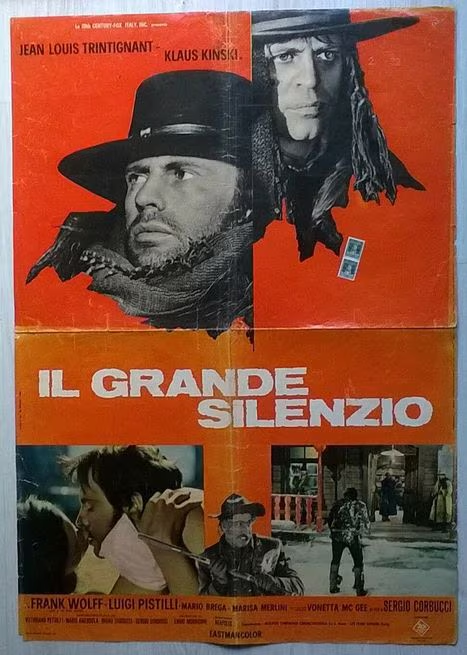
Theatrical poster.Morricone around the time of composing the score to SergioCorbucci’s “IlGrandeSilenzio.”Director SergioCorbucci on location
The Album:
Dagored’s 2016 double-coloured vinyl pressing of Morricone’s 1968 score (one of my all-time favourite Morricones) to SergioCorbucci’s great Spaghetti Western, “IlGrandeSilenzio,” represents the “the first re-issue ever” and is limited to 500 copies.
Album sticker
From the album sticker:
“The legendary soundtrack composed by the Maestro ENNIOMORRICONE for ILGRANDESILENZIO, directed in 1968 by SERGIOCORBUCCI and staring JeanLouisTrintigant and KlausKinski.
Reverse album cover.
A melancholic, emotive score, deeply moving and cold as the snow covered landscape of the film, is considered one of the best “western” work by Morricone since the collaboration with SergioLeone.
Side A.
FIRST VINYL REISSUE EVER LIMITED EDITION OF 500 COPIES DOUBLE COLORED VINYL
Original Italian 1968 pressing.Reverse album cover.1978 Italian re-issue (blue).Reverse album cover.Alternate 1978 Italian re-issue (black).Reverse album cover.Alternate 1978 Italian re-issue.Reverse album cover.Soundcloud thumbnail.
The Film:
IMDb movie data.Jean-Louis Trintignant, beloved giant of European New Wave cinema, as “Silenzio” (Silence).
From A.O. Scott’s 2018 NY Times review:
“I’m not generally one for nostalgia, but I do regret the loss of a certain kind of craziness that used to flourish in movies — the kind that is on rich and ripe display in “The Great Silence,” a 1968 Italian western by Sergio Corbucci that is only now receiving a proper theatrical release in this country.
The cast of “Il Grande Silenzio” in a lighter moment on set.
There is something about the film’s brazen mixing of incompatible elements that defies categorization, imitation or even sober critical assessment. It’s anarchic and rigorous, sophisticated and goofy, heartfelt and cynical. The score, by EnnioMorricone, is as mellow as wine. The action is raw, nasty and blood-soaked. The story is preposterous, the politics sincere.
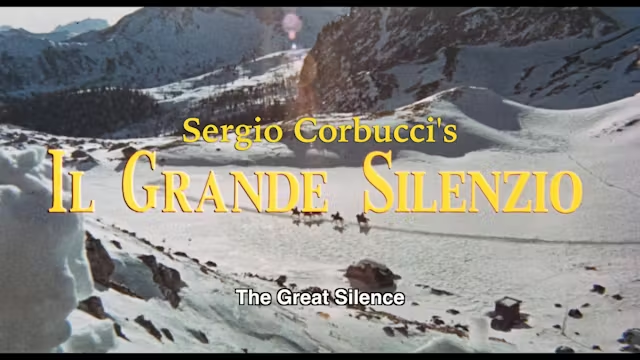
Title shot.
In 2018, it’s possible — and perhaps inevitable — to view “The Great Silence” as a footnote to the oeuvre of Quentin Tarantino, whose admiration for Corbucci is well documented. Corbucci’s 1966 western “Django” was an inspiration for Mr. Tarantino’s “Django Unchained,” and “The Hateful Eight” shares a snowbound aesthetic and a gleeful commitment to cruelty with “The Great Silence.” The scholarly minded viewer can trace other connections and divergences as well — to classic American westerns and to the contemporaneous and better-known work of the spaghetti maestro SergioLeone.
The great Jean-Louis Trintignant rides into town.
But this plate of pasta — bitter and pungent, nourishing and perhaps a bit nauseating — should be savored on its own. It takes place at the end of the 19th century in “Snow Hill, Utah,” a place name that sounds infinitely more exotic in Italian. There, farmers have been driven off their land and forced into banditry, leaving them at the mercy of bounty killers, the most fearsome and sadistic of whom is played by Klaus Kinski.
Klaus Kinski, legendary madman of WernerHerzog classics like “Fitzcaraldo.”
His character — referred to as Tigrero aloud and Loco in the subtitles — is a whispering sociopath and a symbol of the Darwinian brutality that governs Snow Hill. The actual governor wants to bring the area under the rule of law, and dispatches a bumbling, decent sheriff (Frank Wolff) to bring Tigrero and the rest of the bounty killers into line. The lawman’s earnest efforts are a sideshow to the main drama, though, which pits Tigrero and his minions against a solitary avenger known as Silenzio.
Played by the great Jean-Louis Trintignant, Silenzio is a tragic, poetic variation on Clint Eastwood’s taciturn Man With No Name. Silenzio is not a man of few words, but a survivor of horrific violence. When he was a child, the bounty hunters who murdered his parents severed his vocal cords to keep him from talking. He has grown up into Tigrero’s double and opposite, meting out justice for money and following a strict code of ethics. He will never draw his gun first, but he will always shoot faster than his adversary.
Silenzio packs heat.Kinski fires his pistol (and remembers to keep his ears warm at all times).
Silenzio’s services are solicited by Pauline (Vonetta McGee), the widow of one of Tigrero’s victims. The fact that she and her husband are black is at once a casual detail and a sign of the film’s anti-authoritarian, democratic ideology. The couple seems to have been welcomed by the other good people of Snow Hill, but their race is a big issue for the bad guys.
VonettaMcGee as Pauline.
The plot takes a twist or two, but serves mainly as a thread linking shootouts and glowering confrontations, with a brief respite for love. The mood is sometimes jaunty, but “The Great Silence” is no joke, and the fatalism of its ending serves as an implicit critique of the sentimental optimism of many Hollywood westerns. Power speaks louder than silence.”
Album cover art.
Perhaps the greatest influence “Il Grande Silenzio“” has had on contemporary cinema is on display in the snowy landscapes of die-hard Corbucci & Morricone fan QuentinTarantino’s 2nd western, “The Hateful 8,” which also features (an Oscar-winning) score by Maestro Morricone.
Alternate poster.Still from “the 8th film by QuentinTarantino.”UK theatrical poster.
Tarantino’s 1st western, 2012’s “DjangoUnchained,” was likewise inspired by another Corbucci Spaghetti Western, the one for which he is probably most famous, “Django,” released two years previously (1966).
Corbucci ‘s best known work, “Django” released two years before “IlGrandeSilenzio.”Original “Django” (1966) poster, and the film itself, are obvious influences on……the original poster (and film) for Robert Rodriguez’ ‘s take on the Spaghetti Western, “Desperado” (1995).Tarantino’s Django, JamieFoxx, with Corbucci’s original Django, Spaghetti Western icon, FrancoNero, in Tarantino’s 2012 ode to Corbucci’s picture.Title shot.Alternate poster.
Worthy of note in any discussion on “IlGrandeSilenzio” is the performance by American actor FrankWolff as the doomed sheriff first hired by the put-upon townspeople to go after Kinski and his fellow bounty hunters. Having worked extensively in the U.S. with the prince of independent cinema, RogerCorman, Wolff later distinguished himself in many Italian and European films that sprung forth as part of the boom of filmmaking in Rome (and other European cities) in the 1960’s and 70’s. Wolff was an extremely likeable character actor who met a very tragic end, “slashing” his own throat, allegedly over the unrequited love of a young woman, after being left by his wife for another man.
American actor and Italian cinema stalwart, Frank Wolff, who tragically committed suicide just 3 years after appearing as the doomed sheriff in “Il Grande Silenzio.”
From Wikipedia:
(Frank Wolff’s) Death:
Wolff committed suicide by cutting his throat in the bathroom of a residence in his Rome hotel room, a few steps from the Hilton hotel, at the age of 43 on December 12, 1971.[2] Long the victim of a deep depressive crisis, the actor was separated from his wife AliceCampbell, who lived like him in Rome. According to one hypothesis, Wolff would have injured himself for the first time with a razor blade. Having dropped the blade from his hand, the actor would have taken a second one, with which he would have cut the carotid artery. This second injury caused a cerebral anemia that led to his death in a short time.[3]
His body was found by a 24-year-old Austrian friend on the same day, and police said he had slashed his throat.[4] It was speculated that the unrequited love for the young woman might have contributed to Wolff’s fatal act, already suffering from a nervous breakdown for some time, after his wife had left him for another man.[3]
His final two Italian-made films, Milano Caliber 9 and When Women Lost Their Tails were released posthumously in 1972. His voice in the English-language version of Milano Caliber 9was dubbed in by his frequent co-star and roommate at the time of his death Michael Forest.
Additional Film Stills:
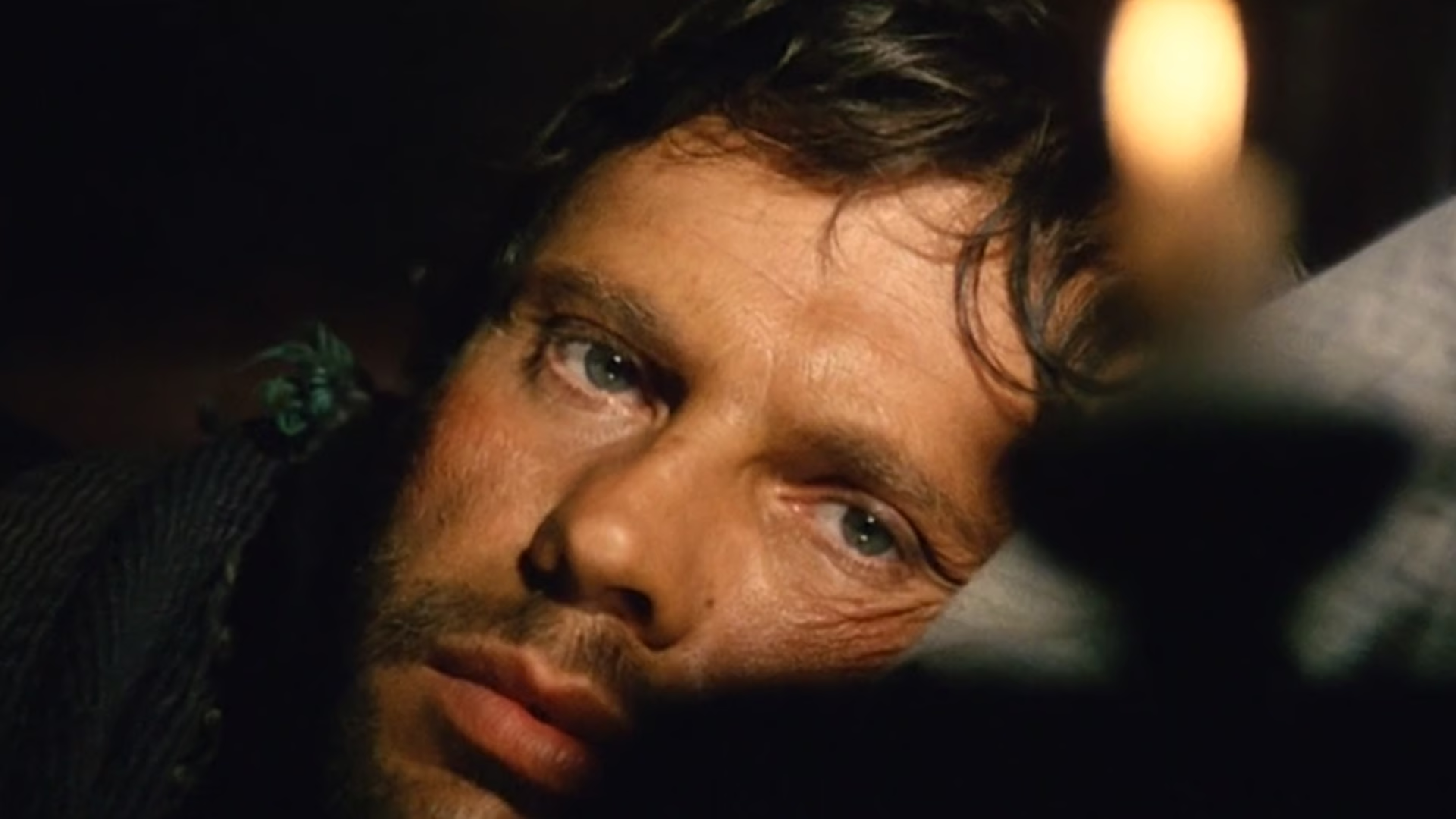
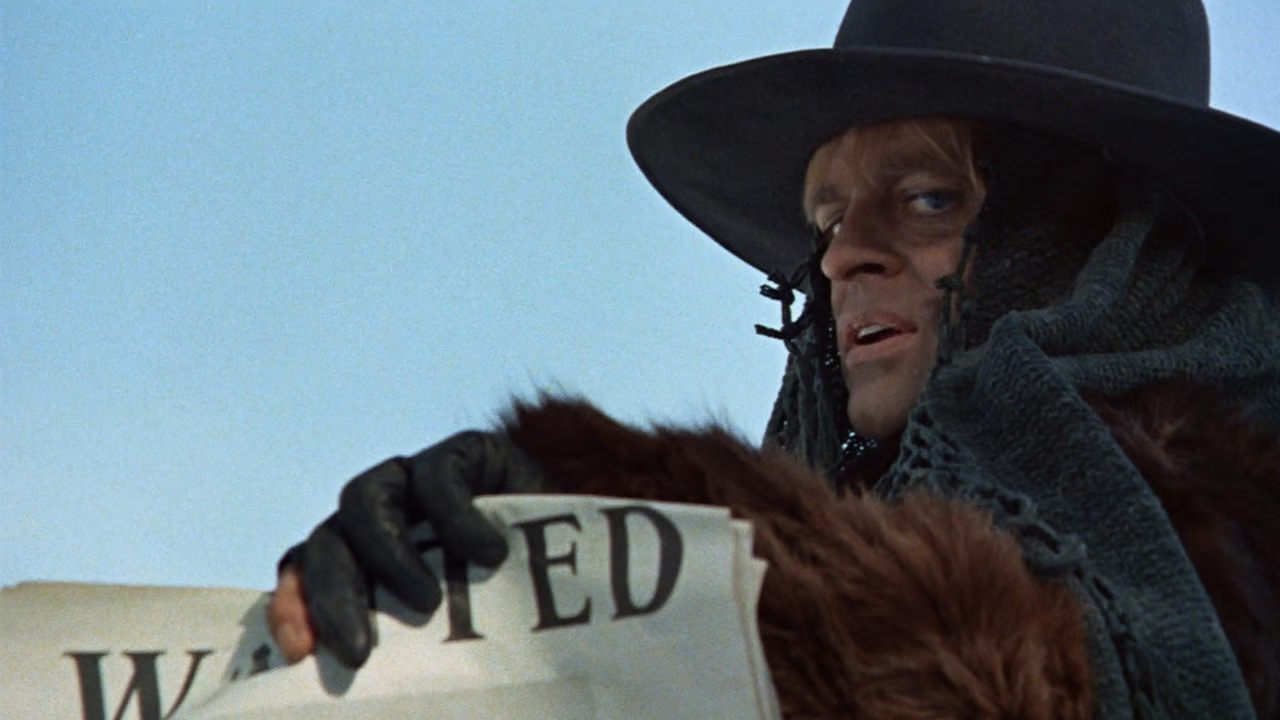
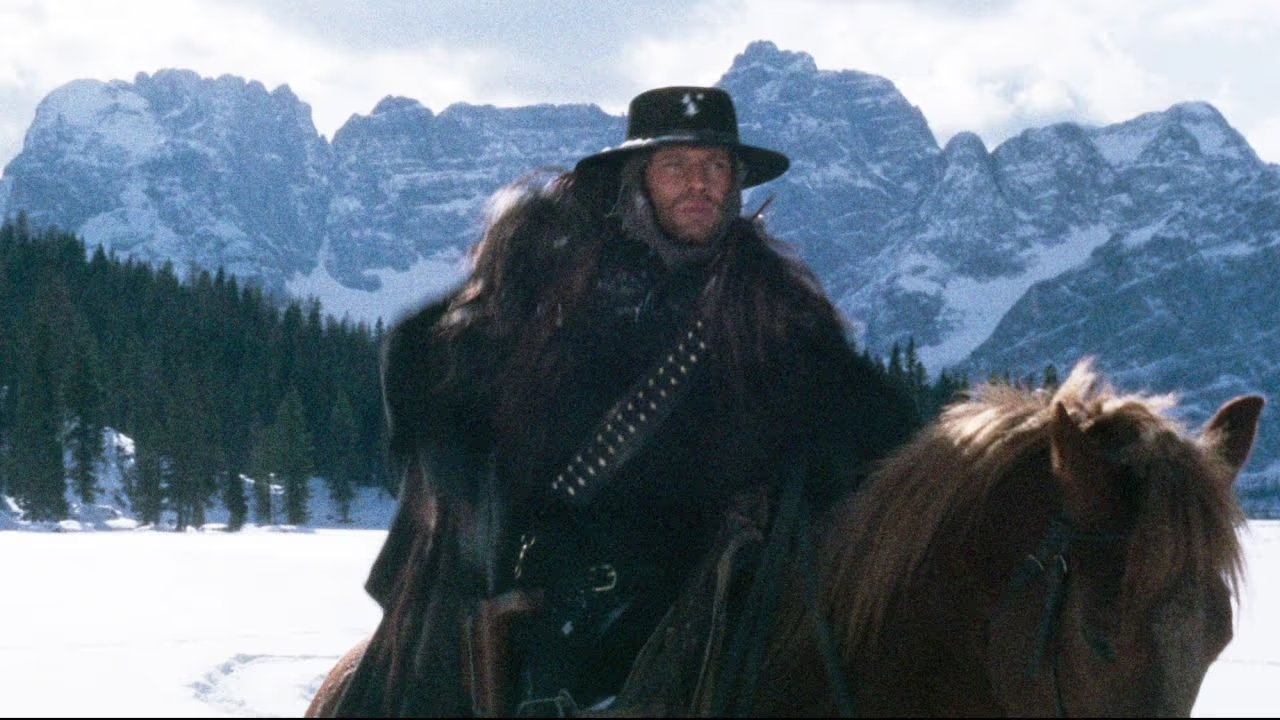
Scars and core wounds.A love story fraught with danger and trauma.Even in winter, the dead must be buried.Frosted windows and a grumpy Silenzio.Silenzio reflects in the glow of a solitary candle.Kinski with the bounty hunter’s greatest prop, the wanted poster.Trintignant rides the high country.Crosses in the snow: a recurring motif.Trintignant makes a grand entrance as “TheGreatSilence.”
The Director:
“Il Grande Silenzio” director Corbucci likes what he sees through the viewfinder.“The Great Silence,” Corbucci’s great achievement.Compilation album of 3 collaborations between Morricone and Corbucci.
Morricone is forever associated with the most famous of the “threeSergios” of Italian cinema, Leone, but equally great are the 7 soundtracks the Maestro scored for another Sergio, that being Mr. Corbucci, for whom Morricone composed the scores for “Compañeros,” “I Crudeli,” aka “The Hellbenders,” “Che C’entriamo Noi Con La Rivoluzione?“, “The Mercenary, ” “Navajo Joe,” “Sonny & Jed,” and of course, “Il Grande Silenzio.”
He is the older brother of screenwriter and film director Bruno Corbucci.[2]
Biography
Sergio Corbucci.
Early career
He started his career by directing mostly low-budget sword and sandal movies. Among his first spaghetti Westerns were the films Grand Canyon Massacre (1964), which he co-directed (under the pseudonym, Stanley Corbett) with Albert Band, as well as Minnesota Clay (1964), his first solo directed spaghetti Western. Corbucci’s first commercial success was with the cult spaghetti Western Django, starring Franco Nero, the leading man in many of his movies.[3] He would later collaborate with Franco Neroon two other spaghetti Westerns, Il Mercenario or The Mercenary (a.k.a. A Professional Gun) (1968) — where Nero played Sergei Kowalski, a Polish mercenary and the film also starring Tony Musante, Jack Palance and Giovanna Ralli — as well as Compañeros (1970) a.k.a. Vamos a matar, Companeros, which also starred Tomas Milian and Jack Palance. The last film of the “Mexican Revolution” trilogy – The Mercenary and Compañeros being the first two in the installment – was What Am I Doing in the Middle of the Revolution? (1972).
Corbucci.
After Django, Corbucci made many other spaghetti Westerns, which made him the most successful Italian Western director after Sergio Leone and one of Italy’s most productive and prolific directors.[4] His most famous of these pictures was The Great Silence (Il Grande Silenzio), a dark and gruesome Western starring a mute action hero and a psychopathic bad guy.[5][6] The film was banned in some countries for its excessive display of violence.
Corbucci (r) on location with “Navajo Joe” star, Burt Reynolds.
Corbucci (r) with actor TomasMilian on set of “Compañeros.”
Corbucci’s Westerns were dark and brutal, with the characters portrayed as sadistic antiheroes. His films featured very high body counts and scenes of mutilation. Django especially is considered to have set a new level for violence in Westerns.[7]
In the 1970s and 1980s Corbucci mostly directed comedies, often starring Adriano Celentano. Many of these comedies were huge successes at the Italian box office and found wide distribution in European countries like Germany, France, Austria and Switzerland, but were barely released overseas.[8]
His movies were rarely taken seriously by contemporary critics[9][10] and he was considered an exploitation director, but Corbucci has managed to attain a cult reputation.[6][11]
His nephew Leonardo Corbucci[13] continues the legacy of film directors in the family in Los Angeles.
In 2021 was released a documentary about Corbucci, directed by Luca Rea, Django & Django, that relies to a considerable extent on an interview with Quentin Tarantino.[14]
In 2022 German thrash metal band Kreator released the instrumental song “Sergio Corbucci is Dead” as an intro to their album Hate Über Alles. According to vocalist/guitarist Mille Petrozza, “Sergio Corbucci was someone who was very anti-authoritarian in his film. In all his films he has a protagonist who rebels against the authorities. Often these characters are very obscure. I was wondering if there are still people like that who make really political films without trying to preach anything to you. It’s a bit of a dig at the bands who don’t speak their minds out of fear of losing fans.”[15]
50th anniversary restoration poster.German lobby card.20th Century Fox international poster.Japanese posterItalian DVD cover art.German theatrical poster.French theatrical poster.Alternate poster.Alternate poster.Danish theatrical poster.British DVD cover art.
If in the Toronto area, say hi to my Filmography podcast co-host Bjorn, and find a copy of “The Great Silence” on DVD or blu-ray at Toronto’s “last great video store,” BayStreetVideo, in store or online at baystreetvideo.com:
Theatrical Poster Art.A young EnnioMorricone around the time he composed the score for “NavajoJoe.”
Though it was released under the pseudonym LeoNichols, the score to SergioCorbucci’s 1966 Spaghetti Western, “NavajoJoe” is unmistakably the work of the Maestro. Despite a screenplay co-written by FernandoDiLeo (“Calibro9“) “NavajoJoe” is certainly not Corbucci’s best film (that would be “IlGrandeSilenzio“), but the music for which it was composed should be counted amongst Morricone’s greatest contributions to the genre.
“NavajoJoe” director SergioCorbucci on location“Navajo Joe” synopsis from MGM’s North American DVD release.
“A band of outlaws, headed by a sullen leader named Duncan, sweeps across the country like the plague, destroying everything in its path, including an Indian village. The outlaws arrive in the town of Esperanza, where they are hired by a crooked doctor to hijack a bank train and share in the wealth. But the sole survivor from the Indian village, a renegade Navajo named Joe (BurtReynolds), fells the plan by relocating the money. An irate Duncan holds an innocent Indian girl hostage until Joe surrenders; the brave citizens of Esperanza, under siege by the bandits, risk their lives to free Joe, who is their only hope of surviving. Joe once again takes on Duncan and his ruthless comrades with unforgettable vengeance.”
James Southall’s review of Morricone’s “NavajoJoe” album:
“SergioLeone’s masterpieces with ClintEastwood were just beginning to make their mark on America when Navajo Joe came along, attempting to do a similar kind of thing but in an even grittier way; a different Sergio was in the director’s chair (Corbucci, who had made the seminal Django), and BurtReynolds was in place of Eastwood. One constant was the composer – of course, EnnioMorricone, whose work in this genre I would rank as the most extraordinarily creative and brilliant film music there has been.
Album Cover with Morricone given proper credit on AppleMusic.
The main title theme for Navajo Joe is a hoot, unexpected even from this most unpredictable of film composers – it begins with a woman’s screech, a primal and startling sound, before a choir sings the name of the character and occasionally utters some words of wisdom about him (eg: ‘Never so bold!’) – a memorable, striking, vintage piece of Morricone, famously used in AlexanderPayne’s ‘Election‘ over thirty years later. And there aren’t many film scores which become ingrained in popular culture because two entirely separate pieces from them cropped up in entirely different films decades later, but as well as the main title in Election, QuentinTarantino used ‘ASilhouetteofDoom‘ in ‘Kill Bill‘ – it’s a driving, suspenseful piece for the villains of the story, built around a five-note motif hammered at the low end of a piano which forms a key building block of the score as a whole.
Election soundtrack.Kill Bill vol. 2 soundtrack.NOT JoshBrolin, but BurtReynolds as “NavajoJoe.”
Those two pieces dominate, cropping up in countless variations over the 45-minute score, but always given fresh impetus with each new appearance thanks to the composer’s ingenious knack for building up whole scores sometimes from relatively small (in terms of volume) ideas. It also helps that there are one or two other set-pieces along the way – the inevitable saloon music, ‘ThePeyoteSaloon‘, with the piano and banjos, the wonderfully outlandish ‘ButJoeSayNo‘, the two ‘NavajoHarmonica‘ source cues and the breathtakingly beautiful ‘TheDemiseofFatherRattigan.’
Reynolds with NicolettaMachiavelli in “NavajoJoe.”
A kind of legend has built up about this score over the years due to numerous factors – no doubt the fact that it is such good music is the key one, and the use in other films has also helped, the fact that Morricone wrote the score (somewhat mysteriously) under the pseudonym LeoNichols (and the possibly apocryphal story that BurtReynolds was furious that the producers were too cheap to hire Morricone so got this Nichols fellow instead) but its peculiar release history also plays a part, with various LPs being issued through the 1960s and 70s which were all unsatisfactory for one reason or another, and the only CD release (in the mid-1990s) suffering from very poor sound. Now Film Score Monthly has put out the definitive release, of the whole score, plus 10 minutes of bonus tracks, in easily the best sound yet (though it is still certainly not problem-free). Even by their standards the liner notes are good, with a short essay by JohnBender, track-by-track analysis from LukasKendall and JimWynorski and a brief note from the latter about his history with the score. Top-notch.”
http://www.movie-wave.net/titles/navajo_joe.html
The Corbucci smile.Young Ennio at the keys
Corbucci would also engage Morricione to score his next film, “TheHellbenders” (aka “ICrudeli“), as well as “TheGreatSilence” (aka “IlGrandeSilenzio“), “TheMercenary,” “Companeros,” and “Sonny&Jed.”
Original Theatrical Poster.Tarantino’s fake Rick Dalton poster.
Above, the original “NavajoJoe” theatrical poster served as inspiration for the fictional “ComancheUprising” poster featuring LeonardoDiCaprio’s Rick Dalton in QuentinTarantino’s “OnceUponaTime… InHollywood.”
United Artists’ poster for North American Theatrical Release.Alternate Theatrical Poster.Spanish Poster Art for “NavajoJoe.”DVD cover art for MGM’s North American release of “NavajoJoe.”Thumbnail from YouTube.Danish VHS cover art for “NavajoJoe.”
Links:
Find a copy of the vinyl for “NavajoJoe” on Discogs here:
Watch the train robbery sequence from “NavajoJoe” here:
Train Robbery Scene on YouTube.
Watch Quentin Tarantino talk about the fictional meeting between Sergio Corbucci and his “Once Upon a Time… In Hollywood” protagonist, Rick Dalton, here:
If you are in the Toronto area, say hi to my Filmography podcast co-host, Bjorn, and find a copy of “NavajoJoe” at “the last great video store” BayStreetVideo here:
www.baystreetvideo.comToronto’s last great video store, located on Bay Street, just south of Bloor.
Outside of Toronto, purchase a blu-ray of “NavajoJoe” on Amazon here: