The MaestroNothing says “giallo” quite like the ubiquitous yellow label of J&B.
Aka The Fifth Cord, Giornata Nera Per L’ariete stars this site’s favourite Italian leading man, Franco Nero, as a reporter caught in a game of cat and mouse with a serial killer, and the score sits alongside other classic giallo compositions from The Maestro, such as What Have They Done To Solange and his Dario Argento Animal Trilogy (The Bird With The Crystal Plumage; Cat O’ Nine Tails; Four Flies On Grey Velvet).
This is Morricone at his creepy, dissonant best. The music unnerves you slowly and completely. Accompanied by the visuals directed by LuigiBazzoni (The Possessed) and lensed by master of colour and light Vittorio Storaro (Apocalypse Now), Morricone‘s score primes you for unbearable suspense.
Italian director Damiano Damiani (A Bullet for the General) reunites with this site’s favourite Italian movie star, Franco Nero (Django) a year after their collaboration on Confessions of a Police Captain(1971), for the story of “an architect jailed for a traffic violation discovers the grim reality of life behind bars, including corrupt staff and inmates, an inhuman judicial system, and the power of the Mafia.” (Courtesy of IMDB.)
How to Kill a Judge poster,
Director and star would continue working together two years later on 1974’s excellent crime drama, How to Kill a Judge.
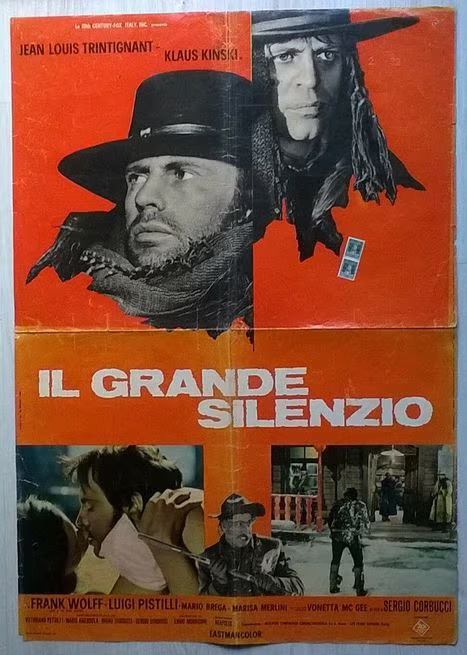
Theatrical poster.Morricone around the time of composing the score to SergioCorbucci’s “IlGrandeSilenzio.”Director SergioCorbucci on location
The Album:
Dagored’s 2016 double-coloured vinyl pressing of Morricone’s 1968 score (one of my all-time favourite Morricones) to SergioCorbucci’s great Spaghetti Western, “IlGrandeSilenzio,” represents the “the first re-issue ever” and is limited to 500 copies.
Album sticker
From the album sticker:
“The legendary soundtrack composed by the Maestro ENNIOMORRICONE for ILGRANDESILENZIO, directed in 1968 by SERGIOCORBUCCI and staring JeanLouisTrintigant and KlausKinski.
Reverse album cover.
A melancholic, emotive score, deeply moving and cold as the snow covered landscape of the film, is considered one of the best “western” work by Morricone since the collaboration with SergioLeone.
Side A.
FIRST VINYL REISSUE EVER LIMITED EDITION OF 500 COPIES DOUBLE COLORED VINYL
Original Italian 1968 pressing.Reverse album cover.1978 Italian re-issue (blue).Reverse album cover.Alternate 1978 Italian re-issue (black).Reverse album cover.Alternate 1978 Italian re-issue.Reverse album cover.Soundcloud thumbnail.
The Film:
IMDb movie data.Jean-Louis Trintignant, beloved giant of European New Wave cinema, as “Silenzio” (Silence).
From A.O. Scott’s 2018 NY Times review:
“I’m not generally one for nostalgia, but I do regret the loss of a certain kind of craziness that used to flourish in movies — the kind that is on rich and ripe display in “The Great Silence,” a 1968 Italian western by Sergio Corbucci that is only now receiving a proper theatrical release in this country.
The cast of “Il Grande Silenzio” in a lighter moment on set.
There is something about the film’s brazen mixing of incompatible elements that defies categorization, imitation or even sober critical assessment. It’s anarchic and rigorous, sophisticated and goofy, heartfelt and cynical. The score, by EnnioMorricone, is as mellow as wine. The action is raw, nasty and blood-soaked. The story is preposterous, the politics sincere.
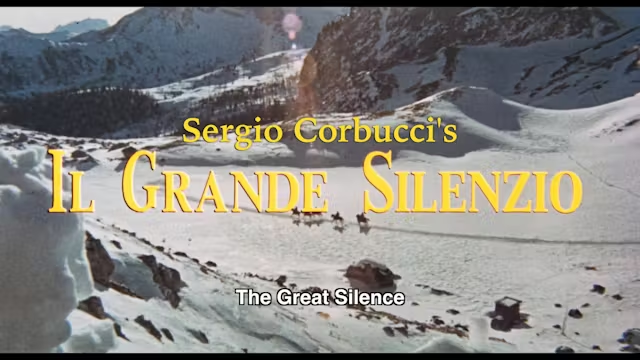
Title shot.
In 2018, it’s possible — and perhaps inevitable — to view “The Great Silence” as a footnote to the oeuvre of Quentin Tarantino, whose admiration for Corbucci is well documented. Corbucci’s 1966 western “Django” was an inspiration for Mr. Tarantino’s “Django Unchained,” and “The Hateful Eight” shares a snowbound aesthetic and a gleeful commitment to cruelty with “The Great Silence.” The scholarly minded viewer can trace other connections and divergences as well — to classic American westerns and to the contemporaneous and better-known work of the spaghetti maestro SergioLeone.
The great Jean-Louis Trintignant rides into town.
But this plate of pasta — bitter and pungent, nourishing and perhaps a bit nauseating — should be savored on its own. It takes place at the end of the 19th century in “Snow Hill, Utah,” a place name that sounds infinitely more exotic in Italian. There, farmers have been driven off their land and forced into banditry, leaving them at the mercy of bounty killers, the most fearsome and sadistic of whom is played by Klaus Kinski.
Klaus Kinski, legendary madman of WernerHerzog classics like “Fitzcaraldo.”
His character — referred to as Tigrero aloud and Loco in the subtitles — is a whispering sociopath and a symbol of the Darwinian brutality that governs Snow Hill. The actual governor wants to bring the area under the rule of law, and dispatches a bumbling, decent sheriff (Frank Wolff) to bring Tigrero and the rest of the bounty killers into line. The lawman’s earnest efforts are a sideshow to the main drama, though, which pits Tigrero and his minions against a solitary avenger known as Silenzio.
Played by the great Jean-Louis Trintignant, Silenzio is a tragic, poetic variation on Clint Eastwood’s taciturn Man With No Name. Silenzio is not a man of few words, but a survivor of horrific violence. When he was a child, the bounty hunters who murdered his parents severed his vocal cords to keep him from talking. He has grown up into Tigrero’s double and opposite, meting out justice for money and following a strict code of ethics. He will never draw his gun first, but he will always shoot faster than his adversary.
Silenzio packs heat.Kinski fires his pistol (and remembers to keep his ears warm at all times).
Silenzio’s services are solicited by Pauline (Vonetta McGee), the widow of one of Tigrero’s victims. The fact that she and her husband are black is at once a casual detail and a sign of the film’s anti-authoritarian, democratic ideology. The couple seems to have been welcomed by the other good people of Snow Hill, but their race is a big issue for the bad guys.
VonettaMcGee as Pauline.
The plot takes a twist or two, but serves mainly as a thread linking shootouts and glowering confrontations, with a brief respite for love. The mood is sometimes jaunty, but “The Great Silence” is no joke, and the fatalism of its ending serves as an implicit critique of the sentimental optimism of many Hollywood westerns. Power speaks louder than silence.”
Album cover art.
Perhaps the greatest influence “Il Grande Silenzio“” has had on contemporary cinema is on display in the snowy landscapes of die-hard Corbucci & Morricone fan QuentinTarantino’s 2nd western, “The Hateful 8,” which also features (an Oscar-winning) score by Maestro Morricone.
Alternate poster.Still from “the 8th film by QuentinTarantino.”UK theatrical poster.
Tarantino’s 1st western, 2012’s “DjangoUnchained,” was likewise inspired by another Corbucci Spaghetti Western, the one for which he is probably most famous, “Django,” released two years previously (1966).
Corbucci ‘s best known work, “Django” released two years before “IlGrandeSilenzio.”Original “Django” (1966) poster, and the film itself, are obvious influences on……the original poster (and film) for Robert Rodriguez’ ‘s take on the Spaghetti Western, “Desperado” (1995).Tarantino’s Django, JamieFoxx, with Corbucci’s original Django, Spaghetti Western icon, FrancoNero, in Tarantino’s 2012 ode to Corbucci’s picture.Title shot.Alternate poster.
Worthy of note in any discussion on “IlGrandeSilenzio” is the performance by American actor FrankWolff as the doomed sheriff first hired by the put-upon townspeople to go after Kinski and his fellow bounty hunters. Having worked extensively in the U.S. with the prince of independent cinema, RogerCorman, Wolff later distinguished himself in many Italian and European films that sprung forth as part of the boom of filmmaking in Rome (and other European cities) in the 1960’s and 70’s. Wolff was an extremely likeable character actor who met a very tragic end, “slashing” his own throat, allegedly over the unrequited love of a young woman, after being left by his wife for another man.
American actor and Italian cinema stalwart, Frank Wolff, who tragically committed suicide just 3 years after appearing as the doomed sheriff in “Il Grande Silenzio.”
From Wikipedia:
(Frank Wolff’s) Death:
Wolff committed suicide by cutting his throat in the bathroom of a residence in his Rome hotel room, a few steps from the Hilton hotel, at the age of 43 on December 12, 1971.[2] Long the victim of a deep depressive crisis, the actor was separated from his wife AliceCampbell, who lived like him in Rome. According to one hypothesis, Wolff would have injured himself for the first time with a razor blade. Having dropped the blade from his hand, the actor would have taken a second one, with which he would have cut the carotid artery. This second injury caused a cerebral anemia that led to his death in a short time.[3]
His body was found by a 24-year-old Austrian friend on the same day, and police said he had slashed his throat.[4] It was speculated that the unrequited love for the young woman might have contributed to Wolff’s fatal act, already suffering from a nervous breakdown for some time, after his wife had left him for another man.[3]
His final two Italian-made films, Milano Caliber 9 and When Women Lost Their Tails were released posthumously in 1972. His voice in the English-language version of Milano Caliber 9was dubbed in by his frequent co-star and roommate at the time of his death Michael Forest.
Additional Film Stills:
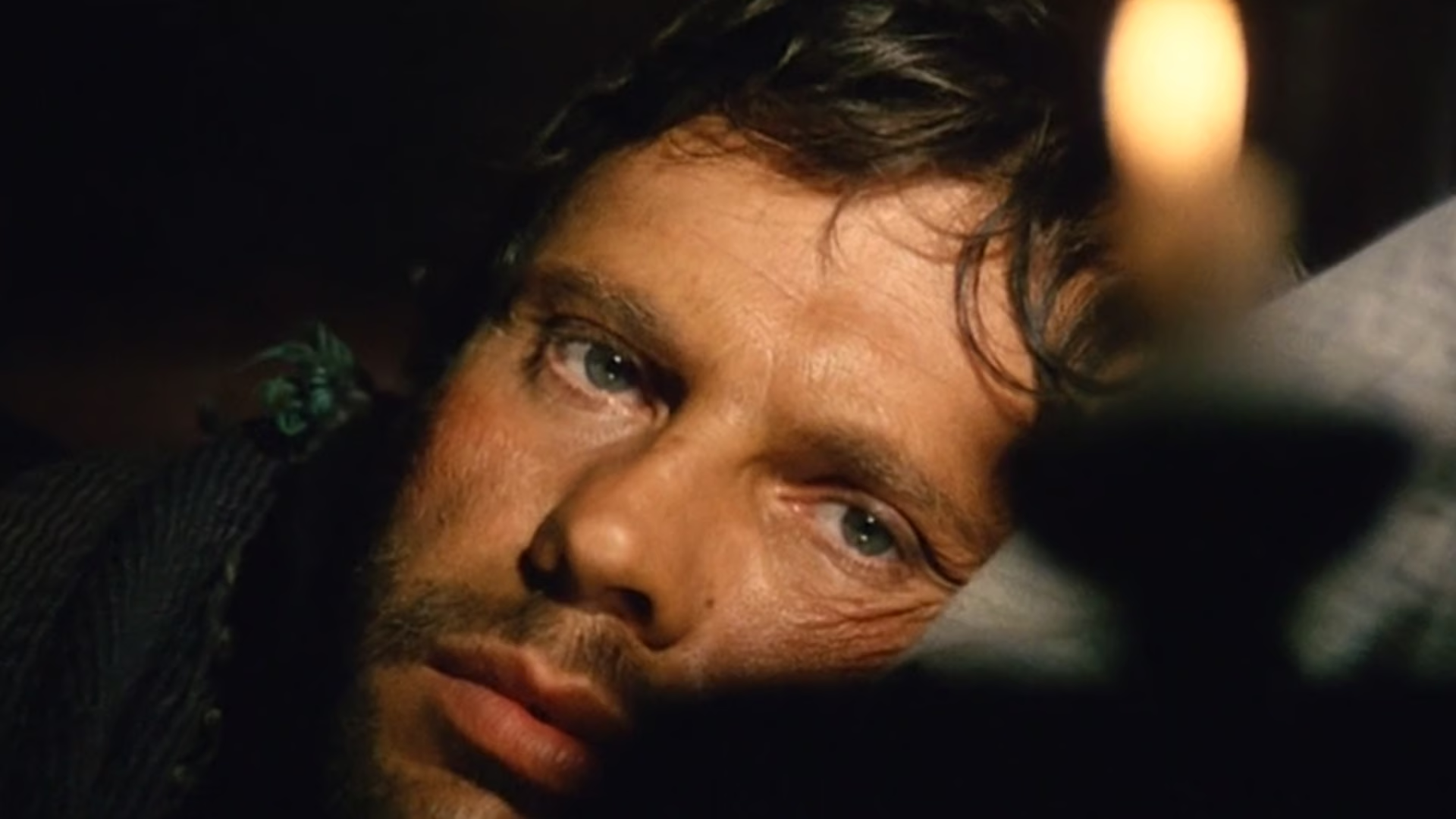
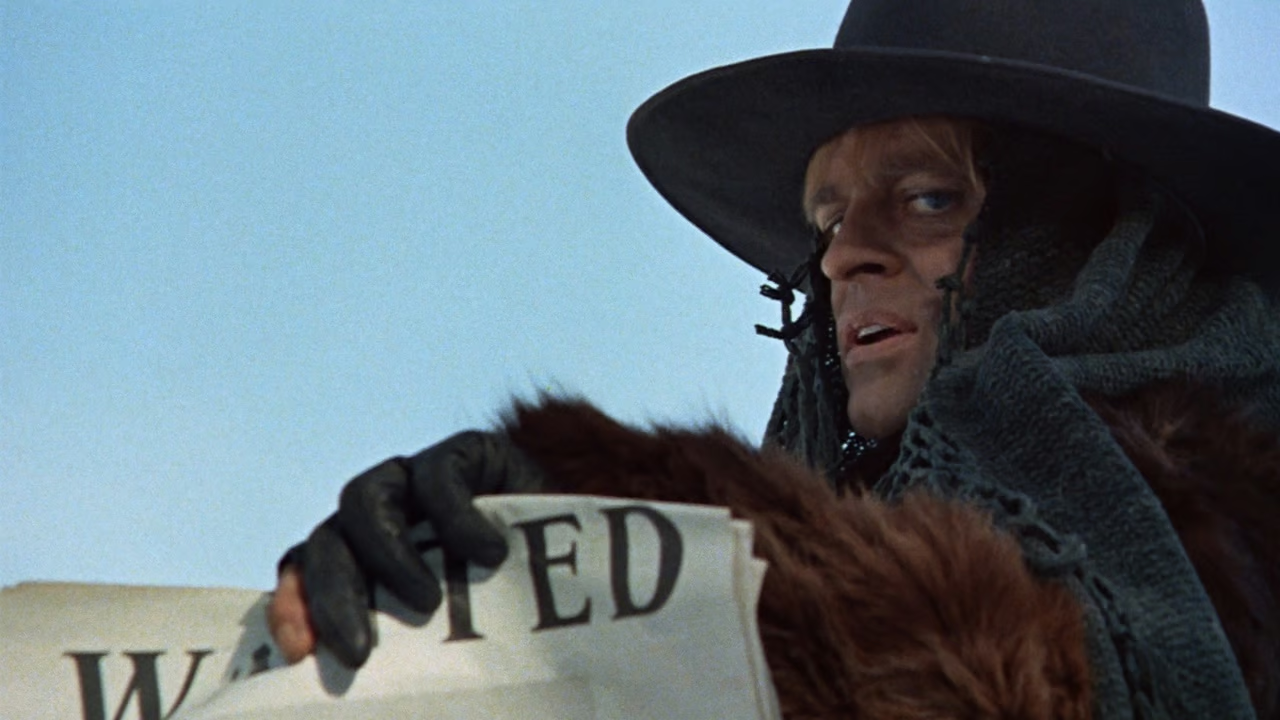
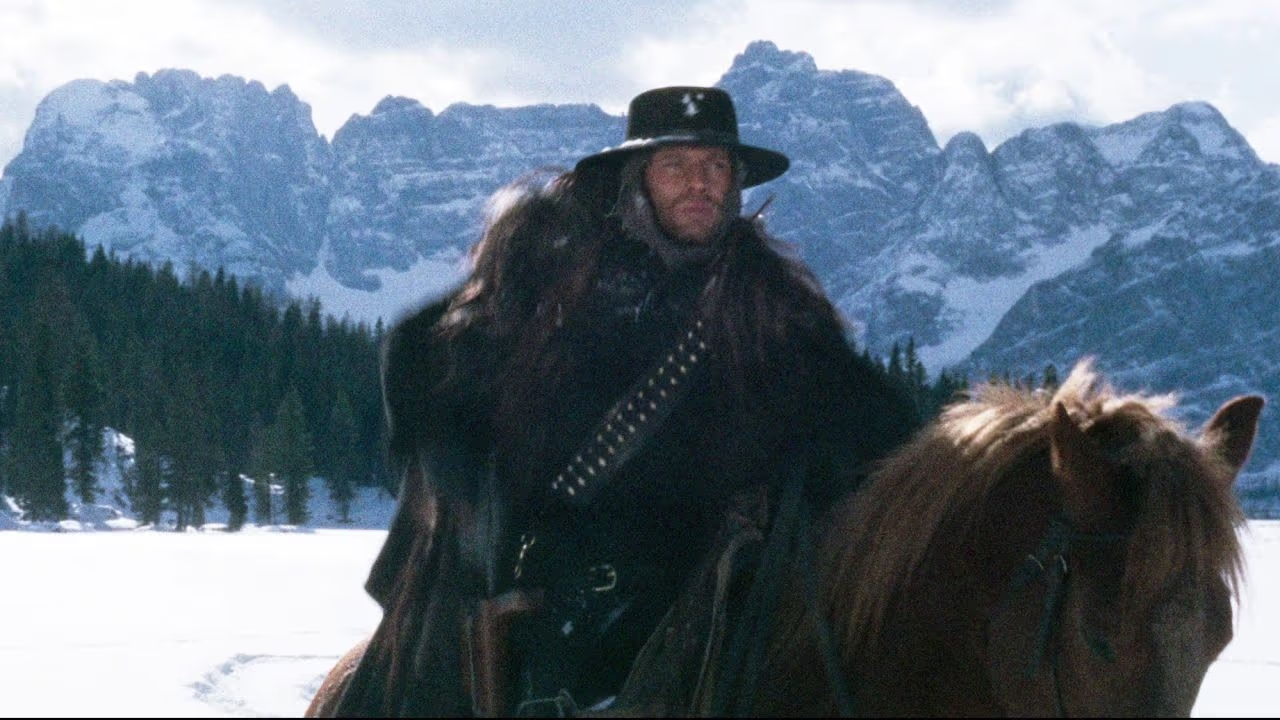
Scars and core wounds.A love story fraught with danger and trauma.Even in winter, the dead must be buried.Frosted windows and a grumpy Silenzio.Silenzio reflects in the glow of a solitary candle.Kinski with the bounty hunter’s greatest prop, the wanted poster.Trintignant rides the high country.Crosses in the snow: a recurring motif.Trintignant makes a grand entrance as “TheGreatSilence.”
The Director:
“Il Grande Silenzio” director Corbucci likes what he sees through the viewfinder.“The Great Silence,” Corbucci’s great achievement.Compilation album of 3 collaborations between Morricone and Corbucci.
Morricone is forever associated with the most famous of the “threeSergios” of Italian cinema, Leone, but equally great are the 7 soundtracks the Maestro scored for another Sergio, that being Mr. Corbucci, for whom Morricone composed the scores for “Compañeros,” “I Crudeli,” aka “The Hellbenders,” “Che C’entriamo Noi Con La Rivoluzione?“, “The Mercenary, ” “Navajo Joe,” “Sonny & Jed,” and of course, “Il Grande Silenzio.”
He is the older brother of screenwriter and film director Bruno Corbucci.[2]
Biography
Sergio Corbucci.
Early career
He started his career by directing mostly low-budget sword and sandal movies. Among his first spaghetti Westerns were the films Grand Canyon Massacre (1964), which he co-directed (under the pseudonym, Stanley Corbett) with Albert Band, as well as Minnesota Clay (1964), his first solo directed spaghetti Western. Corbucci’s first commercial success was with the cult spaghetti Western Django, starring Franco Nero, the leading man in many of his movies.[3] He would later collaborate with Franco Neroon two other spaghetti Westerns, Il Mercenario or The Mercenary (a.k.a. A Professional Gun) (1968) — where Nero played Sergei Kowalski, a Polish mercenary and the film also starring Tony Musante, Jack Palance and Giovanna Ralli — as well as Compañeros (1970) a.k.a. Vamos a matar, Companeros, which also starred Tomas Milian and Jack Palance. The last film of the “Mexican Revolution” trilogy – The Mercenary and Compañeros being the first two in the installment – was What Am I Doing in the Middle of the Revolution? (1972).
Corbucci.
After Django, Corbucci made many other spaghetti Westerns, which made him the most successful Italian Western director after Sergio Leone and one of Italy’s most productive and prolific directors.[4] His most famous of these pictures was The Great Silence (Il Grande Silenzio), a dark and gruesome Western starring a mute action hero and a psychopathic bad guy.[5][6] The film was banned in some countries for its excessive display of violence.
Corbucci (r) on location with “Navajo Joe” star, Burt Reynolds.
Corbucci (r) with actor TomasMilian on set of “Compañeros.”
Corbucci’s Westerns were dark and brutal, with the characters portrayed as sadistic antiheroes. His films featured very high body counts and scenes of mutilation. Django especially is considered to have set a new level for violence in Westerns.[7]
In the 1970s and 1980s Corbucci mostly directed comedies, often starring Adriano Celentano. Many of these comedies were huge successes at the Italian box office and found wide distribution in European countries like Germany, France, Austria and Switzerland, but were barely released overseas.[8]
His movies were rarely taken seriously by contemporary critics[9][10] and he was considered an exploitation director, but Corbucci has managed to attain a cult reputation.[6][11]
His nephew Leonardo Corbucci[13] continues the legacy of film directors in the family in Los Angeles.
In 2021 was released a documentary about Corbucci, directed by Luca Rea, Django & Django, that relies to a considerable extent on an interview with Quentin Tarantino.[14]
In 2022 German thrash metal band Kreator released the instrumental song “Sergio Corbucci is Dead” as an intro to their album Hate Über Alles. According to vocalist/guitarist Mille Petrozza, “Sergio Corbucci was someone who was very anti-authoritarian in his film. In all his films he has a protagonist who rebels against the authorities. Often these characters are very obscure. I was wondering if there are still people like that who make really political films without trying to preach anything to you. It’s a bit of a dig at the bands who don’t speak their minds out of fear of losing fans.”[15]
50th anniversary restoration poster.German lobby card.20th Century Fox international poster.Japanese posterItalian DVD cover art.German theatrical poster.French theatrical poster.Alternate poster.Alternate poster.Danish theatrical poster.British DVD cover art.
If in the Toronto area, say hi to my Filmography podcast co-host Bjorn, and find a copy of “The Great Silence” on DVD or blu-ray at Toronto’s “last great video store,” BayStreetVideo, in store or online at baystreetvideo.com:
Although CamSugar pressed a new LP in 2021, as the third in their “MorriconeSegretto” collection, I sourced the original 1982 vinyl from Discogs, primarily for the excellent cover art.
Italian theatrical poster.The Maestro in 1980, the year he composed the score for “The Blue-Eyed Bandit.“
Released in 1980, The Blue-Eyed Bandit (aka Il Bandito Dagli Occhi Azzurri) is an amusing Italian poliziottesco picture. Written and directed by Alfredo Giannetti, it stars Franco Nero and Dalila Di Lazzaro, and features Morricone’s jazziest score.
The Maestro’s screen credit 1.Screen credit 2.
The Album:
Cover-art for “The Blue-Eyed Bandit“
Side 1.
Side 2.
Reverse album cover.
Other Editions:
2013 Italian CD release.2021 CAMSUGAR release.Lato B.Inner-sleeve.Reverse inner-sleeve.Reverse album cover.
The Film:
From MUBI.com:
The male-pattern baldness bandit.
Franco Nero stars as a mild mannered, elderly bank clerk, who shuffles in and out of the bank everyday, unnoticed by his co-workers, or anyone else for that matter.
Franco Nero disguised as an old, balding, dark-eyed bank clerk.
But this is quickly revealed to be a facade. The balding hairline is a wig. The dark eyes, contact lenses. The shuffle, an affectation.
Some hairpiece.The bandit’s bald wig.His dark eyes……are contacts.
The disguise is in aid of Nero’sreal job, robbing banks as “The Blue-eyed Bandit” of the title.
Not Sean Connery in “The Untouchables.”
Complicating things at work is his attraction to (and attention from) his beautiful co-worker, played by DalilaDi Larraro, who also starred in the Morricone-scored “StarkSystem” the same year (co-starring GianMariaVolonte, star of many Morricone-scored films himself).
“StarkSystem” album cover art.
The Director:
Giannetti with the Oscar he won for his screenplay for “Divorce Italian Style.“Giannetti with Italian film icon, AnnaMagnani.