Categories
Morricone

The Morricone Collection: “Cosa Avete Fatto A Solange” (1972)

The complete score
Film poster
The Maestro
Screen credits
At The Movies pressing

From Quartet Records:

“Quartet Records, in collaboration with GDM and Universal Music Publishing Italia, presents a revised, remastered reissue of famous giallo score composed by Ennio Morricone in 1971 for COSA AVETE FATTO A SOLANGE?, directed by Massimo Dallamano and starring Fabio Testi, Joachim Fuchsberger, Cristina Galbó and Camille Keaton.

Album cover sticker

Morricone’s thriller scores remain some of his most distinctive and original works. As demonstrated in his scores for Dario Argento’s efforts in the genre, Morricone’s uncanny ability to combine lyricism, unbridled avant-garde experimentation and stylish elegance was his most significant contribution to the category. COSA AVETE FATTO A SOLANGE? shows Morricone once again embracing the sophisticated avant-garde sound while beginning his score with a haunting tune performed by Edda Dell’Orso heard over the film’s main titles. The lullaby-like theme has a timeless quality, providing a disturbing and disarming melody for the film.

Side A detail
Side A with inner sleeve

As with many of his giallos, and despite the success of the movie on its release, no album of Ennio Morricone’s score for COSA AVETE FATTO A SOLANGE? was released—not even a 45-rpm single with the main title. It was not until 1986 that the Intermezzo label in Italy released an LP with a selection of 14 cues personally chosen by the composer. This selection was released on CD in 1997, along with Morricone’s unreleased score for the 1974 thriller SPASMO. The first edition of the complete score was released in 2006 on the Digitmovies label. That edition sold out quickly.

Side B detail
Side B with inner sleeve

This new Quartet release has been completely remastered by Chris Malone from original master tapes, giving a new generation of avid collectors the chance to hear this score by the Roman maestro.

Reverse album cover

The Film:

Trailer
French film poster

From Wikipedia:

What Have You Done to Solange? (ItalianCosa avete fatto a Solange?) is a 1972 giallofilm directed by Massimo Dallamano and starring Fabio TestiKarin BaalJoachim FuchsbergerCristina Galbó, and Camille Keaton. The plot follows a series of violent murders occurring at a Catholic girls’ school in London, where a young student has gone missing.

The film is a co-production between Italian production companies Italian International Films S.r.l., Clodio Cinematografica and West German studio Rialto Film. It was released in Germany as Das Geheimnis der grünen Stecknadel (“The Clue of the New Pin“), where it was promoted an Edgar Wallace krimi film.[1]

While in a boat making out with her Italian college professor, Enrico Rosseni, Elizabeth Seccles witnesses a man with a knife stabbing another woman in the woods on the nearby shore. Rosseni convinces Elizabeth to keep silent about what she saw, especially after it turns out that the dead victim was one of her classmates and was killed by having a long knife pushed deep into her vagina. Another girl, a student at the same college, is killed later by the same attacker.

Shortly afterwards, Elizabeth is murdered in her bathroom. Police suspect Rosseni, who admits his affair to his sexually repressed wife Herta in hopes of getting her assistance in order to clear his name. Rosseni is cleared when a common denominator is determined by the later killings. The victims all had seen a local priest and were friends with a young woman named Solange, who began attending the school the previous semester but had mysteriously vanished.

Rosseni’s investigation ultimately leads to the existence of a hedonistic secret club of college girls that Elizabeth and the other murder victims had belonged to. The police further learn that the priest that several of the victims had spoken to was not a real priest, but was instead Solange’s father Professor Bascombe, a wealthy tenured teacher at the same school.

Ruth Holden (aka “Tata”) is the elderly maid of Brenda, one of Solange’s classmates who was also involved in the sex parties. Ruth is found alongside her dog, viciously murdered by having a sickle rammed into her vagina. Rosseni, Herta, and the police confront the father, who at first denies any wrongdoing until his daughter Solange appears. Mute and appearing emotionally disturbed, she leads Herta to the place where the final sex club member was kidnapped.

Bascombe then confesses to why he murdered his victims. His daughter Solange had befriended the members of the sex club and was granted membership. However, after her first orgy, she became pregnant. The other girls insisted Solange take care of the situation by meeting with Ruth Holden, who also functions as a back-alley abortionist. This event traumatized Solange physically, mentally and emotionally. She is henceforth in a very dull mental state where she functions as a baby would, is no longer able to speak and unable to become pregnant.

After confessing to the murders, Bascombe then takes his own life by shooting himself at his desk. At some point, he realized that an abortion was what led to Solange becoming an invalid and symbolically performed a similar deed on the girls once they’d given him details of what trauma really befell Solange.


Cast

edit

What Have You Done to Solange?was an Italian and West German co-production, and credits itself as being based on The Clue of the New Pin by Edgar Wallace.[1][2]The film bears very little relationship to the novel, with authors and film historians Kim Newman and Michael Mackenzie believing that it was marketed this way to sell the film to a German audience as part of the krimi film genre.[2] The relationship to the genre is enhanced by the appearance of cast members Joachim Fuchsberger and Karin Baal who appeared in several Edgar Wallace adaptations produced by Rialto Film in the 1960s.[3] American actress Camille Keaton was cast in the film—her debut role—as Solange. Keaton had originally sent in photos for a casting call for a Franco Zeffirelli film. She was not cast in his film, but received a call from director Massimo Dallamanolater to invite her in for the role. Keaton described working with Dallamano as challenging as she was only learning to speak Italian and he spoke very little English. For her role, Dallamano told her that she was looking for someone who looked frail and ordered her not to tan while filming.[4]

What Have You Done to Solange?was released in both Italy and West Germany on March 9, 1972.[1][5] Fulvio Lucisano stated that the film was the first giallo film to be shown at the Adriano Theaterin Rome, which normally did not show films of the genre.[6] The film was one of the highest grossing gialli in the 1971-1972 season, grossing 846 million Italian lire.[7]

In West Germany, it was released under the title Das Geheimnis der grünen Stecknadel where it was distributed by Constantin.[1][8] The film has been released under various English-language titles, including The Secret of the Green PinThe School That Couldn’t Scream, and Who’s Next?. It is most commonly known under the title What Have You Done to Solange?.[9] In 2005, the Venice Film Festival had a day in honour of Fulvio Lucisano Day as part of its “Secret History of Italian Cinema” screenings, which included a screening of a restored version of What Have You Done to Solange?.[6]

What Have You Done to Solange?was first released on DVD by Shriek Show on July 30, 2002.[10]It was released by Arrow Video on Blu-ray and DVD in the United Kingdom on December 14, 2015 and in the United States on December 15, 2015.[11] Film Comment placed Arrow Video’s release of What Have You Done to Solange? at 15th on their list of top Blu-ray releases of 2015.[12]

In contemporary reviews, the German newspaper Hamburger Abendblatt found the film to be “too broad” but stated that quality acting from Karin Baal, Fabio Testi, Joachim Fuchsberger and Günther Stoll enhance the film.[13]Italian newspaper La Stampapraised the acting of Fabio TestiJoachim Fuchsberger and Karin Baal while stating the director developed the mystery in the story well.[14]

From retrospective reviews, Robert Firsching of AllMovie called the film a “first-rate thriller,” a “creepy mystery”, and noted “Massimo Dallamano’s direction is assured.”[15] Video Librarian stated that the film is “considered a classic of the Italian horror genre known as giallo” but “For all the characteristic sloppiness of the screenplay, this film remains unusual and surprising, with some well-directed murder scenes and startling imagery.” and it was “shamelessly salacious in its exploitation of girls as sexual objects and unsavory in that these minors are assaulted in a vicious, sadistic, and hateful manner” and that ultimately “the extreme violence against young women makes it hard to enjoy”.[16] Danny Shipka, author of a book on European exploitation films found the film to be “One of the most satisfying gialli of its day” and that it had “the right amount of sleaze and story to carry the audience through all the twists and turns with an emotionally satisfying ending.”[17] The review commented that Dallamano took a “serious approach to the subgenre, creating situations that will stay long after you’ve finished the film.”[17] The Herald proclimed the film as “a prime example of “giallo”” and that the film was “better than it sounds” and described it as an influence on Peter Strickand‘s film The Duke of Burgundy (2014).[18]


Aftermath and influence:

What Have You Done to Solange?is the first entry in a loosely linked series of film called the Schoolgirls in Peril trilogy, a series of films based on the sexual exploits of young girls and their reaction to the adults.[19] By 1974, audiences began to grow tired of the giallo genre and began having interest in other European genres such as the poliziotteschi, urban cop thrillers that were influenced by American films such as Dirty Harry(1971) and The French Connection (1971).[20]Dallamano’s next film in the Schoolgirls in Peril trilogy was What Have They Done to Your Daughters? (1974), a film with similar themes to What Have You Done to Solange?.[21] The final part of the series was Red Rings of Fear (1978). Dallamano is credited as a screenwriter on the film. He had intended to direct it, but died before the film began production.[22]

See Also:

https://en.wikipedia.org/wiki/List_of_Italian_films_of_1972

Sources:

edit

Reverse DVD cover

Remake?

https://deadline.com/2016/05/nicolas-winding-refn-remake-what-have-you-done-to-solange-giallo-cannes-1201760962/

From Wikipedia:

“Director Nicolas Winding Refnannounced in 2016 that he was seeking a director and screenwriter for a remake of What Have You Done to Solange?. The film will be produced by Refn’s Space Rocket Nation banner along with producer Fulvio Lucisano.[23]

Categories
Morricone

The Morricone Collection: “Revolver” (1973)

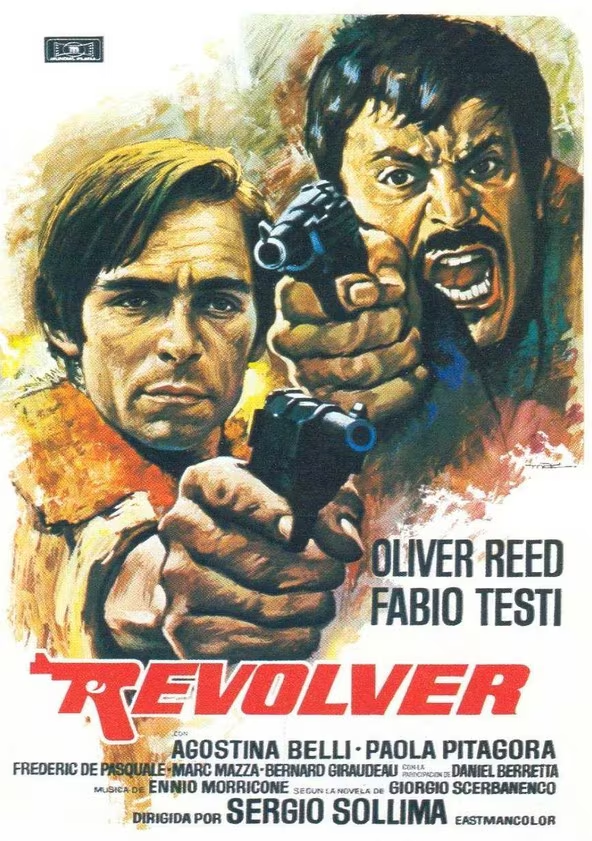
Spanish theatrical poster.
The Maestro around the time he composed the score for “Revolver.”
“Revolver” stars Oliver Reed, Fabio Testi, and their excellent coats.

The Album:

Not to be confused with Guy Ritchie’s film of the same name, most people will be familiar with Morricone’s excellent 1973 score for director Sergio Sollima’s poliziottescoRevolver” through the standout track “Un Amico,” which Quentin Tarantino repurposed for his 2009 WWII opus, Inglourious Basterds.

Morricone-super-fan, Quentin Tarantino.
Tarantino’s “sound of war.”

Other Editions:

Original 1973 Italian pressing.
1977 Japanese pressing.
1995 German CD release.
German CD back cover.
2006 Italian CD re-issue.

The Film:

Synopsis from MoMA’s Ennio Morricone Film Series:

Revolver” at the Moma.

Revolver. 1973. Italy/West Germany/France. Directed by Sergio Sollima. Screenplay by Dino Maiuri, Massimo De Rita, Sollima. With Oliver Reed, Fabio Testi, Agostina Belli, Paola Pitagora. In Italian; English subtitles. DCP. 111 min.

An Italian resistance fighter during World War II, Sergio Solima wrote and directed some of the most socially conscious Spaghetti Westerns The Big Gundown and political crime thrillers, or poliziotteschi, of the 1960s and ’70s. Revolver is a gripping example of the latter, the bitterly cynical story of a deputy prison warden (Oliver Reed) who becomes a pawn in a shadowy conspiracy when his wife is kidnapped by the mob and he’s forced to ally with a convict (Fabio Testi). The film boasts one of Ennio Morricone’s most propulsive scores, anticipating that of Brian De Palma’s The Untouchables. Quentin Tarantino, a giddy fan both of Solima and Morricone, quoted the beautiful “Un amico” for the climax of his Inglourious Basterds, the song that seems to capture a lover’s—or a criminal’s—inclination to hope against hope.”

Reed reaches out to touch someone.

Blu-ray review from cineoutsider.com:

Partners in crime

Oliver Reed is at his restrained best as a prison warden forced to facilitate a jailbreak in order to save his wife in REVOLVER, Sergio Sollima’s rivetingly handled 1973 crime drama. Slarek explores the film on Eureka’s new Blu-ray, and adds another favourite to an increasingly long list.

How’s this for a pre-title sequence? In the darkest of dark Italian nights, the sound of hurried footsteps and exhausted panting is revealed to belong to two men, one of whom is nursing a serious stomach wound and being helped along by his concerned companion. As they reach a row of parked cars, they pause and steal one of them, then speed off into the night to the sound of approaching sirens. As dawn breaks, the car stops at an isolated spot beside a river, and the driver helps his injured cohort out and onto the riverbank, where he bemoans the fact that he came all the way to Italy to be killed by a night watchman. Realising that his injury will soon prove fatal, the wounded man makes his companion promise not to let his body end up on an autopsy table at a morgue. Moments later, he dies, and the man that we by now know is a close and devoted friend mourns his loss with a farewell kiss. Then, as the opening titles unfold, he digs a hole by the riverside and buries his friend with the gun that probably led to his death. And so begins the 1973 Italian poliziotteschi Revolver, and I’m sure I’m not the only one who suspects an influence on the post-title scene of Reservoir Dogs.*If the above wasn’t enough to grab your attention – and it certainly did mine – then worry not, because the intrigue doesn’t stop there. In the next scene, wealthy oil magnate Harmakolos (Jean de Grave) walks out of his plush Parisian hotel and opts to walk instead of taking their car as suggested, dismisses his aide’s concerns about the recent threats to his life. He’s only a few hundred metres from the hotel when a motorcycle rider pulls up and shoots him dead. Elsewhere in the city, popular singer Al Niko (Daniel Beretta) is cheerfully batting away questions from the press about what his connection could be to this assassination as he arrives at police headquarters. Once inside the office on an unnamed Inspector (Marc Mazza), he is shown the wreck of a motorbike, which he recognises as one he bought a couple of years ago and gave to a former friend named Jean-Daniel Auger. It turns out that Jean-Daniel once worked for Harmakolos as his bodyguard and made threats against him after he was fired, and this was the bike ridden by his assassin. The vehicle and the mangled body of its rider were discovered on an unmanned level crossing in Jean-Daniel’s home town of Lyon, and a trip to the morgue sees Niko confirm that the body of the rider is indeed Jean-Daniel. To the Inspector’s coolly expressed relief, the Harmakolos case is thus officially closed.

Over in Italy, a well-dressed Frenchman (Frédéric de Pasquale) disembarks from his flight and is met outside the airport by two taciturn men in a black Mercedes – only later do we discover that the man has flown in from Paris, and that his name is Michel Granier. The purpose for his visit is not yet clear. Meanwhile, on a platform at the central Milan railway station, two Sicilians (Giovanni Pallavicino and Bernard Giraudeau) are approached and offered work by a dodgy-looking tout (Vittorio Pinelli). One of the men takes the tout’s card, looks briefly at it and hands it back. “No,” he says gruffly, “Got work.” Elsewhere in the same city, a woman visible only from the knees down takes off her shoes and steps onto the feet of a man, who begins walking down an apartment hallway, carrying her as he goes, as the two kiss and items of clothing fall to the floor. Eventually, these intimately entwined appendages are revealed to belong to Vito Cipriani (Oliver Reed) and his young wife Anna (Agostina Belli), who are clearly very much in love. We learn that Vito is a warden of the city’s prison when he is called into work the following morning in order to talk a crazed prisoner out of stabbing himself. When he arrives home with flowers of apology later, however, the apartment is empty and a phone call confirms that Anna has been kidnapped. If Vito wants to see her alive again, he’s assured, he must arrange the escape of an inmate named Milo Ruiz (Fabio Testi). It’s only when Vito asks to be taken to Milo’s cell that we discover he’s the man who buried his friend by the riverside in the opening sequence.

A lot of story threads are spun in these opening scenes, and while it is perfectly possible to draw a logical if speculative line of connection between them, not all is what it seems. Indeed, one of the many strengths of Revolver is its ability to continually surprise newcomers and catch them out. With that in mind, if you want to avoid having any of them spoilt even a little bit, then I’d skip the next paragraph, and eve n then proceed with a degree of caution, as it’s nigh on impossible to discuss the film in any more detail than I already have without giving a few things away. That said, I promise to keep the reveals to a minimum and avoid being explicit on later developments.

The first surprise comes when Vito follows a tip from Milo’s cellmate (Sal Borgese) and walks in on sleazy but wealthy criminal kingpin Grappa (Peter Berling). The expectation – my expectation –was that Grappa would get bolshy and the desperate Vito would lose his cool and smack the required information out of him. Instead, after a small bout of self-congratulatory verbal sparring, Grappa is fully cooperative and tells Vito what he knows without fuss, resistance or a hint of irritation, and Vito accepts that what he’s saying the truth and even offers him a small nod of appreciation. The second surprise comes when Vito returns to the jail and has Milo brought to his office, where he sets about viciously beating him about the face. On the surface this is an expression of his anger and frustration, but his actions are then revealed to have a secondary purpose, with the essentially superficial injuries inflicted on Milo providing a reason for him to be moved to the prison hospital, from where, Vito tells him, he will be able to affect his escape. This he does in a process that is lengthy enough to feel plausible, but Milo has only just hit the streets when a car screeches up beside him in a car and he’s ordered to get in at gunpoint by Vito. This gameplaying with expectations and genre convention sets the scene for a plot that rarely follows the predicted path. Thus, a colleague of Vito’s whose arrival looks set to expose his wrongdoing becomes an unexpected ally, a switch of fortune for both Vito and Milo is cancelled out by a surprise rebalancing of their relationship, and even the true reasons for Milo’s forced release prove to be more sinister than they initially seem.

That trademark Oliver Reed (nostril) flare.

The foundations are laid by a smartly constructed script by director Sollima, Arduino Maiuri and Massimo De Rita, and Sollima’s direction is tight, economic and purposeful, never flashy and always in service of the story and characters. Action scenes are rationed, but when they come they are blisteringly handled, their urgency enhanced by their sharp sense of realism, cinematographer Aldo Scavarda’s immaculate camera placement, and Sergio Montanari’s breathless editing. Adding a further layer of class is a typically fine score by Italian maestro Enno Morricone, one that hits all the right emotional buttons without overplaying them, and at one point feels like a trial run for the main theme of the composer’s score for The Untouchables (1987).

An amused Fabio Testi.

Even more crucial to audience engagement are the performances, the best of which comes from a top-of-form Oliver Reed, albeit with a small but curious caveat. As was often the way with Italian films of the period, particularly those with international casts, all of the dialogue was post-dubbed. And while there’s not a hint of mismatch between Reed’s on-screen delivery and his redubbing of his own voice, for reasons that no-one seems to be able to clarify, he elected to do the whole thing with an imperfect American accent. Given that his character name is Vito Cipriani and that he is a former police detective, we can assume that he is meant to be native Italian rather than Italian-American, and as all of the film’s dialogue was delivered in English with an eye on sales to the American market, for the life of me I can’t work out why he didn’t stick to his usual precise English delivery. The thing is, although this does initially feel a little odd, Reed is so bloody good in all other respects that after just a couple of minutes it ceases to matter. Everything else about his performance is sublime, peaking when he is visibly wrestling to keep his true feelings from exploding, and as so often with Reed, the potential for extreme violence can always be seen bubbling just beneath the surface. It’s a masterclass in restraint and emotional control, and up there with Reed’s very finest work on film. As Milo, Fabio Testi proves he’s more than just a handsome face, balancing the character’s cocky disposition with his increasing commitment to a cause he has been unwittingly recruited to help serve. Frédéric de Pasquale (who the two years previously played drug-smuggling TV personality Henri Devereaux in The French Connection) is appropriate unflustered as gangland middle-manager Michel Granier, and Paola Pitagora has a strong role as politically convicted people trafficker Carlotta. The supporting cast is also peppered with the sort of faces you only seem to find in European and East European cinema, providing the film with thugs who look and behave like the real deal, memorably when the Sicilians track down a potential witness and convincingly arrange his subsequent death to look like an accident.

I came to the cinema of Sergio Sollima via his superb 1967 western, Face to Face [Faccia a facia], and while Revolver is a very different work, it does share some of that film’s central themes. In both, two individuals with opposing moral values find themselves switching position over the course of the story, and like Face to FaceRevolver later moves into the area of political commentary, questioning the power structure of a system that protects the wealthy and is able to arrange the disposal of inconvenient elements of what it regards as the lower order. The result is a compellingly structured, impeccably directed, splendidly scored, and powerfully acted gem of Italian crime cinema, and one of the best films I’ve watched so far this year. It also pulls that rare trick of keeping you guessing right up to the final scene. Even the title is not what it initially seems, being a type of gun not used by the central protagonist, and likely instead intended to be read as a commentary on the transformative journey that Vito and his initially unwilling companion undertake over the course of the story.
sound and vision

Sourced from a new 4K restoration (that’s all the detail I have on this one), the 1080p transfer of Revolver on this Eureka Blu-ray is seriously impressive in all respects. Detail is very clearly defined, and the contrast is nicely balanced, nailing the black levels without crushing the shadows. The colour palette has a very slightly muted feel with a slight greenish hue, all of which look right for the film’s downbeat tone and very nicely captured by this transfer. The image is very clean, with no trace of dirt or damage, and a fine film grain is visible. Very nice.


Revolver was shot with the actors delivering their lines in English and their dialogue redubbed in post-production, and here you have the option to watch the film with either the English or Italian language tracks, both of which are Linear PCM 2.0 mono. The dynamic range is a little restricted on both – there are no deep bass thumps or rumbles here – and while voices seems to have slightly more breadth on the Italian track, they also sometimes have a more dubbed feel. Morricone’s music is of similar quality on both tracks, but differs during the opening titles, with the orchestral title theme of the English track turned into a song on the Italian track.


Optional English subtitles for the deaf and hearing impaired are available for the English language track, and a second set of optional English language subtitles kick in automatically if you select the Italian language track. Both seem fine, but there is a small omission here, at least on the review disc (it may be adjusted on the release disc). At one point, Vito reads a note written in Italian, and at another the Inspector looks down at a newspaper headline written in French. If you watch the film with the Italian soundtrack, the subtitles offer English translations of both. If you watch the film with the English language track, however, even with the hearing impaired subtitles enabled, no such translations are provided. Fortunately, it’s just a matter of switching between the subtitle tracks if your French or Italian are as weak as mine, and you don’t need to read either to understand what’s going on. It’s also worth noting (again, we’re talking review disc here) that there is no option on the menu to activate hearing impaired subs, but they can be switched on using the disc player’s remote control.


Special Features

Audio Commentary by Barry Forshaw and Kim Newman
Author of Italian Cinema: Arthouse to Exploitation, and a ton of others, joins author, critic and genre commentary favourite Kim Newman to explore a film that they were both impressed by and rate above the poliziotteschi norm. Individual scenes and plot turns are discussed, as is Ennio Morricone’s score, and the work on this film and others of director Sergio Sollima, particularly his 1970 Violent City [Città violenta] (for which there are spoilers). They opine that Fabio Testi was an actor with a limited range but what he could do he did well, and praise the rare depth and strength (at least for this genre) of the Carlotta character played by Paola Pitagora. But the lion’s share of the discussion is focussed on Oliver Reed, whose performance here both men rank as one of his best, and whose work on this and other key films in his career is covered in considerable detail. There’s a lot more discussed here, all of it compelling and acutely observed, and these two really know their Italian crime cinema.

Stephen Thrower on ‘Revolver’ (21:59)
Nightmare USA author Stephen Thrower examines the work of director Sergio Sollima, with particular focus on Revolver, though also covers the director’s segment in the multi-story L’amore difficile (1962), and his westerns The Big Gundown [La resa dei conti] (1966) and Face to Face [Faccia a facia] (1967). Like Forshaw and Newman above, he’s full of praise for the film, for Sollima’s skilled direction, and for Oliver Reed’s central performance. Like them, he’s also confused by the decision to have Reed play the whole thing with a not completely convincing American accent, but argues that the story and the acting are so good that you soon forget about it, a point on which I am in complete agreement.

Tough Girl (10:21)
Actor Paola Pitagora, who plays Carlotta, recalls working with Oliver Reed, who was an idol of hers but used to start drinking early on in the morning, which sometimes caused problems on set, though she does note that he was always top-notch on camera. She intriguingly describes Sergio Sollima as “a war machine,” as someone who was focussed and meticulous but also funny, and Fabio Testi as gorgeous, very enthusiastic, and focussed on his role. She praises the film scores of Ennio Morricone, though admits her admiration for the composer was soured a little by his claim that women all belonged in the kitchen, and has a revealing story about how Reed’s drinking ultimately cut short her role in the film. She also opines that for her, at least as an audience member, genre cinema begins and ends with Thomas Milian.

Action Man (17:07)
An archival interview with actor Fabio Testi, shot in June of 2006 and redressed with new opening titles and credits for this release, and the remastering of what looks like analogue video to HD. Testi looks back at how his work as a stuntman eventually led to him being cast – and doing all of the stunts – in Demofilo Fidani’s 1968 western, And Now… Make Your Peace with God [Ed ora… raccomanda l’anima a Dio!], and how this prompted him to enrol in acting school and embark on a successful career in films and theatre. He manages to top Paola Pitagora’s description of Sergio Sollima with his claim that “he works like a martial artist, every shot is like a sabre blow,” notes how Italian cinema lost its political edge after the arrival of commercial television and a slew of American imports, and remarks that it’s  nice that people remember him despite his age, which would have been 64 when this interview was shot. And he still looks damned good here. 

English Credits (6:23)
When you select to watch the English language version of the feature, the credits are in the original Italian, so the opening and closing credits of the English language version have been included as an extra.

Original Theatrical Trailer (3:40)
A trailer that really pushes the film’s crime thriller credentials, and employs a trick later favoured by American distributors to sell non-English language films to a potentially subtitle-averse audience by including no audible dialogue – characters speak, but all we hear is Morricone’s score and a few gunshots.

International Trailer (1:15)
Sold here under its original American title of Blood on the Streets, the US trailer sports a seriously toned but hyperbolic narration that includes the news that the film stars “Oliver Reed in a performance that makes Charles Bronson’s Death Wish look like…wishful thinking,” which I have no problem with at all.

Radio Spots (1:33)
Two radio spots pushing the American release, the second considerably longer than the first and both proclaiming that “This is a story of a day all the guns went off.” Er, not quite.
Also included with the release version is a Limited Edition Collector’s Bookletfeaturing two new essays by author Howard Hughes – one covering the background to the making of Revolver – and an extensive piece on Ennio Morricone’s ‘Eurocrime’ soundtracks, but this was not available for review.

Summary
A tightly directed and terrific poliziotteschi that is more thoughtful and restrained than the genre norm, and boasts an excellent performance by Oliver Reed, despite the enduring mystery of that American accent. As is noted in the commentary, it seems likely that the film was at the very least an unconscious influence on the likes of 48Hrs and Midnight Run, but it absolutely holds its own as a compellingly handled and impressively unpredictable crime thriller almost 50 years after it was made. Eureka’s Blu-ray spots a first-rate transfer and some fine special features, including an excellent commentary track. Highly recommended.

The Director:

Italian director Sergio Sollima.
Sollima’s screen credit.

Sergio Sollima (17 April 1921 – 1 July 2015) was an Italian film director and script writer.

A young Sollima.

Biography

Sollima graduated from the Centro Sperimentale di Cinematografia in 1935. During World War II he was in the Italian Resistance.[1]

Sollima (r) with his “Faccia a Faccia” stars Gian Maria Volonte (l) and Tomas Milian (c).

After the war, he gradually progressed from working as a film critic to screenwriting to becoming a director[2] Like many Italian cult directors, Sollima started his career as a screenwriter in the 1950s and wrote many peplum films in the 1960s. He made his directing debut doing one of the four sequences in the anthology film Of Wayward Love. Sollima filmed three Eurospy films and then moved to spaghetti westernsThe Big Gundown (starring Lee Van Cleef and Tomas Milian) was released in 1966 with big success, despite the fact that it had to compete with Sergio Leone‘s The Good, the Bad and the Ugly and Sergio Corbucci‘s Django. Sollima soon filmed two more westerns. Face to Face (Milian and Gian Maria Volonté) was released in 1967 and Run, Man, Run! (Milian) in 1968. Although Sollima directed only three westerns and they never reached the level of popularity as the ones by the other Sergios (Leone and Corbucci), each of them is highly regarded among genre enthusiasts.

In 1970, Sollima switched genres again and directed the Charles Bronson and Telly Savalas starred Violent City, which was one of the first violent and fast-paced Italian crime films often known as poliziotteschi. Like for all of his westerns, the soundtrack was provided by Ennio Morricone. Sollima’s last well-known film is Revolver, a poliziotteschi film starring Oliver Reed and Fabio Testi.

Sollima directed the six-part Italian TV series Sandokan starring Kabir Bedi with several feature films spun off the series.

Selected filmography

References

  1.  p. 93 Fisher, Austin Radical Frontiers in the Spaghetti Western: Politics, Violence and Popular Italian Cinema I.B.Tauris, 6 Feb 2014
  2.  Vivarelli, Nick (3 July 2015). “Sergio Sollima, Italian Director Best Known Internationally For Spaghetti Westerns, Dies at 94”Variety. Retrieved 6 April 2019.

Posters:

German poster. Also includes the alternate English title “Blood In The Streets.”
Nikos Bogris’ alternative poster.
Original Italian lobby card.

Links:

Purchase a copy of the vinyl at Discogs here:

“Revolver” on Discogs.

Watch the trailer from Eureka Classics here:

REVOLVER (Eureka Classics) New & Exclusive Trailer

If you’re in the Toronto area, stop in and say hi to my Filmography podcast co-host, at “the last great video store,” Bay Street Video, and find a copy of “Revolver” in store, or if outside of Toronto, online here:

https://baystreetvideo.com/title.php?page=1&title=Revolver

Watch the film for free here:

Revolver (1973) di Sergio Sollima (film completo ITA)

Purchase the film on Amazon here:

https://www.amazon.ca/Revolver-Oliver-Reed/dp/B000096IA3

Categories
Morricone

The Morricone Collection: “Faccia a Faccia” (1967)

Original Italian theatrical poster.
Morricone closes his eyes and hears a symphony (or so I imagine!).
Reverse album cover.
Morricone blows his horn.

Album write-up from elusivedisc.com:

“This is the soundtrack to Sergio Sollima’s Italian Spaghetti western film Faccia a Faccia (also known as Face To Face), starring Gian Maria Volonte, Tomas Milian and William Berger. Composed by the legendary Ennio Morricone, the 1967 movie’s music is a beautiful mix of typical epic ’60s Morricone western moods, experimental moments and even some sheer Country. The orchestra and chorus are directed by Bruno Nicolai, the famous Italian film music composer. His work is featured in Kiss KissBang Bang and Kill Bill Volume 2 amongst many other movies.”

Other Pressings:

“Faccia a Faccia” aka “Il Etais Une Fois Dans L’Arizona (“Once Upon A Time In Arizona”).

The Film:

Opening title card to Sergio Sollima‘s “Faccia a Faccia.”
The perpetually smoldering icon of ’70s international cinema, Gian Maria Volonte.

British cult-auteur Alex Cox is probably best known to movie lovers for his ‘80s classics “Repo Man,” and “Sid & Nancy,” but he is also one of the foremost authorities on all things Spaghetti Western, as evidenced by his excellent compendium on the genre, “10,000 Ways To Die,” in which he provides a wealth of information and insight into the film and its production.

British director (and Italian Western scholar), Alex Cox.
Alex Cox’s “director’s take on the Italian Western.”

Below is the transcript to Alex Cox’s Moviedrome introduction to Sergio Sollima’sFaccia a Faccia,” originally broadcast by the BBC on August 29th, 1993:

Cox introduces “Face To Face” aka “Faccia a Faccia” on BBC’s Moviedrome program.

Face to Face is one of three ‘political westerns’ by the Italian director Sergio Sollima, who sometimes operates under the pseudonym ‘Sterling Simon’. The other two were The Big Gundown, an excellent bounty-hunter movie starring Lee Van Cleef and Tomas Milian, and Run, Man, Run, a rather worse-than-mediocre sequel involving the further adventures of Milian. They were ‘political’ in much the same way as all the spaghetti westerns, setting up a rural/urban conflict in which the city dwellers are always insidious degenerates or usurous bankers, and the rural characters innocent exploitees, often championed by a glamorous social bandit. It’s a straight-forward, simple-minded view that you can find even in supposedly sophisticated Italian films, the most lumbering example perhaps being 1900.

Tomas Milian takes aim.

Face to Face has been described as a parable of the rise of European fascism. Well, maybe. It certainly has the political schematic outlined above, but to me it seems more of a Borgesian tale of fate and doppelgangers. You can take your pick. It also has, and this is where it gets good, some of the most improbable character names, and some of the most outlandish haircuts ever seen in a western. Gian Maria Volonte plays professor Brad Fletcher, a consumptive Boston University professor who heads west for his health. Volonte is, of course, one of the great spaghetti western actors – he was the bandit chief in A Fistful of Dollars and For a Few Dollars More; he was the unwilling revolutionary in A Bullet for the General. Volonte was a serious actor who had been blacklisted for being a Communist – Leone was the first director to break ranks and give him a job. Later he went on to appear in more ‘serious’ political films, including Sacco and Vanzetti, and Francesco Rosi’s Lucky Luciano. He’s always good, and this is one of his better western roles.

Pistol in the sand.

“In Face to Face, Brad Fletcher becomes involved with a Mexican bandit with the unlikely moniker of Solomon ‘Beauregard’ Bennet, leader of a hippie-esque outlaw gang called Bennet’s Raiders. Beauregard is played by Tomas Milian – the Cuban actor who appeared in Sollima’s other political westerns, and in many other spaghettis including the truly extraordinary Django Kill. Milian, like Volonte, is a ‘proper’ actor – he played the priest in Dennis Hopper’s Peruvian epic The Last Movie, and recently was seen as one of the anti-Castro hitmen in Oliver Stone’s JFK.

Preparing For Battle.

“The chemistry between Volonte and Milian is really interesting, and it keeps the film alive when it might otherwise expire – as, for instance, in the incongruous hippie commune scenes. There are also those haircuts to contend with. But Face to Face is really quite an entertaining and intriguing film. Watch out for several spaghetti western regulars, including William Berger as the mysterious Charlie Sirringo, Aldo Sambrel as the treacherous polecat Zachary Shot, and Angel del Pozo in the role of the gentleman gunfighter, Maximilian de Winton.”

Watch Alex Cox’s Moviedrome intro to “Faccia a Faccia” here:

BBC Moviedrome – Face To Face – Introduced by Alex Cox.

The Director:

Italian writer-director Sergio Sollima.
https://www.imdb.com/name/nm0813177/
Sollima’s Filmography Highlights.

Though he may not be the most famous or critically lauded of the “Three Sergios” (Leone and Corbucci would take gold and silver, respectively, in that contest), Italian filmmaker Sergio Solima was a prolific critic-turned-writer-director with 34 writing credits and 19 directing credits to his name.  

The lesser-known of “The Three Sergios,” Italian writer-director Sollima.
Leone, king of the Sergios.
The other other Sergio, “Django” director Corbucci.

A tough and stylish filmmaker who worked confidently and successfully in many genres, Sollima is best known for his excellent Spaghetti Westerns “Faccia a Faccia,” aka “Face to Face,” and “The Big Gundown,” aka “La Resi Dei Conti,” both released in 1967, and “Run Man Run,” released the following year (in which Tomas Milian reprised his Chuchillo character from “Big Gundown“). All three pictures were scored by the Maestro.

Morricone’s other collaboration with director Sergio Sollima from 1967 resulted in one of the Maestro’s best Western scores.
Alternate “The Big Gundown” album pressing under the original Italian title, “La Resa Dei Conti”
Cover art for Blue Underground’s DVD release of “Run Man Run.”

The director and composer duo would reunite with similarly impressive results on the films “Citta Violenta” aka “Violent City” aka “The Family,” and “Il Diavolo Nel Cervello” aka “Devil In The Brain.

Recent vinyl re-issue of “Citta Violenta” by Ennio Morricone.
Album cover art.

But my favourite Morricone/Sollima collaboration has to be 1973’s “Revolver,” starring Fabio Testi and Oliver Reed, featuring the standout track “Un Amico,” which rabid-Morricone fan Quentin Tarantino repurposed to great effect in “Inglourious Basterds.”

Listen to “Un Amico” from “Revolver” & “Inglourious Basterds!” on YouTube here:
Listen to “Un Amico” by Ennio Morricone on YouTube.
Album cover art.
Watch the “Un Amico” clip from Tarantino’sInglourious Basterds” on YouTube here:
Cinema’s avenging angel, Mélanie Laurent in Tarantino’s WW2 epic.

Sergio Sollima’s Director filmography from IMDb:

Sollima’s 1st of two screen credits from the”Faccia a Faccia”‘ title sequence.
Sergio Sollima on IMDb.
VENICE, ITALY – SEPTEMBER 02: Stefano Sollima attends a photocall for the “Adagio” at the 80th Venice International Film Festival on September 02, 2023 in Venice, Italy. (Photo by Stefania D’Alessandro/WireImage)

Worth mentioning is that Sollima is the father of director Stefano Sollima, who has established an impressive career in his own right, both in television, directing episodes of acclaimed Italian series “Gomorrah,” and “Zero, Zero, Zero” (both adaptations of non-fiction works by Roberto Saviano), and in features, in Italian productions like “ACAB,” aka “All Cops Are Bastards,” and “Suburra,” and more recently, with Hollywood productions “Sicario: Day of the Soldado,” and the Tom Clancy thriller “Without Remorse,” though Sollima returned to Italian cinema with last years’ “Adagio.”

Another Roberto Saviano adaptation for television also directed by Sollima Jr.
All Cops Are Bastards” (“ACAB”) poster.
Suburra“ character poster.
Sollima’s most recent picture, 2023’s “Adagio.”

Title Sequence:

Faccia a Faccia” opens with one of my favourite title sequences of all time (of those not created by Saul Bass, of course), and certainly distinguishes this film from the many homogeneous Spaghetti Westerns produced in its era. Wildly colourful two-tone graphics using (seemingly) hand drawn text, images of its stars, and of various Western film motifs (horses, wagons, etc.) evoke a gritty, expressionistic atmosphere, indisputably fueled by the emotional charge Morricone’s rousing theme music (“Faccia a Faccia (Titoli)”) provides in abundance.

Opening image.
Title card.
The Maestro’s Screen Credit.
Sollima’s 2nd screen credit.

Watch the psychedelic title sequence from “Faccia a Faccia” here:

Title Sequence.

Posters:

Original Theatrical Poster.
French Theatrical Poster.
Alternate French theatrical poster playing on the title of another Morricone and Sergio (Leone, this time) collaboration, “Once Upon A Time In The West.
Alternate Theatrical Poster.
Alternate Poster.
French blu-ray cover art.
DVD cover art.
Cara a Cara” aka “Faccia a Faccia” DVD cover art.
German theatrical poster for “Faccia a Faccia” aka “Von Angesicht zu Angesicht.”
German DVD Cover Art.

Links:

Purchase a vinyl copy of Morricone’sFaccia a Faccia” on Discogs here:

“Faccia a Faccia” on Discogs.
Listen to “Faccia a Faccia (Titoli)” on YouTube here:
Faccia a Faccia (Titoli)” by Ennio Morricone.
Mubi.com

Watch the trailer for “Faccia a Faccia” on Mubi.com here:

https://mubi.com/en/films/face-to-face-1967/trailer
www.mubi.com

Watch the trailer for “Faccia a Faccia” on YouTube here:

International trailer.

Watch a clip from “Faccia a Faccia” on YouTube.


Clip on YouTube.

If you’re in Toronto, say hi to my Filmography podcast co-host, Bjorn, and pick up a copy of “Faccia a Faccia” by it’s English title “Face to Face” (1967) at “Toronto’s last great video store,” Bay Street Video, in person, or online (with the link below):

“Face to Face”

Meet my pal, Bjorn, and discover his Pride Week ’24 film recommendations here:

Queer cinema classics for Toronto’s Pride Week 2024.

Outside of Toronto, purchase a copy of the blu-ray on Amazon here:

“Faccia a Faccia” blu-ray on Amazon.ca

Watch the complete film (for free) here:

Complete Film Online.
See Morricone in a documentary on his improvisational collective, Gruppo di Improvvisazione di Nuova Consonanza (aka Il Gruppo / The Group), filmed in 1967, the same year the Maestro composed the score for “Faccia a Faccia“:
The Group on YouTube
Morricone with his Group.

Read up on Morricone, The Group, and the 1967 documentary in this tribute piece from The Austin Film Society:

AFS’s Morricone tribute.

Categories
Morricone

The Morricone Collection: “The Big Gundown” (1966)

Mr Ugly comes to town! This 1968 recording from United Artists Records to the 1966 Lee Van Cleef (“The Good, The Bad, The Ugly”) Spaghetti Western picture, co-starring Tomas Milan (“Traffic”), and directed by Sergio Sollima (“Revolver“), is one of Morricone’s most fun, and surprisingly emotional scores.

Listen to the album here:

The soundtrack to “The Big Gundown.

Listen to the standout track, “Run Man Run (Main Theme)” here:

Main theme “Run Man Run.”

Watch the trailer for “The Big Gundown” here:

Trailer for “The Big Gundown” on YouTube.”

Watch the full movie here:

Full film available on YouTube.

Watch the original 1973 trailer for “Revolver,”* also directed by Sergio Sollima, and starring Fabio Testi and Oliver Reed, here:

I have a real soft spot for this picture, and it features another stand-out Morricone soundtrack. Expect a future post on this album.

Trailer for “Revolver” here.