Here is a special video edit of the abridged version of the latest episode of The Filmography podcast. Bjorn and I were joined by very special guest Yaw Djang, Manchester-based restauranteur and former owner of X-Ray Films, a boutique video store specializing in Criterion and other hard to find distributors.
Do The Right Thing is Spike Lee’s incendiary third joint, a brilliant, fast, funny, and furious examination of tensions, racial and otherwise, that come to a boil on the hottest day of the summer in the Brooklyn, NY, neighbourhood of Bed Stuy.
It is a film that no one but Spike could have made. Click the links below to watch the special video episode or listen to the audio only episode on Spotify, or search for The Filmography wherever you get your favourite podcasts:
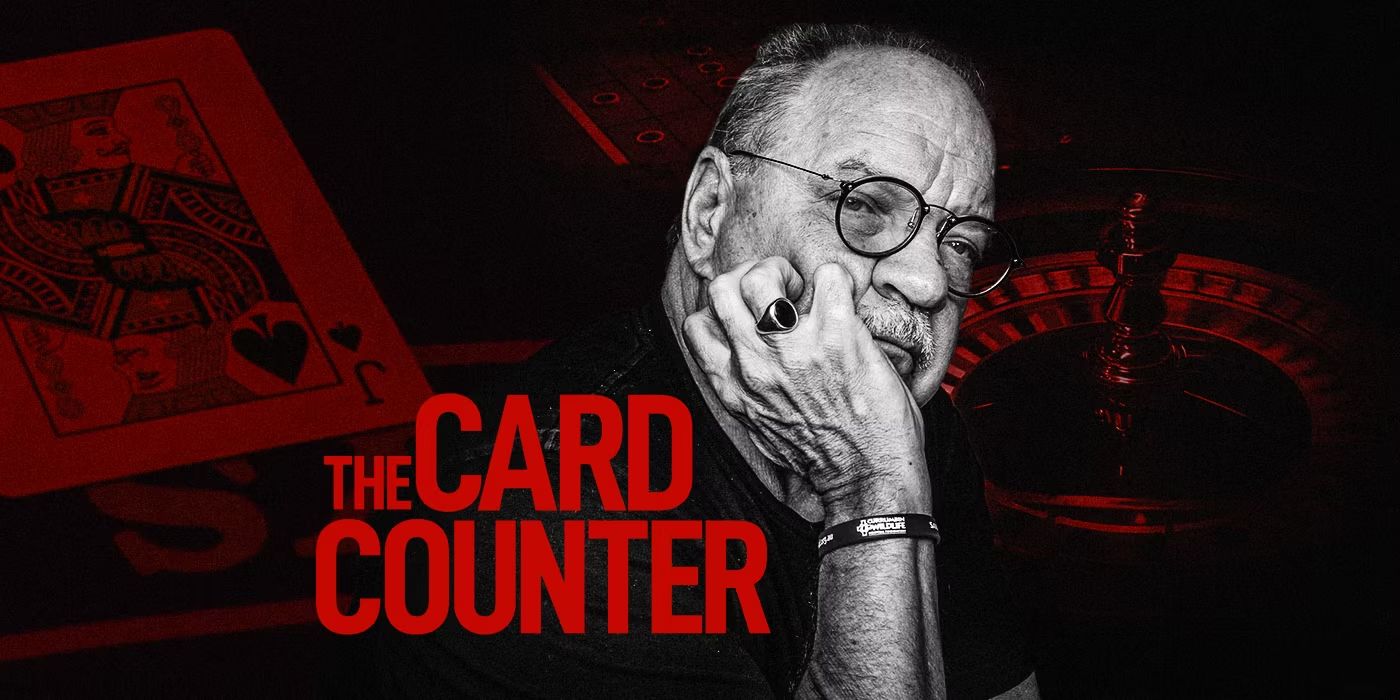
PaulSchrader directs his 22nd picture, “TheCardCounter.”Writer-director PaulSchrader in a press photo for “TheCardCounter.”
On this week’s episode of TheFilmography podcast, Bjorn and I take a deep dive into PaulSchrader’s 22nd picture, 2021’s “TheCardCounter.”
Listen to TheFilmography podcast on Spotify (with the above link), Apple, or wherever you get your podcasts. New episodes streaming Fridays.Character Posters for PaulSchrader’s “TheCardCounter.”
“TheCardCounter” stars Oscar Isaac as William Tell, a gambler with a dark past, another of Schrader’s “man in a room” characters, which we know as soon as we see him sat at his table writing in his journal, as these men in rooms tend to do in Schrader pictures.
A man in a room writing in his journal.
Tell is seeking redemption through his relationship with a troubled young protégée, played by TyeSheridan (“ReadyPlayerOne“).
Tye Sheridan as Cirk.
The relationship between the two men is a gender swap for the older man/younger woman (or girl) relationships we have seen in other Schrader pictures, from “TaxiDriver” (JodieFoster) to “Hardcore” (SeasonHubley).
The protégé and the mentor.
Rounding out the cast of principal players is TiffanyHaddish (“Girl’sTrip“) as La Linda, a manager of card players who recruits, then slowly falls for Isaac’s William Tell.
TiffanyHaddish as La Linda.William Tell and La Linda fall into romance.Fast Eddie returns in “The Color of Money“
La Linda reminds me of Paul Newman’s and Mary Elizabeth Mastrantonio’s characters from Scorsese’s “The Color of Money” combined, serving as both William Tell’s backer and his love interest.
Paul Newman and Mary Elizabeth Mastrantonio in Scorsese’s “The Color of Money.“
Incidentally, “TheColorofMoney” director (and frequent Schrader collaborator) MartinScorsese also serves as Executive Producer of “TheCardCounter.”
“The Color of Money” one-sheet.
And like “TheColorofMoney” the film is more pre-occupied with the interpersonal relationships of its central trio than the mechanics of the pool or poker.
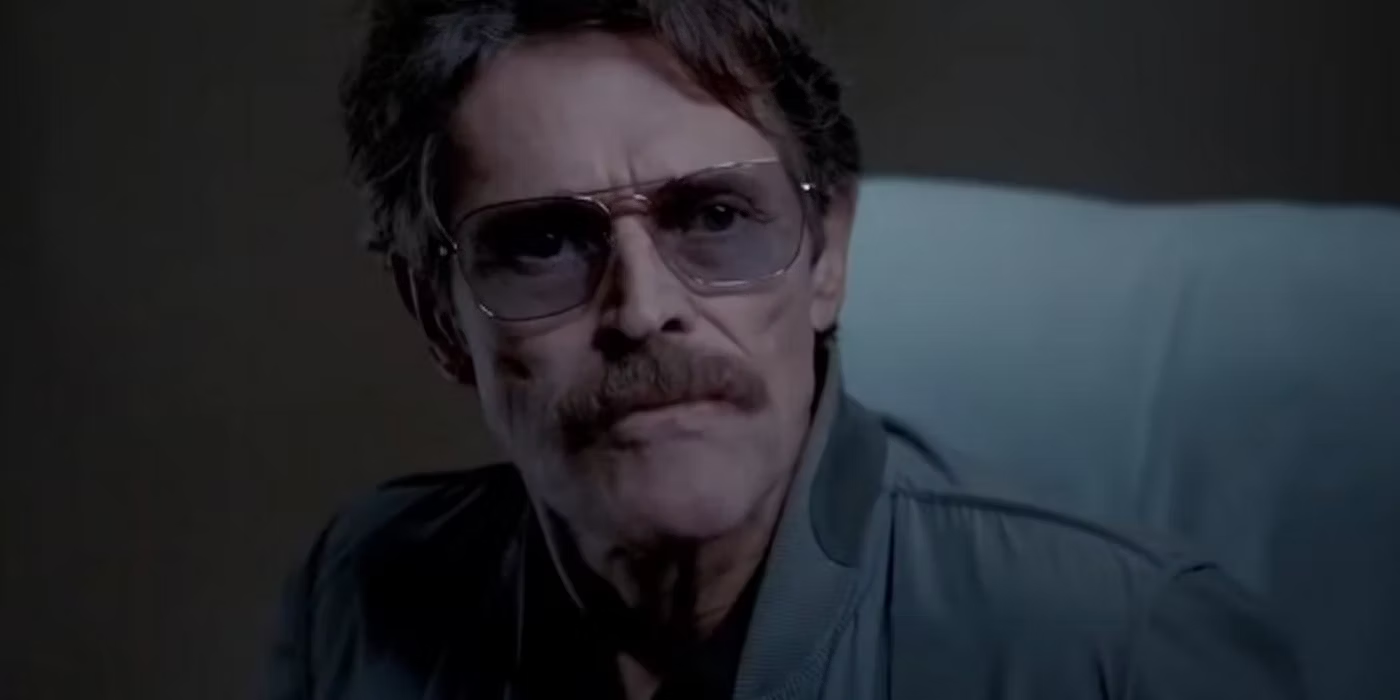
In the villainous role of Major John Gordo, WillemDafoe returns for his 8th collaboration with Schrader.
WillemDafoe returns for his 8th Schrader picture.
Most of the Maj. Gordo storyline takes place in flashbacks to William Tell’s military past, a new approach to the “man in a room” picture, which have previously avoided the use of flashbacks.
Extreme wide angles used for the flashback sequences.
Another unusual component to the flashback sequences is the use of an extreme wide angle lens, something that would not have been out of place amongst the visual experimentations of Schrader’s “DogEatDog” but feels new to these men in a room pictures.
OscarIsaac in a still from “”TheCardCounter.”
Like the endless musical variations on a theme that Schrader’s “Mishima” composer PhilipGlass is able to create in ways that always feel fresh and new, Schrader’s variations on his “man in a room” stories continue to feel like discoveries of new territories rather than retreads of familiar grounds.
Schrader and Isaac enjoy a lighter moment on set.
After the success and accolades of “FirstReformed,” it’s exciting to see Schrader follow it up with another powerful narrative about guilt and the search for love and redemption.
Schrader directs Isaac on set.
Though “FirstReformed” is the more celebrated film, I prefer “TheCardCounter” for reasons that are hard to articulate, and would require revealing some of the pictures biggest surprises. For that, and all of the highs and lows of one of Schrader’s best pictures, you’ll have to tune into the podcast and hear for yourself!
Schrader with his cast.
Watch the trailer for “The Card Counter” here:
The Card Counter trailer on YouTube
Listen to Philip Glass’ complete score for Schrader’s “Mishima”:
Glass’ “Mishima” score on YouTube.
Read the Guardian’s article on Schrader‘s and Dafoe’s creative partnership here:
As Bjorn and I were preparing to launch the first season of our new podcast, The Filmography, where we planned to take a deep dive, chronologically, into the entire back catalogues of our favourite directors, it suddenly dawned on us that we were going to need a logo, which was something beyond our particular skill sets. Fortunately, Bjorn had a graphic designer friend, AlexBoucher, who came to our rescue!
TheFilmography Motion Logo by AlexBoucher.
Bjorn and I wanted something that conjured up the feeling of the old studios of 1970s New Hollywood (especially the old WarnerBros. logo), in keeping with our subject for Season I, the Godfather of that era himself, Mr. FrancisFordCoppola.
1972 WarnerCommunicationsCompany motion logo.New Hollywood maverick (and subject of our first season), FrancisFord Coppola.
With only that minimal direction to work from, Alex created a logo that far exceeded our expectations. I only wish we were launching a studio rather than a podcast so that the venture would be worthy of Alex’s excellent design!
TheFilmography logo on red background.
In addition to the motion graphic and logo above, Alex created several variations for us to use with different backgrounds on social media, or in the new video podcast episodes we have planned (more on that in a future post).
Variant logo, red rings on transparent background.
Having such a dynamic graphic design to represent our podcast played no small part in Bjorn and I having the confidence to actually release it into the world.
Variant logo, grey rings on transparent background.
We knew this image was going to be how most people would first interact with our podcast. So, it had to feel like us, and like our vision for the show, which was something we were still figuring out as we prepared to publish that first episode. Now more than 50 episodes later, hard at work on our third season (director reveal coming soon!) we are still so grateful to Alex for creating something that we are very proud to have as the face of a project that has come to mean a great deal to both of us. As we slowly grow our audience, we know that Alex’s design presents us and our show in the best light imaginable.
Variant “Projector” motion logo.
It is with that gratitude that I thought it only appropriate to write this appreciation post, to introduce you to the artist behind the design, feature a few examples of her other work, and when you inevitably want to see more, point you in the right direction.
Ottawa-based Graphic Designer AlexBoucher.
View Alex’s other work and case studies on her website here:
“I’ve made some important films. ‘Dog Eat Dog’ is not one of them.” –Paul Schrader
Paul Schrader directs “Dog Eat Dog.”
On this week’s episode of TheFilmography podcast, Bjorn and I take a deep dive into PaulSchrader’s wildest picture yet, 2016’s bonkers neo-noir “DogEatDog.”
Nicolas Cage sees red in “Dog Eat Dog.”
The film marks the second collaboration between Schrader and Nicolas Cage following their mutual dissatisfaction with the removal of Schrader as director in the botched post-production process of finishing their first picture together, 2014’s “DyingoftheLight.”
Japanese poster.“DogEatDog” author EdwardBunker as Mr. Blue (with MichaelMadsen) in QuentinTarantino’s debut film, “ReservoirDogs.”Edward Bunker’s novel, on which MathewWilder’s screenplay is based.
Adapted from (most of) the novel of the same name by Edward “Mr. Blue” Bunker (“ReservoirDogs”) , the film features a totally unhinged supporting turn from Willem Dafoe, who was absolutely riveting 17 years earlier opposite Edward Furlong in the excellent EddieBunker adaptation “Animal Factory,” directed by Bunker’s fellow “ReservoirDogs” alum, Steve “Mr. Pink” Buscemi (who also played a small part).
WillemDafoe tripping out in “DogEatDog.”Steve Buscemi and Edward Bunker as co-stars in Tarantino’s “Reservoir Dogs.”Willem Dafoe with Eddie Furlong in Steve Buscemi’s adaptation of Edward Bunker’s “Animal Factory.”Willem Dafoe in “AnimalFactory”Steve Buscemi in “Animal Factory”Buscemi, stepping behind the camera into the director’s role on his debut picture, “TreesLounge.”Poster for “Animal Factory.”The devil in Mr. Defoe: “Dog Eat Dog.”
Apparently, after playing smaller parts in “Affliction” and “TheWalker,” Dafoe told Schrader not to bother casting him again unless he had a truly interesting character for himto sink his famous teeth into. Dafoe got his wish (and more!) in a role that sees him at his most uninhibited, crazed, and funniest best.
Dafoe freaking even himself out with his extreme behaviour.
It’s not the first time that Dafoe and Cage have brought out the extreme in each other on screen before, having previously co-starred in DavidLynch’s brilliantly deranged ode to “TheWizardofOz,’ 1992’s “WildAt Heart.”
Cage and Dafoe in Lynch’s “WildatHeart.”Cage as Troy in “Dog Eat Dog.”
In the lead role, NicolasCage demonstrates some of his best and worst thespian instincts. For instance, he spends much of the film impersonating HumphreyBogart, an alternately amusing and distracting creative choice that he apparently surprised Schrader with on the day.
Cage in HumphreyBogart mode.The real thing: Bogart in his best and most iconic role in “Casablanca.”
Rounding out the trio of disorganized criminals at the heart of the film is ChristopherMathewCook (“Treme,” “2Guns”), who steals many scenes from his much more famous co-stars.
The three stooges: Dafoe, Cage, and Cook cosplay in their police uniforms.Cook as “Diesel,” the muscle in Cage’s crew.
In particular, Cook is excellent in a scene with one of the few female characters in the film, played with great depth and tenderness (despite her limited screen time) by LouisaKrause (“Billions,” TheGirlfriendExperience” series).
Krause and Cook in a standout scene.Krause as Zoe in “Dog Eat Dog.”
With its midnight-black humour and outrageous violence, “DogEatDog” is a lot of fun, and certainly a step up from the last Schrader–Cage flick, “DyingoftheLight,” though it’s hardly a masterpiece.
Dafoe blows the audience away as Mad Dog in “DogEatDog.”
If nothing else, it’s the shotgun-blast, who-gives-a-fuck picture that Schrader clearly needed to make before he was ready to return to his transcendental roots a year later for what is, arguably, his true masterpiece, “FirstReformed.”
Poster for “FirstReformed.”Schrader in press photo for “Dog Eat Dog.”
Schrader even makes a rare (and entertaining) cameo in the film as “El Greco” (The Greek), a decidedly non-Greek mobster.
PaulSchrader as “The Greek.”
For the complete breakdown of all the highs and lows of Schrader’s 20th picture (including a debate on the meaning of that mad ending!), you will have to check out the full Filmography podcast episode below:
Listen to TheFilmography on Spotify (with above link), Apple, or wherever you get your podcasts.
Watch the trailer for “DogEatDog” here:
“DogEatDog” trailer on YouTube.
Watch an interview with PaulSchrader on “DogEatDog” here:
And before next week’s episode of The Filmography where Bjorn and I will take a deep dive into “FirstReformed,” check out PaulSchrader’s definitive treatise on “Transcendental Style in Film: Ozu, Bresson, Dryer” here:
On this week’s episode of TheFilmography, Bjorn and I find a rare opportunity to truly disagree on a picture!
LindsayLohan looking appropriately miserable with JamesDeen glaring at her.
While Bjorn found much to praise about PaulSchrader’s 2013 LindsayLohan-starring, BretEastonEllis-scripted, self-financed, psycho-sexual thriller, “TheCanyons,” I found myself wanting a lot more from (as the poster reminds us) the creators of “AmericanPsycho” and “TaxiDriver.”
PaulSchrader with his screenwriter BretEastonEllis.
There is no way to detail my number one complaint without a major spoiler, so suffice it to say that the story doesn’t get interesting until the last 15 minutes of this movie. Although it doesn’t look anywhere as cheap as it’s actual budget, it lacks the polish of Schrader’s other pictures, is his least ambitious piece of filmmaking, and the most compelling thing about it is the fact that Schrader and Ellis self-financed. That should have resulted in a picture of great artistic vision, where two iconoclasts who have pushed the boundaries of what is acceptable (or even advisable) in mainstream cinema and literature, respectively, are freed from the constraints of studio interference. But there is nothing particularly revolutionary about the film itself.
LindsayLohan looking adrift in a still from “TheCanyons,” a picture that ultimately wastes her talents.
Lohan is (unsurprisingly) much better than her part calls for, but everyone else is beyond wooden. Notorious pornstar (and accused rapist) JamesDeen’s casting in particular reeks of a publicity stunt. It’s only in the last couple of scenes that he gives off even a glimmer of whatever Schrader and Ellis must have seen to cast him in the first place. The bottom line is that Schrader and Lohan both deserve far better material than this.
Schrader directing Lohan, Deen, et al.
Listen to the latest episode of TheFilmography podcast here:
Listen to the episode on Spotify, Apple, or wherever you get your podcasts.Producer BraxtonPope, writer BretEastonEllis, and director PaulSchrader on location with Lohan and one of her co-stars.
Watch the trailer for “TheCanyons” here:
“The Canyons” trailer on YouTube.
Watch the Q&A from the world premiere of “TheCanyons” at the FilmSocietyofLincolnCenter here:
PaulSchrader’s “TheCanyons” Q&A on YouTube.
Read the NY Times Magazine’s article “Here Is What Happens When You Cast Lindsay Lohan In Your Movie” here:
StellanSkarsgard is the younger version of Father Merrin, and BillyCrawford is the boy possessed by the demon Pazuzu.
On this week’s episode of The Filmography podcast, Bjorn and I discuss PaulSchrader’s divisive 2005 prequel to WilliamFriedkin’s 1973 horror classic, TheExorcist.
One of the greatest shots in cinema history (which also made for one of the all-time greatest film posters!) from WilliamFriedkin’s 1973 original.
Listen to the podcast here:
TheFilmography podcastisavailable on Spotify, Apple, or wherever you get your podcasts. New episodes streaming every Friday.Director PaulSchrader on location.
Considering that Schrader was taken off the picture in post-production, and replaced by Die Hard 2: Die Harder‘s Renny Harlin, who re-cast, re-shot, and retitled it, it’s a miracle that this version ever saw the light of day.
RennyHarlin, director of the re-shoot, re-titled The Exorcist: The Beginning.
Starring StellanSkarsgard in the role originally made famous by the late, great MaxVonSydow, (and though my esteemed co-host may disagree with me) it’s worth the price of admission alone for the gorgeous cinematography by master of light, shadow, and (especially) colour, Vittorio Storaro (pictured with Schrader below).
PaulSchrader with legendary cinematographer VittorioStoraro.
The least successful elements of the picture are those which are meant to tie the film into the “Exorcist” franchise. The exorcism sequence itself feels like an afterthought, but where the film succeeds on its own terms is in the very Schrader-esque exploration of a deep crisis of faith. After successfully exploring the humanity of the son of God in MartinScorsese’s “TheLastTemptationofChrist,” I was intrigued by the potential flip side of that coin. When not slipping into the silliness of its supernatural elements, “Dominion” asks some profound questions about the nature of faith in the presence of evil. If the devil exists, then surely God must also exist, right?
WillemDafoe as Jesus, wearing his crown of thorns, in Scorsese & Schrader’s“TheLastTemptationofChrist” (1988).A still from Dominion‘s harrowing WW2 prologue, which serves as the core wound for Father Merrin’s crisis of faith.
Watch the trailer for “Dominion: Prequel To The Exorcist” here:
2005 trailer for “Dominion: Prequel To The Exorcist” on YouTube.
Watch the full movie here:
“Dominion: Prequel To The Exorcist” full movie on YouTube.
Watch the trailer for Scorsese & Schrader’s “TheLastTemptationofChrist” here:
Trailer for MartinScorsese’s “TheLastTemptationofChrist,” written by PaulSchrader.
Watch the trailer for the 4K release of WilliamFriedkin’s 1973 original “Exorcist” picture here:
Watch the trailer for RennyHarlin’s version, “TheExorcist: TheBeginning” here:
2004 trailer for “TheExorcist: TheBeginning” on YouTube.
Watch the full RennyHarlin version here:
Full movie (RennyHarlin version) on YouTube.
Watch RennyHarlin discussing his version, retitled “TheExorcist: TheBeginning” here:
RennyHarlin talks TheExorcist: TheBeginning.
Watch the trailer for the first sequel, JohnBoorman’s “TheExorcistII: TheHeretic” here:
Trailer for Scream Factory’s Blu-ray release of TheExorcistII: TheHeretic on YouTube, featuring a score by EnnioMorricone (expect future post on that).
Watch the trailer for WilliamPeterBlatty’s “TheExorcistIII” here:
Trailer for Scream Factory’s Blu-ray release of “TheExorcistIII” on YouTube.
Watch the trailer for DavidGordonGreen’s “TheExorcist: Believer” here:
And while we’re at it, watch the trailer for Renny Harlin’s “Die Hard 2: Die Harder” here:
On this week’s episode of The Filmography podcast, Bjorn and I dive into PaulSchrader’s 2002 BobCrane biopic, “Auto Focus,” a dark and funny portrait of the destabilizing effects of Crane’s twin addictions to sex and videotape.
Original theatrical poster.GregKinnear giving the best performance of his life as sex and video-addicted BobCrane.
GregKinnear gives a performance of great depth, one that was only suggested by his most popular roles, such as his Oscar-nominated turn in “AsGoodAsItGets.”
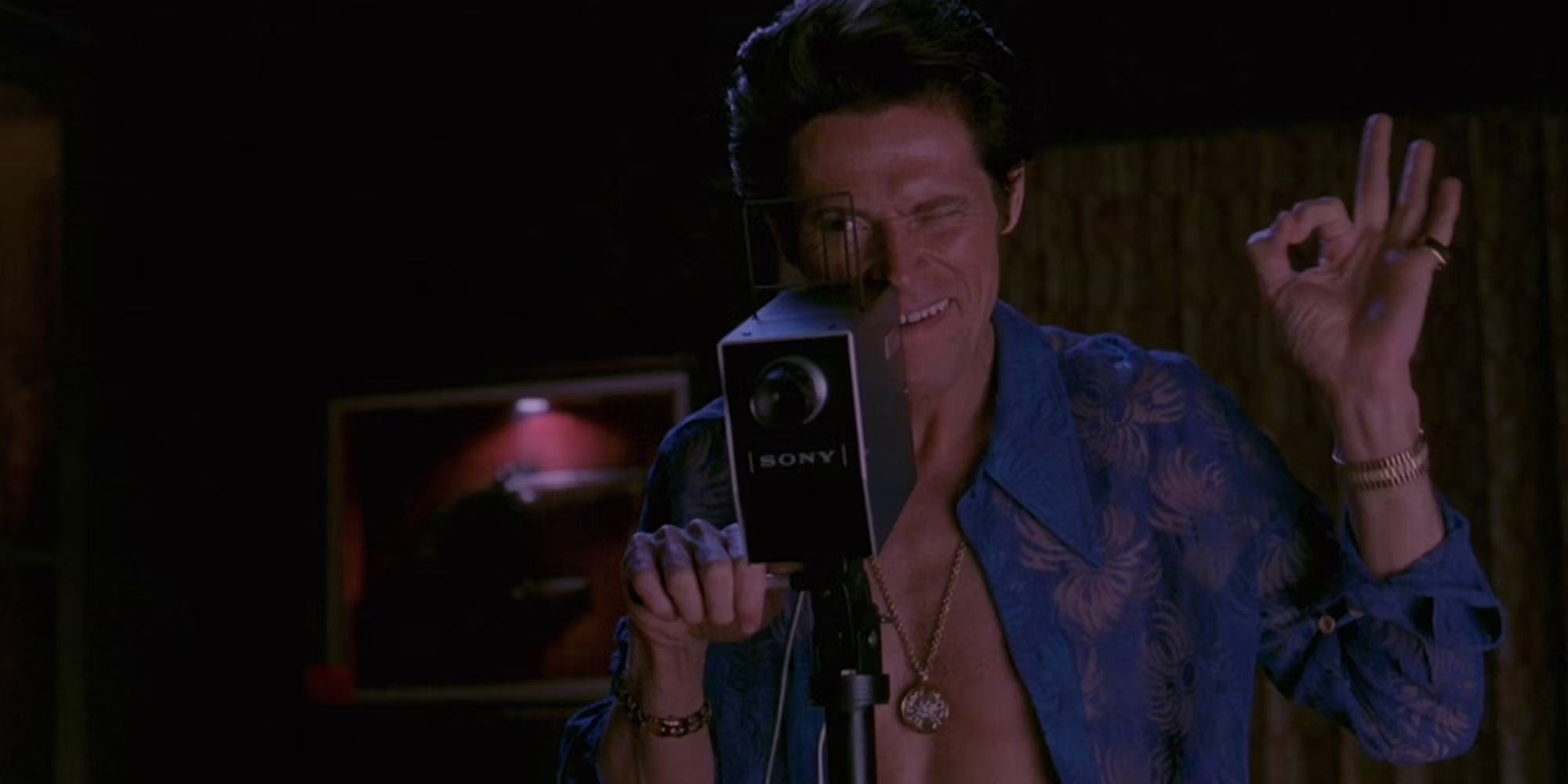
WillemDafoe having a blast as John “Carpy” Carpenter, Crane’s friend, enabler, and (possibly) murderer.
In a brilliant supporting part, WillemDafoe plays Crane’s friend, enabler, and (possibly) murderer, John “Carpy” Carpenter.
Their strange co-dependent relationship, and the chemistry between Kinnear and Dafoe, make for a fascinating psychological portrait of the destructive forces of addiction.
Wielding the video camera like a weapon.The (video) fruits of Bob’s labour.
It’s a lot funnier than it’s subject matter would suggest, thanks in no smart part to the influence of co-producers ScottAlexander & LarryKaraszewski.
As co-screenwriters, Alexander & Karaszewski practically invented this particular brand of empathetic but irreverent biopic with their script for TimBurton’sEd Wood, and perfected it with their scripts for MilosForman’s brilliant AndyKauffman and LarryFlynt biopics (ManOnTheMoon and ThePeoplevs. LarryFlynt, respectively).
Ed Wood poster art (detail) from the soundtrack album (score by Howard Shore).Man on The Moon theatrical poster (detail).Theatrical poster (detail) for Milos’ Forman’sThe People vs. Larry Flynt.
Listen to the podcast here:
TheFilmography podcast, streaming on Spotify, Apple, or wherever you get your podcasts.
Listen to the DVD audio commentary here:
PaulSchrader’s audio commentary for “Auto Focus.”
Watch the trailer for Ed Woodhere:
Trailer for Ed Wood on YouTube.
Watch the trailer for The People vs. Larry Flynt here:
DVD cover art for Paul Schrader’s “Forever Mine,” a film every bit as horny as critics said “The Comfort of Strangers” was.
On this week’s episode of The Filmography, Bjorn and I are joined by special guest Cameron Pulley for a discussion about Paul Schrader’s stylish and strange (and barely released!) 1999 neo-noir melodrama, “Forever Mine,” starring Joseph Fiennes, Gretchen Moll, and Ray Liotta.
Paul Schrader and Gretchen Moll on the set of “Forever Mine.”
The film is so strange in fact that rather than attempt to summarize the narrative myself, I’ll just re-post the synopsis from Paul Schrader’s website here:
“Forever Mine” synopsis fromhttp://paulschrader.orgJoseph Fiennes and some very strange make-up choices.(The greatly underrated) Gretchen Moll.
Listen to the podcast here:
Now streaming on Spotify, Apple, or wherever you get your podcasts.
On this week’s episode of The Filmography, Bjorn Olson and I take a deep dive into Paul Schrader’s adaptation of Russell Banks’ harrowing account of the fallout from an abusive father-son relationship, featuring Oscar-nominated turns from Nick Nolte (who has only ever been better in Neil Jordan’s “The Good Thief“), and James Coburn. As the abusive father, Coburn won the Oscar.
Listen to the podcast here:
Now streaming on Spotify, Apple, or wherever you get your podcasts.
Watch the trailer for “Affliction” here:
Nick Nolte was Oscar-nominated, and James Coburn won, for their portrayals of an embattled father and son on a collision course.
See what Siskel& Ebert had to say about “Affliction” here:
Siskel & Ebert raise their thumbs for Schrader’s picture.
Paul Schrader’s 1997 adaptation of Elmore Leonard’s “Touch.”
Happy Filmography Friday! In this week’s episode, Bjorn Olson and I are joined by returning special guest, Noah Taylor, for a discussion of Paul Schrader’s adaptation of Elmore Leonard’s strangest novel, “Touch,” the first of two films Schrader released in 1997 (followed by Affliction). Thank you for listening!
New episode now streaming on Spotify, Apple, or wherever you get your podcasts.