When you’ve waited fifteen years to kill a man… It’s a shame you can only kill him once!”
-Tagline for “Death Rides A Horse.”
Theatrical Poster.Title Shot.Morricone’s On-Screen Credit.Dagored’s re-issue of Morricone’s “DeathRidesAHorse.”
From the album cover sticker on Dagored’s excellent 2017 re-issue of Morricone’s score to Giulio Petroni’s 1967 Spaghetti Western, “Death Rides A Horse“:
“The soundtrack for this epic western movie featuring the great LeeVanCleef bears the signature of EnnioMorricone: Guitars, flute, piano, timpani, drums and a Native-American choir style make this motion picture a kind of original masterpiece in the maestro ouvre. I Cantori Moderni di Alessandro Alessandroni perform here in their own unique way with Alessandro Alessandroni on evidence with his original whistling.
Reverse Album Cover Art.ScreenshotScreenshotScreenshotScreenshotAlbum Insert.Reverse Album Insert.
The main musical theme was employed by QuentinTarantino in ‘KillBillvol. 1′ and in IngloriousBasterds!'”
Album Cover Art.Album Cover Art.Lee Van Cleef in “DeathRidesAHorse.”John Phillip Law (l), with Van Cleef (r).Law and VanCleef.Earlier Album Pressing.Italian Poster Art: “DaUomoAUomo” aka “DeathRidesA Horse.”Alternate Poster Art.French Poster.Alternate Poster ArtDVD Cover Art.
Links:
Listen to the complete score here:
https://youtu.be/Jy5D7D_XzaU?si=Xdauo27R6uUmnN9f
Watch the complete film for free here:
Complete film on YouTube.www.baystreetvideo.com
If you are in the Toronto area, say hi to my Filmography podcast co-host, Bjorn, and order the film from BayStreetVideo.
Outside of Toronto, you can find “DeathRidesAHorse” on blu-ray at Amazon here:
Theatrical poster.Album cover art.Reverse album sleeveSide ASide B
Having previously written the scores for the HenriVernueil-directed pictures “GunsForSanSebastián,” TheSicilianClan,” and “LeCasse” (aka “TheBurglars“), EnnioMorricone was once again enlisted by Verneuil, this time to compose the score for his new spy thriller, “LeSerpent.”
Album cover art (earlier pressing).
Side A of Morricone’s score for “IlSerpente” starts off weary and mournful, with a theme that would not be out of place in a romantic drama (at that inevitable point when the lovers part). As sad and wistful as things begin, they quickly turn jazzy and psychedelic, with grungy guitars, propulsive drums, and wailing electric keyboards. Then the Maestro slows things down again with strings, piano, and flute, another melancholy theme, veering on romantic. Heavy organs follow, furthering the “funeral music” vibe. A slower variation on the opening theme ends on a bittersweet note, before a traditional- sounding military march caps off the first half of the record.
Album cover art (earlier French pressing).
Side B kicks off with high tension from a string arrangement that recalls some of Morricone’sgiallo scores. Strange percussive sounds add to the uneasy feeling that might have the listener on edge as the strings become jagged razors.
Album cover art (Dagored pressing).
With the next track, Morricoene blurs the line between score and sound design, providing more mood and atmosphere than melody and rhythm.
Album cover art (Japanese pressing).
Taut, disorienting, and anxiety-inducing for the remainder of Side B, “IlSerpente” is not one of the Maestro’s most melodic compositions, but it very effectively creates the suspense and tension an international spy thriller requires.
CD album art.
Morricone would also go on to write the scores for Verneuil’s “PeurSurLaVille” (aka “FearOverTheCity“), starring Jean–PaulBelmondo (in one of his best action-star performances), and “I… For Icarus,” starring YvesMontand.
Album cover art.Album cover art.
With an impressive international cast of headliners (HenryFonda, YulBrynner, DirkBogard, PhilipNoiret, and VirnaLisi), “LeSerpent” (aka “NightFlightFromMoscow“) tells the story of a Soviet diplomat (Brynner) plotting his defection to America by trading a list of alleged Soviet double agents. As Brynner is taken into Fonda’s custody in the US, the names on his list begin getting knocked off, one by one.
HenryFonda has his eye on the slippery YulBrynner.YulBrynner as soviet spy, Col. AlexeiVlassov.Lobby card featuring Fonda and Brynner.Lobby card featuring Fonda.Alternate poster art.Alternate poster.More lobby cards.Italian poster.Japanese poster.
Links:
Listen to Morricone’s score for “IlSerpente” here:
“IlSerpente” score on YouTube.
Watch the trailer for “LeSerpent” here:
“LeSerpent” aka “NightFlightFromMoscow” trailer on YouTube.
Watch the complete film for free here:
Full film on YouTube.
If you are in the Toronto area, say hi to my Filmography co-host Bjorn, and find “Le Serpent” (as “Night Flight From Moscow“) at Bay Street Video here:
“We can’t rule out the possibility that he is a pervert.”
-Quote from “The Bird With The Crystal Plumage.”
EnnioMorricone circa 1970, the year “The BirdWithTheCrystalPlumage” was released.Original theatrical poster.Spanish DVD art for “The Bird With The Crystal Plumage.”Italian DVD art for Arrow’s home video release of “TheBirdWithTheCrystalPlumage.”Front album cover art.Reverse album cover sleeve.Vinyl Side 1Vinyl Side 2
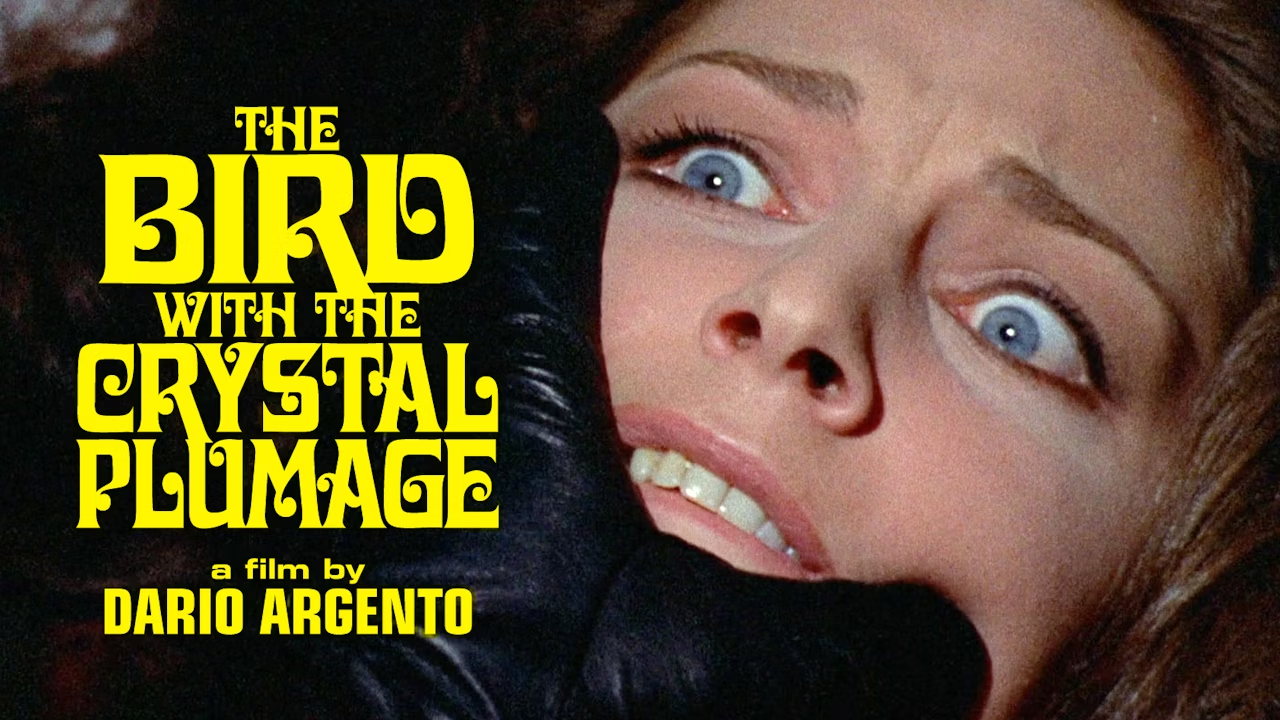
Morricone’s score for DarioArgento’s debut picture, 1970’s Rome-set thriller “TheBirdWithTheCrystalPlumage,” is the first of three scores the Maestro composed for Argento’s so-called “AnimalTrilogy” (followed swiftly by “The Cat O’ Nine Tails,” and “Four Flies On Grey Velvet“).
“The Cat O’ Nine Tails.““4 Flies On Grey Velvet.”
Morricone would later compose the music for Argento’s “The Stendhal Syndrome,” and “The Phantom Of The Opera,” bringing the total of Argento-directed films with Morricone scores to 5.
Of course, Argento was already an established screenwriter of note before making his directorial debut on “The Bird With The Crystal Plumage.” Argento penned the screenplays for the Morricone-scored pictures “Comandamenti Per Un Gangster,” “Once Upon a Time In The West,” “Metti Una Sera A Cena,” “Un Esercito Di 5 Uomini,” and “La Stagione Dei Sensei,” making it a 10 film-collaboration over four-decades.
“The Bird With The Crystal Plumage” director DarioArgento with the Maestro himself.
The “The Bird With The Crystal Plumage” score begins with a light touch, very much in the vein of Morricone’s more melodic lounge compositions, but things quickly get weird, with strange vocalizations, moans, and heavy breathing over sparse, jagged, anxiety-inducing discordant themes.
SuzyKendall and TonyMusante in “TheBirdWithTheCrystalPlumage.”
The effect is that Morricone’s score lulls you into a dreamy state before it strikes with dissonance and unnerving sounds meant to put you on a razor’s edge, only appropriate given the nature of the film to which this music belongs.
Tony Musante and a soon to be murder-victim in “TheBirdWithTheCrystalPlumage.”TonyMusante interviewed by the police in “TheBirdWithTheCrystalPlumage.”A staple of the giallo picture: the silhouette of a mysterious killer all in black.
Although it wasn’t the first (credit MarioBava‘s “The Girl Who Knew Too Much” with that honour) Argento’s oft-imitated suspense picture set the benchmark for the giallo genre.
The original giallo picture, Mario Bava’s “The Girl Who Knew Too Much”
Literally translated as “yellow” from Italian, gialli are Italian thrillers that take their name from “Il Giallo Mondadori,” a series of popular Italian murder mysteries originally published by Arnoldo Mondadori Editore, with their iconic yellow jackets.
“Giallo” was an Italian literary genre before bleeding into Italian cinema.Argento wields the knife.
Argento was the best of the best in the giallo business, and has become synonymous with the genre, but there are many other classics to seek out, from LucioFulci’s “Don’tTorturea Duckling,” to one of my personal favourites, LuigiBazzoni’s “TheFifthCord” (also scored by Morricone).
Poster for LucioFulci’sgiallo classic.Poster for LuigiBazzoni’s giallo classic.
After you check out the soundtrack, don’t forget to see the film! And on the subject of gialli, ArrowVideo has been releasing a number of significant giallo pictures both on blu-ray and on their Arrow Player streaming app.
Visit the giallo section of ArrowVideo’s website here:
https://www.arrow-player.com/giallo-essentials
Along with Spaghetti Westerns (Italian westerns) and Poliziotteschi (Italian cop thrillers), the giallo sub-genre shows what a rich period the 1960s and ’70s were for Italian cinema. For more on everything giallo, check out the documentary “AllTheColorsofGiallo,” which is a fun deep-dive for fans of the genre and newcomers alike.
Watch the complete documentary “AllTheColorsofGiallo” here:
https://www.youtube.com/watch?v=MtdnC_wxevk
“AlltheColorsofGiallo” on YouTube.
And for more on poliziotteschi and why the ’60s and ’70s were the heyday for Italian genre cinema, check out the trailer for “Eurocrime: The Italian Cop & Gangster Films That Ruled The 70s” here:
If you are in the Toronto area, say hi to my Filmography podcast co-host Bjorn, and rent or purchase “The Bird With The Crystal Plumage” by visiting the last great video store, BayStreetVideo, in store or with the link below:
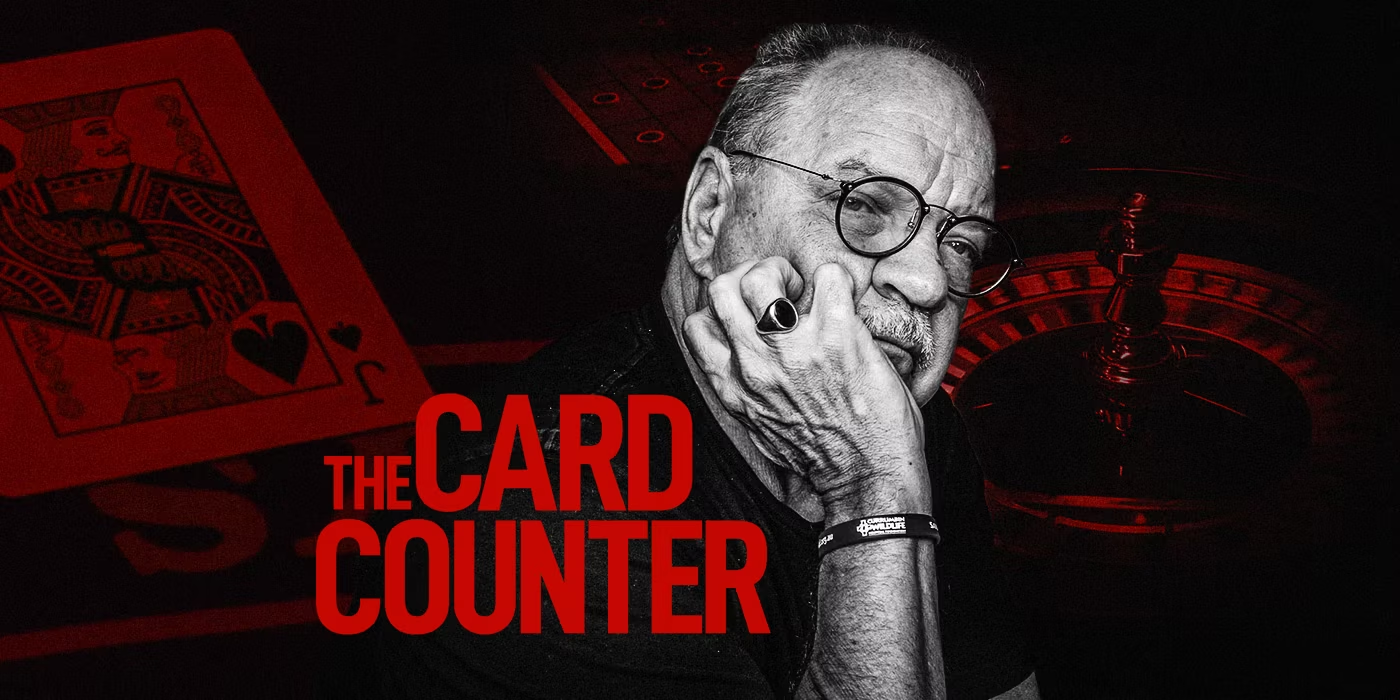
PaulSchrader directs his 22nd picture, “TheCardCounter.”Writer-director PaulSchrader in a press photo for “TheCardCounter.”
On this week’s episode of TheFilmography podcast, Bjorn and I take a deep dive into PaulSchrader’s 22nd picture, 2021’s “TheCardCounter.”
Listen to TheFilmography podcast on Spotify (with the above link), Apple, or wherever you get your podcasts. New episodes streaming Fridays.Character Posters for PaulSchrader’s “TheCardCounter.”
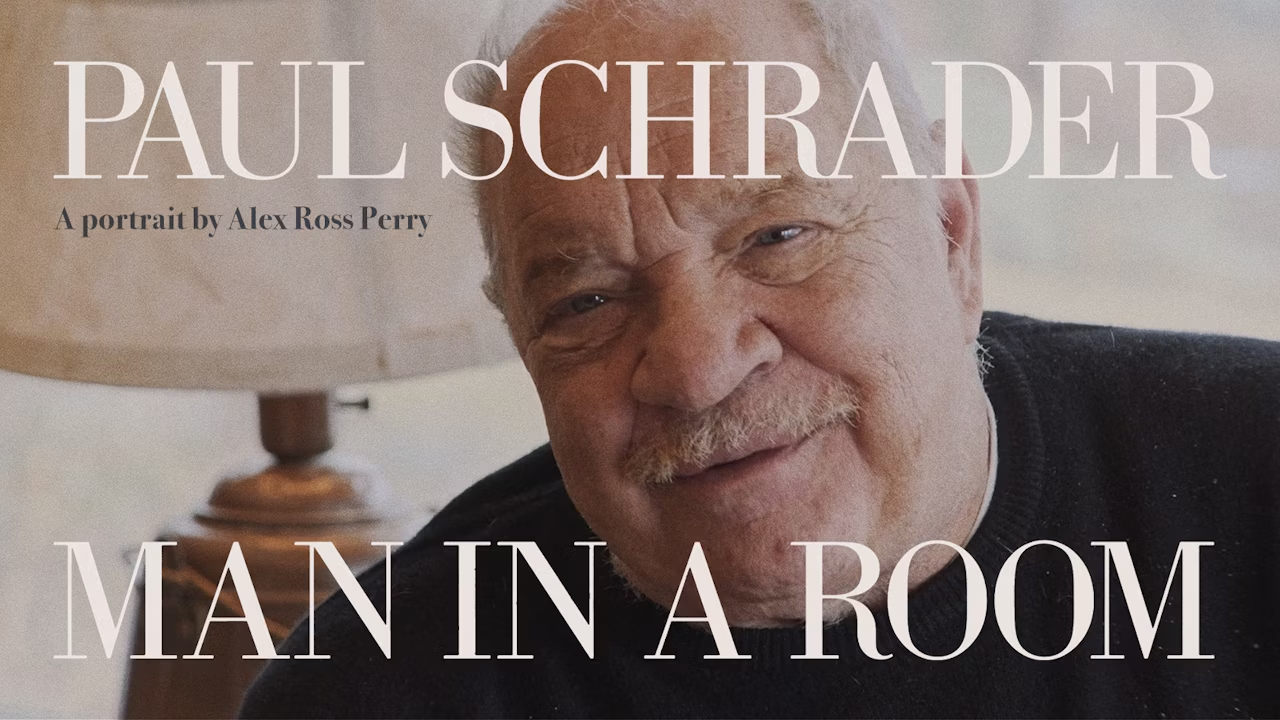
“TheCardCounter” stars Oscar Isaac as William Tell, a gambler with a dark past, another of Schrader’s “man in a room” characters, which we know as soon as we see him sat at his table writing in his journal, as these men in rooms tend to do in Schrader pictures.
A man in a room writing in his journal.
Tell is seeking redemption through his relationship with a troubled young protégée, played by TyeSheridan (“ReadyPlayerOne“).
Tye Sheridan as Cirk.
The relationship between the two men is a gender swap for the older man/younger woman (or girl) relationships we have seen in other Schrader pictures, from “TaxiDriver” (JodieFoster) to “Hardcore” (SeasonHubley).
The protégé and the mentor.
Rounding out the cast of principal players is TiffanyHaddish (“Girl’sTrip“) as La Linda, a manager of card players who recruits, then slowly falls for Isaac’s William Tell.
TiffanyHaddish as La Linda.William Tell and La Linda fall into romance.Fast Eddie returns in “The Color of Money“
La Linda reminds me of Paul Newman’s and Mary Elizabeth Mastrantonio’s characters from Scorsese’s “The Color of Money” combined, serving as both William Tell’s backer and his love interest.
Paul Newman and Mary Elizabeth Mastrantonio in Scorsese’s “The Color of Money.“
Incidentally, “TheColorofMoney” director (and frequent Schrader collaborator) MartinScorsese also serves as Executive Producer of “TheCardCounter.”
“The Color of Money” one-sheet.
And like “TheColorofMoney” the film is more pre-occupied with the interpersonal relationships of its central trio than the mechanics of the pool or poker.
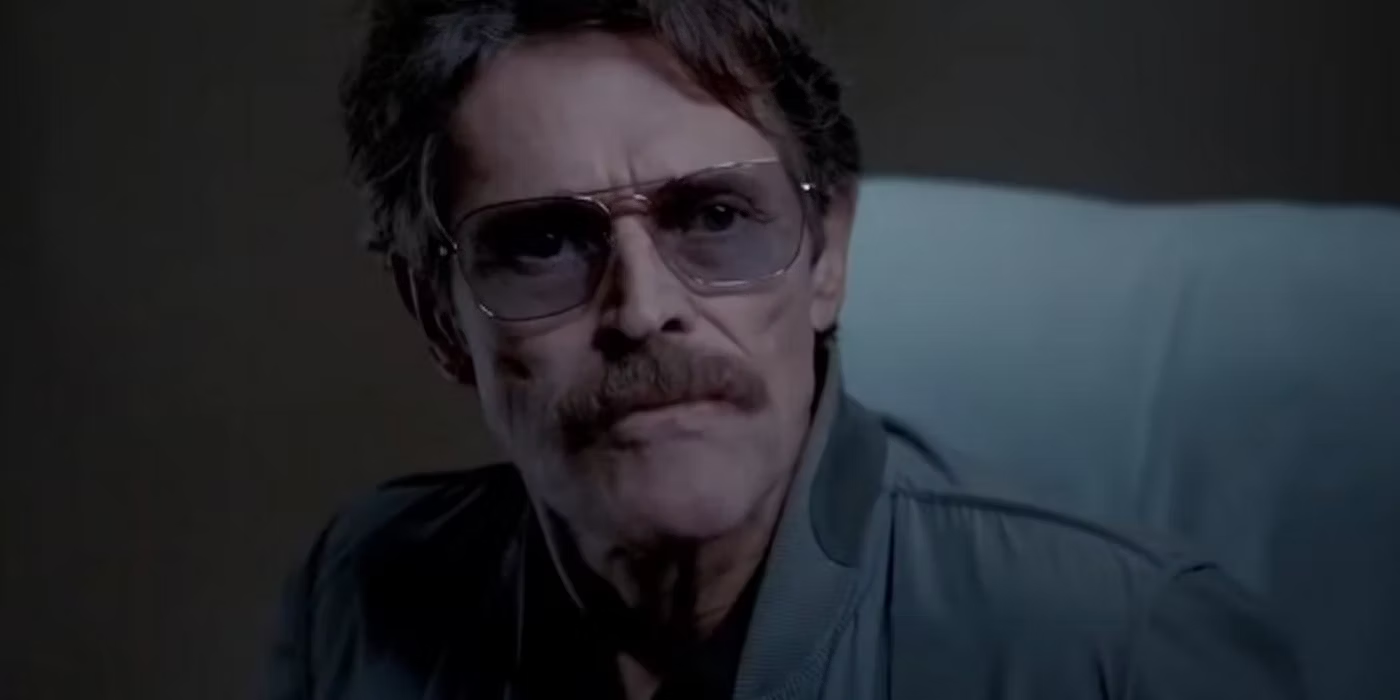
In the villainous role of Major John Gordo, WillemDafoe returns for his 8th collaboration with Schrader.
WillemDafoe returns for his 8th Schrader picture.
Most of the Maj. Gordo storyline takes place in flashbacks to William Tell’s military past, a new approach to the “man in a room” picture, which have previously avoided the use of flashbacks.
Extreme wide angles used for the flashback sequences.
Another unusual component to the flashback sequences is the use of an extreme wide angle lens, something that would not have been out of place amongst the visual experimentations of Schrader’s “DogEatDog” but feels new to these men in a room pictures.
OscarIsaac in a still from “”TheCardCounter.”
Like the endless musical variations on a theme that Schrader’s “Mishima” composer PhilipGlass is able to create in ways that always feel fresh and new, Schrader’s variations on his “man in a room” stories continue to feel like discoveries of new territories rather than retreads of familiar grounds.
Schrader and Isaac enjoy a lighter moment on set.
After the success and accolades of “FirstReformed,” it’s exciting to see Schrader follow it up with another powerful narrative about guilt and the search for love and redemption.
Schrader directs Isaac on set.
Though “FirstReformed” is the more celebrated film, I prefer “TheCardCounter” for reasons that are hard to articulate, and would require revealing some of the pictures biggest surprises. For that, and all of the highs and lows of one of Schrader’s best pictures, you’ll have to tune into the podcast and hear for yourself!
Schrader with his cast.
Watch the trailer for “The Card Counter” here:
The Card Counter trailer on YouTube
Listen to Philip Glass’ complete score for Schrader’s “Mishima”:
Glass’ “Mishima” score on YouTube.
Read the Guardian’s article on Schrader‘s and Dafoe’s creative partnership here:
Paul Schrader in press photo for “First Reformed.“
On this week’s episode of TheFilmography podcast, Bjorn and I take a deep dive into PaulSchrader’s 21’s picture, “FirstReformed,” for which he received his first Oscar nomination for Best Screenplay.
Listen to TheFilmography on Spotify (link above), Apple, or wherever you get your podcasts.Ethan Hawke as Reverend Toller in my favourite still from “First Reformed.” Just look at that pink and purple sky! Like something out of an impressionist painting.PaulSchrader in a press photo for “FirstReformed.”
With “FirstReformed,” PaulSchrader’s wilderness years are finally over. It seems “DogEatDog” did what it was supposed to do, blasted away all the cobwebs, cleansed the palate (especially of “TheCanyons”), done away with all of the experimentations of genre and style, and returned Schrader to his transcendental roots, exploring the influence of austere filmmakers like Ozu, Bresson, and Dreyer, on whom Schrader wrote the book that launched his career as a film critic even before he became a celebrated screenwriter and director.
Paul Schrader’s classic text on the style of Ozu, Bresson, and Dreyer.
From the moment we see Ethan Hawke alone in a room, sitting at a table, writing in a journal, we know immediately that this is not just a Paul Schrader picture, but one of his “man in a room” stories, a cycle which began with “Taxi Driver,” and includes “American Gigolo” (no journal writing), “Light Sleeper,” “The Walker” (no journal), “FirstReformed,” and following that, “TheCard Counter,” and “MasterGardner.”
These films are linked with common themes of isolation and self-destructive violence.
Out of bullets, DeNiro’s finger becomes a weapon.Willem Dafoe goes kamikaze in “LightSleeper,” and survives.Ethan Hawke works out his Jesus complex in “FirstReformed.”
“FirstReformed” recalls “TaxiDriver” in many other ways, too. Some similarities are superficial, referencing specific shots, such as the Pepto Bismol in the whiskey glass in “FirstReformed,” and the Alka Seltzer in water in “TaxiDriver.”
Breakfast of champions in “First Reformed.”MartinScorsese’s out-of-the-box AlkaSeltzer ad from “TaxiDriver.”
Some references are more profound, such as the protagonists of both films attempting to save themselves by saving a young woman. In the case of “TaxiDriver,” that woman was initially a romantic interest, as played by CybilSheppard, before morphing into an actual rescue attempt, with the character played by JodieFoster.
CybilSheppard as Betsy, a campaign worker DeNiro’sTravisBickle fixates on.JodieFoster as Iris, an adolescent sex worker that Travis attempts to rescue.
In “FirstReformed,” both parts manifest in one character. Played by AmandaSeyfried, Mary is one of Reverend Tiller’s parishioners, a pregnant widow to whom he feels an immense sense of responsibility, since he blames himself for her husband’s suicide.
AmandaSeyfried as Mary in “FirstReformed.”
Unlike Travis’ relationships with Betsy or Iris, Rev. Tiller’s feelings for Mary are reciprocated, fuelled by a shared sense of grief and trauma. It is Schrader’s most tender romance to date, culminating in a hyper-stylized “magical mystery tour” sequence (as Bjorn calls it) that would have eyes rolling in the hands of most other directors, but coming from such an unsentimental filmmaker as Schrader, is actually quite moving.
AmandaSeyfried in a still from “FirstReformed.”The “magical mystery tour” sequence in “FirstReformed.”Three men in a room (though two are pictured outside here!): EthanHawke, OscarIsaac, and JoelEdgerton.
With the success and acclaim of “FirstReformed” Schrader must have realized he had finally hit upon the winning formula. His next two pictures, “TheCardCounter,” and “MasterGardner,” would complete an unofficial “man in the room” trilogy.
The “man in a room” trilogy.
Though “LightSleeper” remains my favourite Schrader Picture, “FirstReformed” may very well be his best. For the full breakdown on why, you’ll have to listen to the podcast!
Rare photo of Schrader smiling!
Watch the trailer for “FirstReformed” here:
“FirstReformed” trailer on YouTube.
Listen to Schrader’s audio commentary for “First Reformed” here:
Audio commentary by PaulSchrader for “FirstReformed” on YouTube.
Watch the “magical mystery tour” sequence from “FirstReformed” here:
EthanHawke takes AmandaSeyfried on a “magical mystery tour” in “FirstReformed.” “FirstReformed” double exposure image from Mubi.com
As Bjorn and I were preparing to launch the first season of our new podcast, The Filmography, where we planned to take a deep dive, chronologically, into the entire back catalogues of our favourite directors, it suddenly dawned on us that we were going to need a logo, which was something beyond our particular skill sets. Fortunately, Bjorn had a graphic designer friend, AlexBoucher, who came to our rescue!
TheFilmography Motion Logo by AlexBoucher.
Bjorn and I wanted something that conjured up the feeling of the old studios of 1970s New Hollywood (especially the old WarnerBros. logo), in keeping with our subject for Season I, the Godfather of that era himself, Mr. FrancisFordCoppola.
1972 WarnerCommunicationsCompany motion logo.New Hollywood maverick (and subject of our first season), FrancisFord Coppola.
With only that minimal direction to work from, Alex created a logo that far exceeded our expectations. I only wish we were launching a studio rather than a podcast so that the venture would be worthy of Alex’s excellent design!
TheFilmography logo on red background.
In addition to the motion graphic and logo above, Alex created several variations for us to use with different backgrounds on social media, or in the new video podcast episodes we have planned (more on that in a future post).
Variant logo, red rings on transparent background.
Having such a dynamic graphic design to represent our podcast played no small part in Bjorn and I having the confidence to actually release it into the world.
Variant logo, grey rings on transparent background.
We knew this image was going to be how most people would first interact with our podcast. So, it had to feel like us, and like our vision for the show, which was something we were still figuring out as we prepared to publish that first episode. Now more than 50 episodes later, hard at work on our third season (director reveal coming soon!) we are still so grateful to Alex for creating something that we are very proud to have as the face of a project that has come to mean a great deal to both of us. As we slowly grow our audience, we know that Alex’s design presents us and our show in the best light imaginable.
Variant “Projector” motion logo.
It is with that gratitude that I thought it only appropriate to write this appreciation post, to introduce you to the artist behind the design, feature a few examples of her other work, and when you inevitably want to see more, point you in the right direction.
Ottawa-based Graphic Designer AlexBoucher.
View Alex’s other work and case studies on her website here:
“I’ve made some important films. ‘Dog Eat Dog’ is not one of them.” –Paul Schrader
Paul Schrader directs “Dog Eat Dog.”
On this week’s episode of TheFilmography podcast, Bjorn and I take a deep dive into PaulSchrader’s wildest picture yet, 2016’s bonkers neo-noir “DogEatDog.”
Nicolas Cage sees red in “Dog Eat Dog.”
The film marks the second collaboration between Schrader and Nicolas Cage following their mutual dissatisfaction with the removal of Schrader as director in the botched post-production process of finishing their first picture together, 2014’s “DyingoftheLight.”
Japanese poster.“DogEatDog” author EdwardBunker as Mr. Blue (with MichaelMadsen) in QuentinTarantino’s debut film, “ReservoirDogs.”Edward Bunker’s novel, on which MathewWilder’s screenplay is based.
Adapted from (most of) the novel of the same name by Edward “Mr. Blue” Bunker (“ReservoirDogs”) , the film features a totally unhinged supporting turn from Willem Dafoe, who was absolutely riveting 17 years earlier opposite Edward Furlong in the excellent EddieBunker adaptation “Animal Factory,” directed by Bunker’s fellow “ReservoirDogs” alum, Steve “Mr. Pink” Buscemi (who also played a small part).
WillemDafoe tripping out in “DogEatDog.”Steve Buscemi and Edward Bunker as co-stars in Tarantino’s “Reservoir Dogs.”Willem Dafoe with Eddie Furlong in Steve Buscemi’s adaptation of Edward Bunker’s “Animal Factory.”Willem Dafoe in “AnimalFactory”Steve Buscemi in “Animal Factory”Buscemi, stepping behind the camera into the director’s role on his debut picture, “TreesLounge.”Poster for “Animal Factory.”The devil in Mr. Defoe: “Dog Eat Dog.”
Apparently, after playing smaller parts in “Affliction” and “TheWalker,” Dafoe told Schrader not to bother casting him again unless he had a truly interesting character for himto sink his famous teeth into. Dafoe got his wish (and more!) in a role that sees him at his most uninhibited, crazed, and funniest best.
Dafoe freaking even himself out with his extreme behaviour.
It’s not the first time that Dafoe and Cage have brought out the extreme in each other on screen before, having previously co-starred in DavidLynch’s brilliantly deranged ode to “TheWizardofOz,’ 1992’s “WildAt Heart.”
Cage and Dafoe in Lynch’s “WildatHeart.”Cage as Troy in “Dog Eat Dog.”
In the lead role, NicolasCage demonstrates some of his best and worst thespian instincts. For instance, he spends much of the film impersonating HumphreyBogart, an alternately amusing and distracting creative choice that he apparently surprised Schrader with on the day.
Cage in HumphreyBogart mode.The real thing: Bogart in his best and most iconic role in “Casablanca.”
Rounding out the trio of disorganized criminals at the heart of the film is ChristopherMathewCook (“Treme,” “2Guns”), who steals many scenes from his much more famous co-stars.
The three stooges: Dafoe, Cage, and Cook cosplay in their police uniforms.Cook as “Diesel,” the muscle in Cage’s crew.
In particular, Cook is excellent in a scene with one of the few female characters in the film, played with great depth and tenderness (despite her limited screen time) by LouisaKrause (“Billions,” TheGirlfriendExperience” series).
Krause and Cook in a standout scene.Krause as Zoe in “Dog Eat Dog.”
With its midnight-black humour and outrageous violence, “DogEatDog” is a lot of fun, and certainly a step up from the last Schrader–Cage flick, “DyingoftheLight,” though it’s hardly a masterpiece.
Dafoe blows the audience away as Mad Dog in “DogEatDog.”
If nothing else, it’s the shotgun-blast, who-gives-a-fuck picture that Schrader clearly needed to make before he was ready to return to his transcendental roots a year later for what is, arguably, his true masterpiece, “FirstReformed.”
Poster for “FirstReformed.”Schrader in press photo for “Dog Eat Dog.”
Schrader even makes a rare (and entertaining) cameo in the film as “El Greco” (The Greek), a decidedly non-Greek mobster.
PaulSchrader as “The Greek.”
For the complete breakdown of all the highs and lows of Schrader’s 20th picture (including a debate on the meaning of that mad ending!), you will have to check out the full Filmography podcast episode below:
Listen to TheFilmography on Spotify (with above link), Apple, or wherever you get your podcasts.
Watch the trailer for “DogEatDog” here:
“DogEatDog” trailer on YouTube.
Watch an interview with PaulSchrader on “DogEatDog” here:
And before next week’s episode of The Filmography where Bjorn and I will take a deep dive into “FirstReformed,” check out PaulSchrader’s definitive treatise on “Transcendental Style in Film: Ozu, Bresson, Dryer” here:
“‘Dying of the Light,’ a film I wrote and directed, was taken away from me after the submission of the Director’s Cut (June 2014). Grindstone Pictures and the producers wanted a generic Nic Cage video-on-demand film, while my editorial instincts were pointing toward something more interesting. Grindstone recut, scored, and mixed the film without my input. Subsequently, actors Nicholas Cage and Anton Yelchin, executive producer Nic Refn and I distanced ourselves from the film… I remain hopeful that someday I will be allowed to finish the film.” –Paul Schrader
PaulSchrader with his “DyingofTheLight” stars AntonYelchin and NicolasCage.
In this week’s episode of TheFilmography podcast, Bjorn and I are joined by very special returning guest (and noted Cage-o-holic) MarkHanson for a discussion of PaulSchrader’s 2014 CIA spy thriller, “DyingoftheLight,” the first of two back-to-back Schrader / NicCage collaborations, as well as Schrader’s own psychedelic bootleg cut of the film, “Dark.”
NicCage stars as Evan Lake, a CIA operative whose quest for revenge is hampered by the ravages of dementia.
Although the film was taken away from Schrader in post-production (echoes of his experience with “Dominion: PrequeltotheExorcist“), re-cut, and poorly marketed as just another anonymous NicolasCage Direct-To-Video (DTV) actioner, Schrader at least attempted to do something new with the spy genre, as evidenced by “Dark,” which takes a radical TonyScott / “ManonFire” approach to the material, re-framing shots as extreme-close-ups, with music video-style quick cutting, and featuring extended psychedelic sequences, as seen in the image below:
NicCage tripping out on dementia.
While it drove Bjorn nuts, the bootleg “Dark” cut suggests a much more expressionistic take on the story, aiming to put you in Cage’s POV, heightening the sensation of his deteriorating state of mind. In both cuts, the dementia angle is an interesting complication to what is otherwise a fairly straight-forward revenge thriller.
Cage losing his composure while delivering his big speech at CIA headquarters.
When the film was taken away from Schrader, he and his stars, NicCage and AntonYelchin, and executive producer NicolasWindingRefn (who was originally slated to direct before he signed on to “Drive” instead, with HarrisonFord and ChanningTatum cast in the Cage and Yelchin roles, respectively) were photographed wearing their NDA agreements on their t-shirts as a silent protest.
The cast and filmmakers of “Dying of the Light” in their protest apparel.
“Because we were threatened with lawsuits if we spoke ill of the Grindstone version, our protests took the form of wearing T-shirts bearing the “non-disparagement” clause that prohibited public statements. For now, that’s the only photo I’ll include on this web page.” –Paul Schrader
The released cut of “Dying of the Light” is nowhere near as bad as one might expect from a picture that has been taken away from its writer/director and re-cut by its meddling producers, but it’s disappointing to see another Schrader picture barely get released.
Cage and a very large (but cozy-looking) hat in “Dying of the Light.”
“I made Dog Eat Dog to redeem myself from the humiliation of DyingoftheLight, which was taken away from me. Nic and I disowned it, I subsequently did my own edit, put it on torrent, but it was a career killer.” –PaulSchrader
Cage with less than all of his ear in “Dying of the Light.“
It turned out not to be a career-killer, neither for Cage, who is currently having a resurgence after his stellar turn in this years’ Oz (son of Anthony) Perkins‘ directed serial-killer thriller “Longlegs,” nor for Schrader, who would re-team with Cage on the above-mentioned “DogEatDog” before his own resurgence with, arguably, his finest picture yet, 2017’s “FirstReformed.”
A barely recognizable NicCage in OzPerkins‘ “Longlegs.”Ethan Hawke in Schrader’s comeback picture, “FirstReformed.”
Deserving special mention here is the supporting performance by AntonYelchin, who brings a deep level of compassion and decency to his role as Cage’s young espionage protegé.
Cage and Yelchin as mentor and protégé.
Yelchin was an extremely likeable actor who made all of his characters highly relatable with an abundance of natural charm and thoughtfulness, who was tragically killed in a freak accident much too young. I would have liked to have seen many more films from him, having watched him mature into a very fine actor in the years since his auspicious debut as a child actor in the under-appreciated 2001 Stephen King adaptation “HeartsinAtlantis,” starring AnthonyHopkins, and directed by ScottHicks.
Yelchin as a boy in the 2001 AnthonyHopkins picture “Heartsin Atlantis.”
“Dark” is an interesting cinema artifact in that it hints at the film Schradermight have made had he been allowed to finish his cut of “DyingoftheLight.” However, it’s too rough around the edges (made from DVD rough cuts of Schrader’s unfinished workprint) to really satisfy as a picture on its own terms.
Still from “Dark.”Poster for the bootleg cut.
What we are ultimately left with in “Dying of the Light” is a movie that is neither the total disaster Schrader seems to think it is, nor one that transcends the DTV action-thriller limitations of the genre that Cage has all-too-often dipped his toes in (with a back catalogue of mediocre and disposable pictures to his credit with interchangeable titles like “Stolen,” “KillChain,” “Vengeance,” “Primal,” “Rage,” “SeekingJustice,” etc., etc, etc).
Three forgettable NicolasCage DTV action thrillers.Three more forgettable NicolasCage DTV action thrillers.
Knowing that both Cage and Schrader would independently go onto make much better pictures in the years following this one takes a little of the bad taste out of your mouth, though their next film together, “DogEatDog,” isn’t quite the redeeming palate-cleanser that Schrader suggests. Of course, for more on that, you’ll have to tune into next week’s episode! Until then, thanks for listening!
Listen to the podcast here:
Listen to the latest episode of TheFilmography on Spotify (with the above link), Apple, or wherever you get your podcasts. New episodes released every Friday.
Read IndieWire’s article on “Dark,” PaulSchrader’s recut of “DyingoftheLight” here:
On this week’s episode of TheFilmography, Bjorn and I find a rare opportunity to truly disagree on a picture!
LindsayLohan looking appropriately miserable with JamesDeen glaring at her.
While Bjorn found much to praise about PaulSchrader’s 2013 LindsayLohan-starring, BretEastonEllis-scripted, self-financed, psycho-sexual thriller, “TheCanyons,” I found myself wanting a lot more from (as the poster reminds us) the creators of “AmericanPsycho” and “TaxiDriver.”
PaulSchrader with his screenwriter BretEastonEllis.
There is no way to detail my number one complaint without a major spoiler, so suffice it to say that the story doesn’t get interesting until the last 15 minutes of this movie. Although it doesn’t look anywhere as cheap as it’s actual budget, it lacks the polish of Schrader’s other pictures, is his least ambitious piece of filmmaking, and the most compelling thing about it is the fact that Schrader and Ellis self-financed. That should have resulted in a picture of great artistic vision, where two iconoclasts who have pushed the boundaries of what is acceptable (or even advisable) in mainstream cinema and literature, respectively, are freed from the constraints of studio interference. But there is nothing particularly revolutionary about the film itself.
LindsayLohan looking adrift in a still from “TheCanyons,” a picture that ultimately wastes her talents.
Lohan is (unsurprisingly) much better than her part calls for, but everyone else is beyond wooden. Notorious pornstar (and accused rapist) JamesDeen’s casting in particular reeks of a publicity stunt. It’s only in the last couple of scenes that he gives off even a glimmer of whatever Schrader and Ellis must have seen to cast him in the first place. The bottom line is that Schrader and Lohan both deserve far better material than this.
Schrader directing Lohan, Deen, et al.
Listen to the latest episode of TheFilmography podcast here:
Listen to the episode on Spotify, Apple, or wherever you get your podcasts.Producer BraxtonPope, writer BretEastonEllis, and director PaulSchrader on location with Lohan and one of her co-stars.
Watch the trailer for “TheCanyons” here:
“The Canyons” trailer on YouTube.
Watch the Q&A from the world premiere of “TheCanyons” at the FilmSocietyofLincolnCenter here:
PaulSchrader’s “TheCanyons” Q&A on YouTube.
Read the NY Times Magazine’s article “Here Is What Happens When You Cast Lindsay Lohan In Your Movie” here:
On this week’s episode of TheFilmography, Bjorn and I discuss PaulSchrader’s return to his “maninaroom” films with this 2007 crime drama starring WoodyHarrelson as Carter Page III, the eponymous “walker,” a gay man who escorts the wealthy wives of Washington elites to the social functions that their husbands are too busy (or too disinterested in) to attend.
Woody Harrelson is “TheWalker.”Schrader directs WoodyHarrelson, LaurenBacall, LilyTomlin, and KristinScottThomas.
As these men in rooms tend to do, Carter becomes embroiled in a murder for which he becomes the prime suspect.
Not a still from Mitchell&Webb’s “PeepShow,” but could be!
The film co-stars screen legends LaurenBacall and LilyTomlin, along with KristinScottThomas and (Schrader’s wife) Mary Beth Hurt, as the society women who take Carter’s arm, NedBeatty, and Schrader regular WillemDafoe, as two of their husbands.
“The Walker” cast group photo.
Though it may be my least favourite of the “man in a room” films (which is like saying “the least delicious chocolate”), “TheWalker” is nonetheless a smart, nuanced character study that features strong performances all around, and some nice thriller moments (one very effective chase scene in particular), and depicts a world not often seen in the mainstream cinema of its era.
The one and only LilyTomlin.Woody with Hollywood legend, LaurenBacall.
Listen to the podcast here:
Watch the trailer for “TheWalker” here:
Trailer for “TheWalker” on YouTube.
And just for fun, here’s a compilation of over an hour of PeepShow hilarity from the show’s YouTube channel: