


A Universal Pictures release.
Cast:


Filmmakers:

Directed by Brian De Palma.

Written by David Koepp.

Based on the novels After Hours and Carlito’s Way by Edwin Torres.

Music by Patrick Doyle.

Edited by Bill Pankow & Kristina Boden.

Cinematography by Stephen H. Burum.

Produced by Martin Bregman, Willi Baer, and Michael Bregman.

“You’re always being criticized by the fashion of the day. And when the fashion changes, everybody forgets about that.”
-Brian De Palma


Carlito’s Way arrived in theatres on November 12th, 1993 to mostly mixed reviews, calling the film derivative of even its director’s own previous mob pictures, Scarface and The Untouchables.


The headline to Janet Maslin’s November 1993 New York Times review criticized De Palma’s film for its “triumph of atmosphere over detail” (whatever that means).


In his contemporaneous Rolling Stone review, Peter Travers trashed Pacino’s “Rican” accent, writing that he “slips into his Southern drawl from Scent of a Woman.” He called the shootouts “derivative,” the pacing “erratic,” and ultimately dismissed the entire enterprise, writing that it went down “smokin’ in the shadow of Scarface.”


Entertainment Weekly’s Owen Gleiberman labelled the film “unsurprising,” “okay entertainment,” and wrote that, “the plot would have worked better as a lean and mean episode of Miami Vice.”

Of course, once again, this site’s favourite film critic, Robert Ebert, could be counted on to have the more clear-eyed view.

Ebert awarded the film 3.5 out of 4 possible stars, praising De Palma’s set-pieces, and rightfully recognizing CW as one of the director’s finest pictures.
Discussing it on their wildly popular TV program, Ebert gave CW thumbs up, but his salty partner, Siskel, thumbs down.

Siskel complained, “I had the same kind of objections I had to Scarface, which was that it was about a character that I really wasn’t interested in, because the movie makes his behaviour heroic in a way that I didn’t think it deserved.”


On the Making Of featurette that accompanied the 2004 DVD release, screenwriter David Koepp recalled how De Palma predicted, in the lead up to the film’s premiere, that “Pacino, having just won an Oscar, would be criticized; Koepp, having just done Jurassic Park, would “suck”; Penn would be “brilliant” because he had not done anything for a while; and De Palma, having not been forgiven for The Bonfire of the Vanities, would not quite be embraced.[11]“

On the DVD’s audio commentary track, producer Martin Bregman, (also Pacino’s then-manager), said he was suprised by the negative reviews upon CW’s initial release, but noted that its reputation has improved over the years.

As Matt Zoller Seitz wrote for Reverse Shot: “Within seven years of its release, Cahiers du Cinema named it the best film of the Nineties.”


In Noah Baumbach‘s & Jake Paltrow‘s excellent 2015 De Palma documentary, the legendary filmmaker laments CW‘s initially poor reception.


For me, it is De Palma’s best picture, nudging ahead by a nose in a photo-finish horse race with Blow Out (1981), because it has so much heart, such melancholy emotion, such grandiose visual flourish. They don’t make pictures like this anymore. And De Palma may never make another picture again. Period. So, now feels like an appropriate time to look back and reappraise Carlito’s Way.


“His books are a brass knuckle to the groin. There isn’t a false note on any page.”
–Richard Price, author of Clockers.

De Palma’s film was primarily based on the novel After Hours, and to a lesser degree, its sequel, Carlito’s Way, by judge-turned-novelist, Edwin Torres.


Torres also penned the novel from which Sidney Lumet adapted his brilliant (and criminally underrated) 1990 cops & lawyers drama, Q&A (one of his best!), starring Nick Nolte, Armand Asante, and Timothy Hutton, and featuring CW’s Luis Guzmán in a key early supporting role.


Judge Torres’ Carlito Brigante stories were adapted for the screen by prolific nineties screenwriting phenom David Koepp, hot-as-hellfire coming off the unprecedented success of Steven Spielberg’s giant summer dinosaurs-run-amok blockbuster, Jurassic Park (1993).


Fresh from his Best Actor Oscar win for Scent of a Woman the year before, Pacino headlines here as the titular hero, Carlito Brigante. A reformed drug dealer, Carlito chases the promise of a new life in paradise with Gail, his one true love. But when first we meet Carlito, he’s been shot and is hanging on for dear life by a very loose thread. This may, or may not, be the end of Carlito, but it sure isn’t the beginning of his story. And so the film flashes back a few months prior.

An incarcerated Carlito, doing 30 years in Lewisburg, has his case thrown out on a legal technicality. He’s been given a new lease on life, thanks to the work of his somewhat slimy lawyer, and best pal, Davey Kleinfeld (an almost unrecognizable Sean Penn).

As Kleinfeld, Penn is at his smirking, smarmiest best. Few movie stars are as capable of so completely disappearing into a part. Especially in a supporting role, second-billed to a much bigger star.


CW is the first significant suggestion of the calibre of work Penn would go on to accomplish throughout the decade. He’s now a five-time Oscar nominee. He has won Best Actor Oscars twice. First for Clint Eastwood’s Mystic River (2003); and again for Gus Van Sant’s Milk (2008).


After 1990’s superb (and underappreciated) Irish mob drama, State of Grace, at the height of his rising popularity, Penn famously took a three-year break from acting.


During this hiatus, Penn wrote and directed 1991’s devastating family tragedy The Indian Runner, inspired by Bruce Springsteen’s song Highway Patrolman, from his best record, 1982’s Nebraska. After such a prolonged absence from the silver screen, Penn was welcomed back with open arms and singled out for praise for his performance as Davey Kleinfeld, even by those critics who otherwise dismissed Carlito’s Way.


I can’t say I noticed Pacino slipping into his Scent of a Woman drawl, but in the early courtroom sequence, he does seem to have trouble shaking the wild “blind” eyes of Lt. Col. Frank Slade, his character from that earlier picture.


Rather, Pacino’s performance in this scene reminds me of his “You’re out of order!” speech from the late great Norman Jewison’s …And Justice For All (1979). That film is often cited as the beginning of Pacino’s unfortunate penchant for overacting, but is a performance, and a picture, I very much enjoy.

Fans of 1970’s New Hollywood will be happy to spot director Paul Mazursky (Blume in Love; An Unmarried Woman) in an effective cameo.


Mazursky plays the judge forced to throw out Carlito’s case because of the federal prosecutor’s use of illegally obtained wiretaps.


Norwalk, the overzealous DA with highly questionable methods , is played by one of my favourite 90s character actors, James Rebhorn (Independence Day). Rebhorn appeared in over 100 films and TV shows before he sadly passed away in 2014.

Having previously shared the screen with Pacino as the antagonistic headmaster in Scent of A Woman (1992), Rebhorn specialized in playing those parts you love to hate.


He would go on to appear again with Sean Penn in David Fincher’s beguiling puzzle thriller The Game (1997).


He was hilarious playing opposite Ben Stiller and Robert De Niro in 2000’s in-laws-from-hell cringe-comedy, Meet The Parents.


Two decades earlier, it’s not hard to imagine Rebhorn cast in the parts made famous by another actor-you-love-to-hate: the late great G.D Spradlin (Francis Ford Coppola’s The Godfather Pt. II and Apocalypse Now).


Thanks to Kleinfeld’s efforts (and Norwalk’s misdeeds) Carlito emerges from the courthouse declaring himself a new man: “rehabilitated and reinvigorated.” He vows to leave the crimes of his past in the past. A one-time legend of the streets, Carlito Brigante is a criminal no more. But Norwalk, the DA, will be watching his every move.


Dancing and drinking the night away to celebrate his release, Carlito lays out his plan to his pal, Kleinfeld, and ignores the party girls the lawyer has lined up for the night. As we will soon come to learn, Carlito only has eyes for one woman: his long lost love, Gail. If Carlito can raise $75,000 he can buy into a used car lot in Florida. “You’re gonna sell cars?” an amused and incredulous Kleinfeld asks. “I know a lot about cars,” Carlito says, though his knowledge is most likely limited to how to steal them.


Carlito loves Kleinfeld, and feels he owes the lawyer his life. Considering the fatalistic events of the opening sequence, it is a debt Carlito may just have to pay back in full before the film’s end. Though he doesn’t realize it yet. For someone who always sees the angles, Carlito has a major, Kleinfeld’s-sized blind spot.

Carlito returns to the streets that made him, and finds them unrecognizable. But he hasn’t been forgotten by the old school gangsters who still hold sway over the barrio.


Carlito meets with his old partner, now a neighborhood kingpin, and assures him Carlito doesn’t hold any grudges. He certainly doesn’t resent his old friend’s success. Nor does he expect any compensation for keeping his mouth shut when he was first arrested. Carlito wants no part of his old life. And he’s no threat. He’s retired, going straight.


But, as is the way in these pictures, and as it will be for Carlito, it isn’t so easy to shake the tendrils of the past. To his young cousin, played by John Ortiz (American Gangster; Silver Linings Playbook), Carlito is a legend. He would be doing the errand boy a huge favor if Carlito would accompany him to a routine money drop. It’s no big deal, “these guys are friends,” his cousin says. It would greatly boost his own minor reputation if Carlito would walk in like his backup. Okay, Carlito says, if only to get this over with. Carlito has promised the boy’s mother that he will look after him. And Carlito is not beyond flattery. He tells anyone who will listen that he is a different man now, but Carlito never corrects anyone who remarks on his legacy. Being one of the biggest gangsters to ever walk these neighborhood streets is a matter of pride for Carlito.


And so, Carlito follows his young cousin into a dive bar pool hall to make the drop. But inside, these guys don’t seem like friends at all.

Rick Aviles plays Quisqueya, the dealer who Carlito’s cousin is bringing the cash to. Aviles‘ face was instantly recognizable to CW‘s audience for two unforgettable, villainous appearances in a pair of 1990’s biggest blockbusters.


Aviles‘ is probably best remembered for his portrayal of Willie Lopez, the mugger who shoots Patrick Swayze dead in Ghost. With only a few minutes of screen-time, Aviles was one of the true standouts of Jerry Zucker’s supernatural romance.


He was just as memorable, in an even-briefer appearance, in Francis Ford Coppola’s The Godfather Pt III; playing one-half of the deadly duo sent by Joey Zaza (Joe Mantegna) to kill Vincent Mancini (Andy Garcia).

Aviles’ promising career as one of the decade’s most interesting character actors was tragically cut short. Just two years after the release of Carlito’s Way, the actor sadly passed away from complications due to AIDS. Quisqueya may be his best work.


Almost instantly, Carlito smells something rotten in the state of Denmark. The whole set up feels wrong. De Palma imbues the scene with a creeping sense of dread as Carlito realizes they have walked into a trap.


An old school pro like Carlito isn’t going to simply wait for the other shoe to drop. He quickly formulates a plan. He will distract the goons gathered around the barroom pool table with one of his famous trick shots.


Of course, Carlito isn’t the only one setting up one of his famous trick shots. Pacino’s dialogue sounds like it could be De Palma himself speaking to the audience. The pool hall sequence, one of the most thrilling of the pictures many breathtaking set pieces, is enough, as Carlito promises, to “make you give up your religious beliefs.”


In a blink-and-you’ll-miss-it bit-part, one of the pool-hall hoods is played by charismatic 90s supporting-actor Jon Seda.


Seda was heartbreaking in the underrated teen boxing drama Gladiator the year before (the Cuba Gooding, Jr. picture, not Russell Crowe’s Roman epic).


He later played a small but memorable supporting part as a fellow time traveller opposite Bruce Willis in Terry Gilliam‘s 1995 sci-fi classic, 12 Monkeys.


But his greatest role would have to be as the prison escapee dying of cancer who kidnaps Woody Harrelson in Michael Cimino‘s underseen road movie The Sunchaser (1996).

As Carlito lines up his shot, the shit hits the fan. He knew it would, and, of course, we did, too. But as with all De Palma set-pieces, the pleasure is not in being surprised by what is about to happen. Rather, it is in the skillful way that the director pays that set-up off. It’s all in the details. As De Palma says, “You have to know where everything is.” Once all the balls are meticulously arranged, knocking them into the pockets is the easy part.


Carlito is quick on the attack, but not quick enough to stop his cousin from getting his throat cut.


In the immediate aftermath, Carlito blasts away at the room full of killers, in a dizzying display of masterful cross-cutting by De Palma’s editors, Bill Pankow (9-time De Palma collaborator) & Kristina Boden.


Carlito survives the barrage of bullets blasted his way, and takes refuge in the empty washroom.

“You think you’re big time? You’re gonna fucking die BIG TIME!”
-Carlito Brigante


Emerging from the bathroom, Carlito finds his cousin murdered, and everybody else dead or gone. But there is no time to mourn the dead. Hearing approaching police sirens, Carlito scoops up the cash and hoofs it.


After disposing of the weapon he took off the goons in the pool hall, Carlito pays his lawyer a visit. Slumped on Kleinfeld’s sofa, Carlito is cool as a cucumber. If the shootout in the pool hall has rattled him, he doesn’t show it. He doesn’t even mention it to Kleinfeld. Instead, Carlito says he has checked out the nightclub Kleinfeld has invested in, and thinks it’s a good investment. Kleinfeld needs someone to run it and keep an eye on Sasso, the slippery manager. Sasso has serious gambling debts and he’s been raiding the till to cover them. Kleinfeld offers to front Carlito the $25 grand that Sasso needs to cover the vig, but Carlito declines. With the $30K he netted in the shootout, he can put his own money in. Kleinfeld asks Carlito where he got the money. He was owed by “some people,” he tells his lawyer, from back in the day.


At El Paraiso, the aptly-named club in question, Sasso (a hilarious Jorge Porcel) welcomes Carlito with open arms, but tells his old friend he’s not called Sasso anymore. “Call me Ron,” he tells Carlito. I don ‘t know why I find that so funny, but I do. Carlito and Sasso/Ron, go back a long way, but Carlito doesn’t waste anytime reminiscing. They have business to discuss. And when it comes to business, Carlito doesn’t fuck around.


Waiting outside is Carlioto’s loyal muscle, Pachanga.

Pachanga is one of the few vestiges of Carlito’s past that he doesn’t try to distance himself from. But it’s evident in all of their scenes together that, while Carlito may tell himself he’s not a gangster any more, Pachanga hasn’t gotten the memo. And one can’t help but forgive him for being confused, because there is still plenty of the old Carlito left on display. There is no greater proof of that than in the first appearance of Benny Blanco, from the Bronx (John Leguizamo).


Benny Blanco represents everything Carlito is running from. Blanco may be the future of the streets, but all Carlito can see is the past. Specifically, his own past.


Fans of the picture know that Carlito has just made his first real mistake by dismissing Blanco, but for Carlito, the rising hood is nothing but a distraction. As always, his thoughts drift towards Gail.


Gail is the one thing from Carlito’s past, the one good thing, that he isn’t running from. Losing Gail is his greatest regret, and his longing for her is perhaps what ultimately sets Carlito’s Way apart from all those gangster pictures, De Palma’s own included, that it is so often compared to. Carlito, and by extension, the picture that bears his name, is undeniably romantic. Carlito is a little like Bogart’s Rick from Casablanca. He has loved and lost, and it has left a black hole in him.

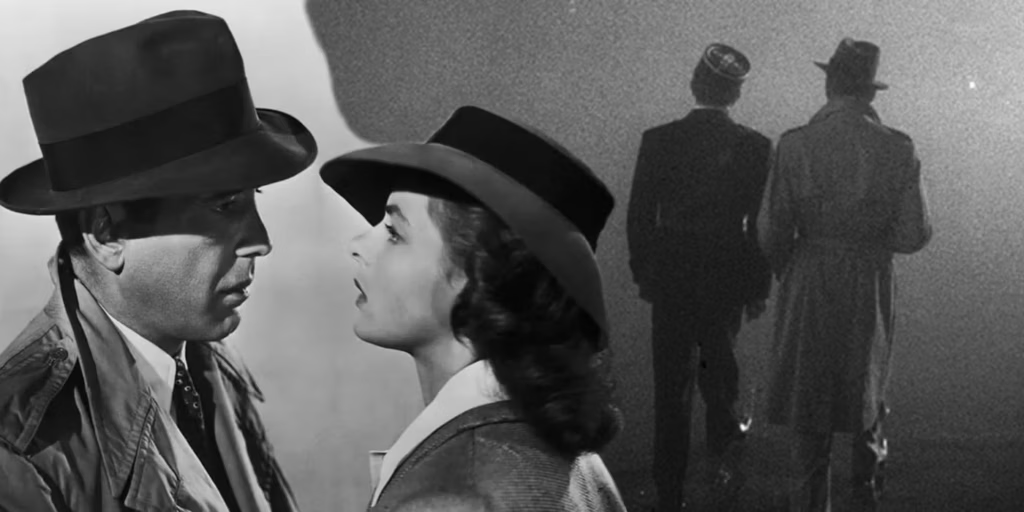
But where Bogie made peace with letting Ingrid Bergman go in the end, Carlito is holding onto his love for Gail with everything he’s got. Dreaming of her has sustained him through his incarceration, and all of his dreams for the future are built around her.


But Carlito is forced to watch her from a distance. We will learn how he pushed her away, how he couldn’t bear to face his time inside while wondering what she was doing on the outside, who she was with. It was a selfish mistake, and we see in Pacino’s eyes just how much the mistake has cost him. Stripped of any dialogue to express his melancholy loneliness and his desperate need to re-connect with Gail, Pacino says everything that needs to be said with nothing more than his wounded gaze. It may be my favourite moment in the entire picture. It is truly a movie star moment. It’s pure cinema. You cannot get this feeling from a stage performance. Pacino’s face fills the frame and De Palma milks it for all he’s got, drenching Carlito in moody, torrential rain and blue-soaked light.

Gail is played with great tenderness and grace by Penelope Anne Miller (Kindergarten Cop).


A beautiful, talented actor, Miller mostly appeared in supporting parts in a few major pictures, like Alec Baldwin’s take on The Shadow (another failed attempt to re-capture the mega-success of Tim Burton’s Batman), the character made famous by the voice of Orson Welles on the radio program of the same name (“Who knows what evil lurks in the hearts of men? The Shadow knows.”).


Rare lead performances in smaller pictures, like the comic, would-be star vehicle, The Gun In Betty Lou’s Handbag, unfortunately failed to make Miller the bigger star that she deserved to be.

Pacino doesn’t get enough credit for his appeal as a romantic leading man, something that distinguishes him from Robert De Niro, the actor (and friend) he is most often compared to.


Consider the abundance of charm that buoyed his winning performance opposite his Scarface co-star, Michelle Pfeiffer, in director Gary Marshall’s (Pretty Woman) underseen 1991 film adaptation of the Terrance McNally play, Frankie & Johnny In The Clare de Lune (wisely shortened to just the characters names for the movie).

In her too-few scenes with him, Miller is every bit Pacino’s match. She runs through the gamut of emotions you would expect to feel if you were suddenly approached on the street by the lover who broke your heart after years of no contact.


As Carlito attempts to rekindle the old spark with Gail, Kleinfeld is busy trying to put out fires. Namely, the raging brush fire that is Mr. Taglialucci, the jailed mob boss from whom Kleinfeld has stolen a million dollars, promising to make a bribe on Taglialucci’s behalf, only to keep the pay-off for himself.


Kleinfeld fervently denies stealing from him, but Taglialucci isn’t having any of it. He knows Kleinfeld pocketed the money, so as far as the mob boss is concerned, he’s got a “million dollar credit” with Kleinfeld. The lawyer can either work off the debt by springing Taglialucci out of the joint (he’s paid off one of the guards to get him in the water and all Kleinfeld has to do is pick him up in this boat), or Taglialucci can have his kid Frankie put a bullet in Kleinfeld’s brain and dump his body in the river instead.

It’s not much of a choice, but as David Mamet teaches us in his MasterClass, character is not revealed by the choice between right and wrong, but by two wrongs. Everything that Kleinfeld does from here on out will ultimately come to define him.


He’s a lawyer whose been flirting with being a gangster. But as we learned in Boardwalk Empire, “you can’t be half a gangster.” Kleinfeld is going to have to pick which side of the fence he’s on.


Poor old Davey Kleinfeld emerges from his prison visit with Taglialucci rattled to the point of vomiting. He knows Taglialucci will kill him either way. But looking out over the water, where he is meant to pick Taglialucci up the next day, Kleinfeld seems suddenly inspired. Maybe there’s a way to get out of all of this without winding up as eel food on the bottom of the river after all.


But Taglialucci isn’t Kleinfeld’s only problem. It isn’t only gangsters who want his head, which we learn when his courtroom nemesis, the prosecutor, Norwalk, pays Kleinfeld an ominous visit.


Meanwhile, Carlito is minding the club (and his own business), working towards that $75,000 grand he needs to buy himself a new life in Florida, when he is paid a visit of his own, by an old friend from his drug dealing past.


Played by a pre-Lord of the Rings-fame Viggo Mortensen, who previously starred in Penn’s Indian Runner debut, Lalin, Carlito’s old pal, was always a stand-up guy. But not anymore.

After taking a couple of bullets in the back, poor Lalin is confined to a wheelchair. But things could be worse. The last Carlito was told, Lalin was doing 30 years. But he beat it, he tells an unconvinced Carlito.


Carlito takes his Norwalk problem to Kleinfeld, who assures him that it’s just a fishing expedition. “You’re not dealing, so he can’t have anything on you.” Kleinfeld promises Carlito that he will take care of the DA.


Carlito goes down to 48th & Broadway, to the place where Lalin has seen Gail dance. But when he gets there, it’s not the classy joint Carlito was expecting.


Expecting to see Gail in a legitimate theatrical production, with her clothes on, he’s shocked to find her naked on stage in the kind of place where the regulars are middle aged men who drink themselves silly drooling over the mostly much younger dancers.


Back at the club, Kleinfeld is getting a lie too familiar with the hostess, Steffie. That usually wouldn’t be a problem, as Carlito says, “Good for Dave,” but Steffie “belongs” to Benny Blanco now. “Who?” Carlito asks. “You remember,” the unlucky waiter who Benny sends to fetch Steffie tells him, “Benny Blanco, from the Bronx.”


And though Carlito is ostensibly standing up for his friend and employee, his issue with Benny Blanco runs much deeper. “This guy is you 20 years ago,” Sasso says, pleading with Carlito to be diplomatic. But that is precisely the problem. Carlito hates the man he used to be. That man cost Carlito his freedom and the love of his life. If Benny Blanco from the Bronx is Carlito 20 years ago, then Benny Blanco from The Bronx can fuck right off.


Kleinfeld, feeling brave with Carlito behind him, makes things worse by pulling a piece. It’s the point of no return and now none of these gangsters can back down without losing face, and so Carlito has no choice but to have Benny Blanco from the Bronx taken out back, where we assume he willl have Benny killed.


But Carlito lets Benny go with a warning. He knows it’s a mistake. The old Carlito would never have left such a lethal loose thread hanging? But “I’m not that guy anymore,” he tells us.


Remember me? Benny Blanco, from the Bronx!
Benny Blanco, to Carlito

The Prequel:


12 years after the original, Carlito’s Way: Rise to Power was released direct-to-video in September, 2005, to universally negative reviews.


In her brief NY Times review, film critic Anita Gates singled out what she considered to be the film’s sole notable achievement achievement: “It makes Sean Combs (better known, at the moment, as Diddy) unconvincing as a rich man who enjoys power and luxuries.” Faint praise, indeed.

CW producer, Martin Bregman, owning the rights to both of Torres’ Carlito Brigante novels, developed the prequel from the material unused by Koepp and De Palma in the first picture. But despite Rise to Power’s many shortcomings, and generally negative reputation, Torres’ allegedly* gave the film his ringing endorsement.
*According to Highdefdigest.com.

Starring Jay Hernandez (Crazy/Beautiful) as the young Carlito, Rise to Power tells the story of the Puerto Rican gangster’s ascent in the underworld, building the legend that Pacino had to live down in De Palma’s film.

Carlito’s rise begins with his incarceration, locked up with a brilliant Harlem numbers man, played by Mario Van Peebles (New Jack City; Posse), and an Italian mobster, played by Michael Kelly (Netflix’s House of Cards remake), which feels like the set up to a joke that never comes (A Puerto Rican, an Italian, and an African-American walk into a bar…). Each of them represents a neighborhood, and a market, the others cannot access, so the trio conspires to transcend the ethnic barriers of their respective hoods and gang affiliations to make their fortunes together, trafficking in the new wave of heroin flooding New York’s streets in the 1970s.

Without De Palma at the helm, or a writer of Koepp’s calibre penning the script, Rise to Power never approaches the dazzling emotional and aesthetic heights of the original (but really, how many directors can compete with a master stylist on De Palma’s level?). At its best, Rise to Power feels like an extended, feature-length pilot for a Sopranos-like HBO series. At its worst, it feels like what it is, a Direct-To-Video prequel. It’s nowhere near as good as it could have been, considering that it uses the same source material as the first film. But neither is it even remotely close to being the disaster that most DTV franchise pictures are.

These “legacy sequels” often feature interchangeable sub-titles, new characters and stories, with fan-service cameos by familiar faces from the originals.

They are, without exception, pale imitations intended to cash in on the popularity and success of those original films, and they tend to leave a bad taste in the mouth, souring our fond memories of the films they are meant to honour.

How can you make a sequel to Spike Lee’s biggest commercial joint, without Spike Lee?!! It boggles the mind.

The sub-genre is, to borrow the title of an Errol Morris classic: fast, cheap, and out of control.


For irrefutable evidence, consider the partial list of remarkably un-remarkable DTV sequels featured above.


And of course, let’s not forget about the depressingly diminishing returns of the National Lampoon franchise, which has fallen so far from the highs of Animal House and the first and third Vacation pictures.

Universal Pictures, which produced CW, is possibly the worst offender (for the 5 American Pie Presents movies alone!).

Although Hernandez is saddled in Carlito II with the unenviable (and impossible) task of matching Pacino, one of the greatest actors of all time, in one of his best parts, he is likeable and engaging enough in the lead role.

Mario Van Peebles is great as the Harlem numbers man, and some other notable character actors also appear, including The Wire’s Dominick Lombardozi, and Breaking Bad’s Giancarlo Esposito, in minor roles.


Even recently disgraced (and currently incarcerated) hip-hop mogul and sexual predator, Sean Combs (aka “Puff Daddy,” aka “Puffy,” aka “P. Diddy,” aka “Diddy”) is decent in his supporting role as Hollywood Nicky, clearly inspired by infamous Harlem gangster, Nicky “Mr. Untouchable” Barnes, played by Cuba Gooding, Jr. in Sir Ridley Scott’s underrated 2009 crime picture, American Gangster.

But the greatest joy for CW fans will be found in the return of Luis Guzmán, who plays a new character, but gives off heavy Pachanga vibes all the same.

Ultimately, the problem with Carlito’s Way: Rise to Power, is one that’s been a matter of public discourse of late: nepotism. To adapt & direct the prequel, Bregman hired his son, Michael Bregman, who served as executive producer on the first film. Bregman Jr., who co-produced the preciously mentioned Shadow reboot, had only one other picture to his name at the time, the forgettable Table One (also co-starring Guzman).


As with Michael Mann engaging his daughter Ami to direct former DEA Special Agent-In-Charge Don Ferrarone’s excellent screenplay for Texas Killing Fields, these 2nd generation filmmakers more often than not, are lacking their famous parents’ chops (Sofia Coppola, being a notable example to the contrary).


With only one other picture to his name as director, Bregman Jr. is credited as producer, or associate producer, on a dozen other films, including the high of his father’s earlier Pacino film, Sea of Love (1988), and the low of the notorious Eddie Murphy bomb, The Adventures of Pluto Nash (2002). Rise to Power suggests he shouldn’t quit his day job.
Legacy:


